
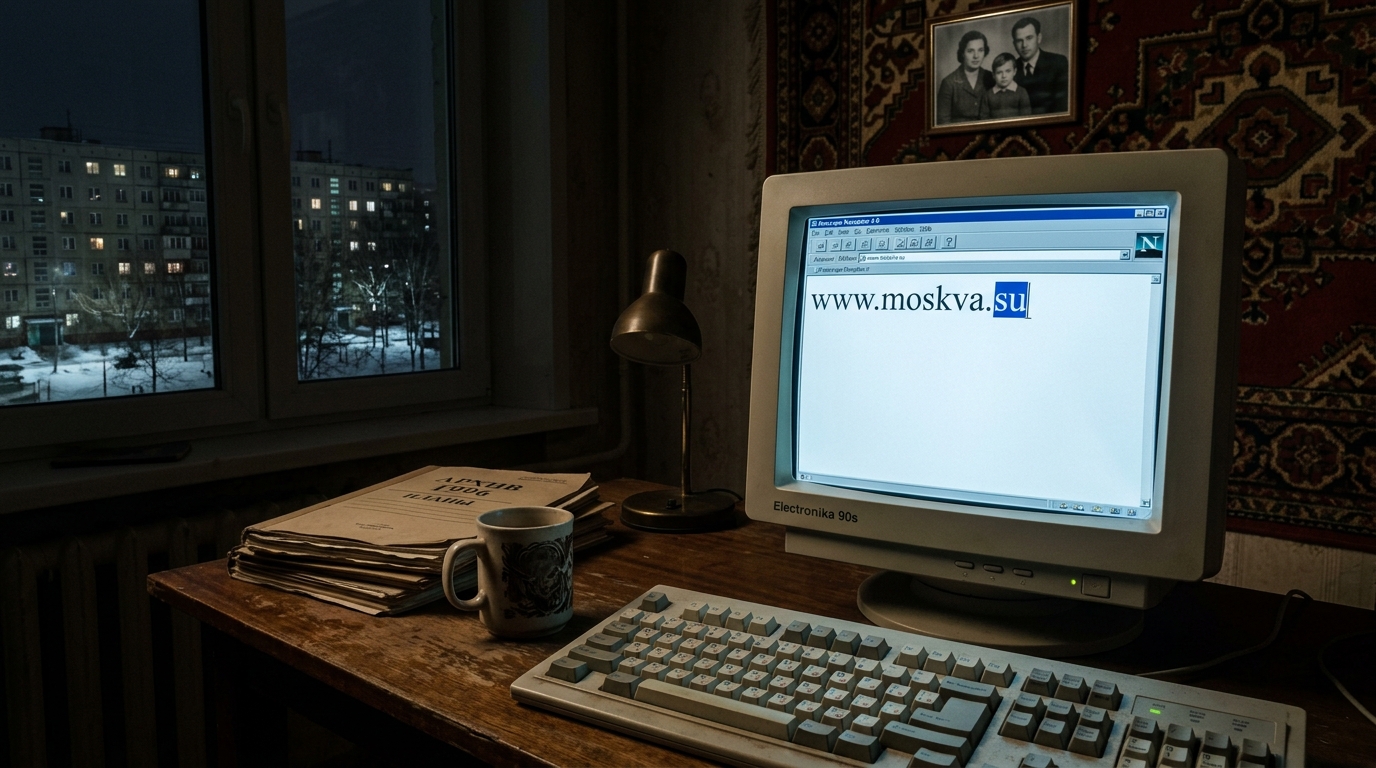
A country can disappear from the map without its internet address fading away. The USSR collapsed at the end of 1991, but its web extension, the famous .su, continues to exist today. Even better: it still accepts new registrations, managed from Moscow in a form of digital anomaly that has traversed three decades of history without anyone daring to touch it.
- The .su domain was registered on September 19, 1990, just fifteen months before the Soviet Union’s official dissolution on December 26, 1991.
- Although ICANN deemed in 2022 that the USSR is ineligible for a country-code top-level domain, no firm withdrawal timetable has been set, and a withdrawal slated for 2030 remains uncertain.
- Managed since 2020 by RosNIIROS ANO under the authority of Roskomnadzor, .su remains fully active with about 100,000 registered domains and is now subject, like .ru and .рф, to mandatory holder identification via the Gosuslugi portal.
- A domain born a few months before the fall of the USSR
- .Su, the digital ghost no one wanted to erase
- Moscow at the helm: a still very much alive extension open to registrations
A domain born a few months before the fall of the Soviet Union
The story begins with an odd timing. On September 19, 1990, the SUUG association registers with IANA, the body that allocates internet extensions globally, the domain .su for the Soviet Union. The idea is simple: to give the Soviet Union its own digital address, just like every other country on the planet.
The problem is that History did not wait for internet bureaucracy to stabilize. Barely fifteen months after this registration, on December 26, 1991, the USSR simply ceased to exist. Fifteen republics became independent, and the map of Eurasia changed drastically.
Yet no one pulls the plug. The SU code does disappear from ISO 3166-1 in 1992, the standard that officially lists the world’s countries, but no domain withdrawal procedure was launched at that moment. A legal vacuum settles in, and it lasts far longer than anyone anticipated.
.Su, the digital ghost no one wanted to erase
This administrative ambiguity could have lasted a few years before a logical cleanup. Instead, the domain benefited from a genuine regulatory nudge. In 2008, the SU code was added to ISO’s list of exceptionally reserved codes, at the request of the registry operator itself. A sort of protected status, which artificially extended the extension’s lifespan.
It wasn’t until March 2022 that an official voice spoke clearly on the matter. During ICANN 73’s public forum, the organization that regulates global domain name allocation, its president Martin Botterman stated outright that the USSR is no longer considered eligible for a ccTLD, the famous country-code extensions like .fr or .de. In other words, on paper, .su has no reason to exist.
Things began to move cautiously in 2025. On February 6, PTI, the ICANN unit responsible for technical functions, sent a private letter to the domain administrator informing them of a withdrawal scheduled for by 2030. But in March of the same year, Kurt Erik Lindqvist, ICANN official, clarified that there is no firm timetable for sending the formal withdrawal notice—the precise step that would trigger a five-year countdown. In short, the USSR’s digital ghost still has plenty of life left ahead.
Moscow at the helm: a still very much alive extension open to registrations
Here lies the heart of the mystery: who actually administers this domain today? For a long time, the answer was the Internet Development Fund, which carried out the administrator’s duties until July 31, 2020. But since then, the situation has changed, and information has circulated little beyond specialized circles.
In October 2020, a decree signed by Russian Prime Minister Mikhail Mishustin designates Roskomnadzor, the Russian telecommunications regulator, as founder, on behalf of the Russian state, of the RosNIIROS ANO. It is this structure that now holds the rights to the .su zone. Never withdrawn by ICANN, .su is thus managed from Moscow, in a legal gray area that apparently suits everyone.
And the most surprising part is that this domain is not quietly fading away: it remains actively in use. At the time of the 2025 notification, the zone counted about 100,000 registered domain names, under the management of the Russian Institute for Development of Public Networks, and continued to accept new registrations like any ordinary extension. The withdrawal policy developed by the ccNSO, approved by ICANN’s board in 2022, indeed provides a default five-year countdown once a formal withdrawal notice is sent, but that period can be extended by five more years at the operator’s simple request. In other words, the countdown has not even officially started.
Russia appears to be tightening its administrative grip on this extension rather than letting it slip away. Since September 1, 2026, mandatory holder identification for domains in .ru, .рф and now .su has come into force on Russian soil, via the Gosuslugi state portal, under a federal law passed in late December 2025. A clear sign: far from being a forgotten relic, .su is today part of a broader digital strategy in which Moscow intends to keep control over every corner of its internet infrastructure, including the one that still bears, thirty-five years later, the name of a country that no longer exists.
