
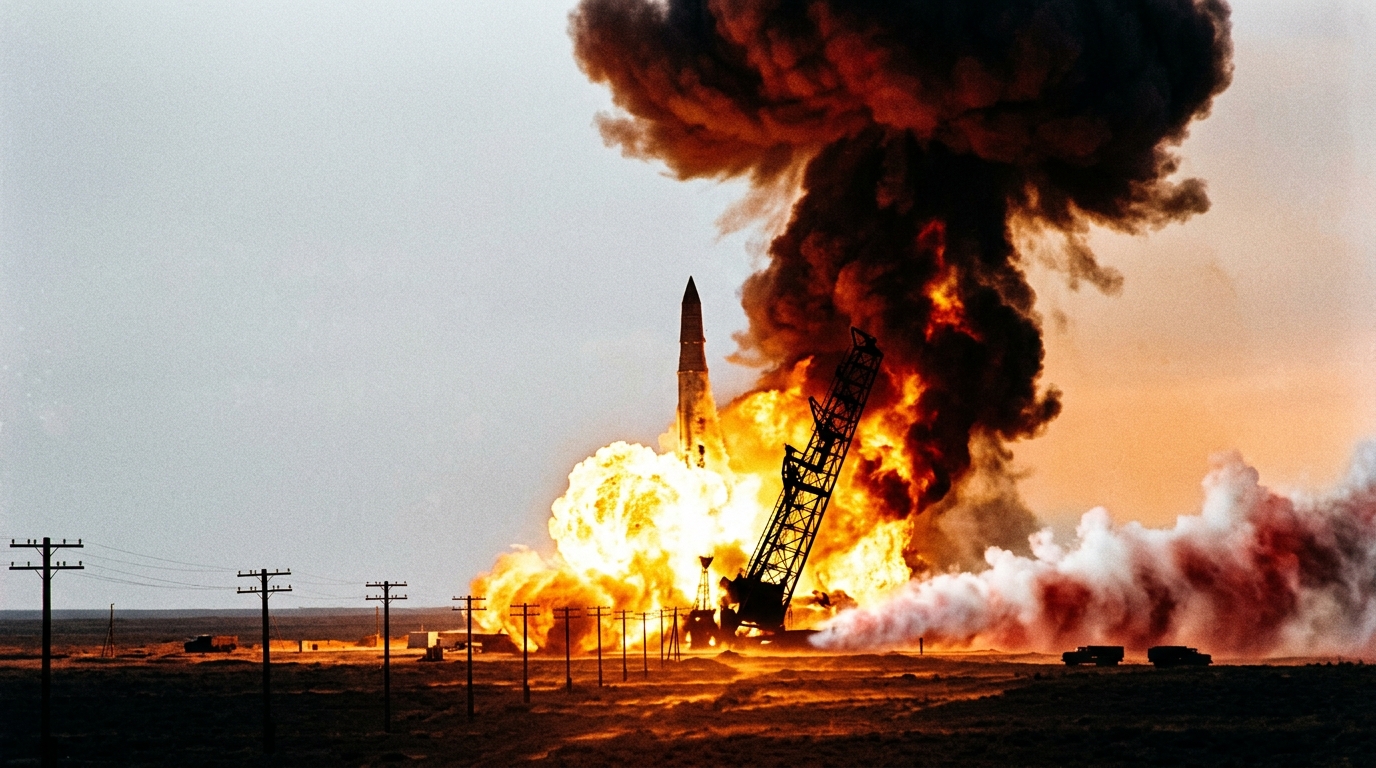
A missile can kill without ever leaving its launch pad. That is exactly what happened at Baikonur: the premature ignition of an R-16 rocket engine triggered an explosion that killed at least 74 people, including Marshal Mitrofan Nedelin himself. The whole affair was covered up for nearly thirty years.
- On October 24, 1960, the premature ignition of the R-16’s second stage ignited the still-load first stage with toxic propellants, triggering a deadly explosion at Baikonur
- Pressed by Khrushchev to meet deadlines despite known technical flaws, Marshal Nedelin persisted with the test and died in the accident alongside dozens of technicians
- The USSR covered up the tragedy by announcing Nedelin’s death in an airplane accident, keeping the secret until 1989 under Gorbachev
- The bold gamble of Khrushchev: launching an intact missile despite known defects
- Thirty seconds of error: how a sequencing order triggered hell
- Moscow’s silence: how the USSR covered up the worst space disaster in its history
There are disasters that History remembers immediately, and others that are deliberately buried. This one belongs to the latter category. For nearly three decades, the world ignored that a major industrial accident had decimated the elite of the Soviet ballistic program. Off to Kazakhstan, at launch pad number 41, to understand how a mad dash against time turned into carnage.
The bold gamble of Khrushchev: launching an intact missile despite known faults
In the early 1960s, the Cold War forced an insane technological pace. The Soviets were determined to outpace the Americans with an intercontinental missile capable of carrying a nuclear warhead. The R-16 was to be that ultimate weapon, more powerful and more reliable than anything that existed at the time.
Problem: the device accumulated technical faults during preliminary tests. Several engineers warned of anomalies that were never corrected. But the political timetable left no room for doubt.
Nikita Khrushchev wanted a spectacular success for the anniversary of the October Revolution. Marshal Nedelin, head of the Strategic Forces and the direct supervisor of the program, was ordered to meet the deadlines at all costs. Postponing the test would amount to admitting an unacceptable political failure.
On October 24, 1960, in the late afternoon, the missile sat on its launch pad with unresolved faults. No one yet imagined that this hierarchical pressure would turn into a time bomb.
Thirty seconds of error: how a sequencing order triggered hell
Around 6:45 p.m., while dozens of technicians were still busy around the missile trying to fix an electrical malfunction, the second-stage engine ignited. Too soon. Far too soon.
This premature ignition acted like a giant blowtorch on the first stage, still saturated with propellant. The R-16 relies on a particularly fearsome hypergolic propellant couple: UDMH combined with a mixture of nitric acid and nitrogen tetroxide. Russian engineers even nicknamed it the devil’s venom, given how devastating its contact with air or skin can be.
The first stage tore apart under the unexpected thrust. The tanks literally exploded, sending flames and toxic vapors over everyone at the foot of the launch pad. There was no escape: the area was crowded with people conducting the final checks before launch.
The human toll listed by the Soviet state commission in 1994 stood at 78 dead—74 on the spot and four more dying later in hospital from their burns. Other sources, including academic studies and some Russian media, cite much higher figures, sometimes over 90, or even more than 126 according to certain estimates. This persistent uncertainty shows how state secrecy has long obscured the true events.
Among the victims was Marshal Nedelin himself, who had come to oversee the test closely. His presence underscored the absurdity of the situation: the man charged with guaranteeing the program’s success pays the highest price.
Moscow’s silence: how the USSR covered up the worst space disaster in its history
The next day, the TASS news agency released a completely fabricated official version. Nedelin is said to have died in an airplane crash, far from any connection to the ballistic program. His funeral was held with great pomp on Red Square three days after the tragedy.
On the American side, intelligence services quickly sensed the ruse. The CIA could find no trace of any airplane crash in the USSR on that date. A declassified 1965 report even sums up what the agency already suspected about the true origin of the general’s death.
But lacking formal proof, it was impossible to publicly debunk the Soviet version. The lie thus persisted for nearly three decades, until 1989, when the USSR officially acknowledged the accident in the context of the openness initiated under Gorbachev.
Since that catastrophe, October 24 has earned the nickname Black Day at Baikonur. No launch is ever scheduled there on that exact date, out of superstition or out of respect for the victims. A second fatal accident, occurring exactly three years later during an R-9 missile test, only strengthened this tacit tradition in the cosmodrome’s history.
Today, this tragedy remains one of the deadliest accidents in the history of space exploration. It also serves as a stark reminder that during the height of the Cold War, political pressure could weigh far more than the safety of the people who were advancing science.
