
On August 5, 1858, two ships dropped anchor a few hours apart on opposite shores of the Atlantic. One reached land at Trinity Bay, Newfoundland, the other at Valentia Bay, Ireland. Between them stretched a single cable, 3,200 kilometers long, laid along the ocean floor. A few days later, a queen and a president would begin the first correspondence in history without a ship crossing the ocean. The exhilaration was enormous and would last three weeks.
The adventure did not begin with that summer alone. Cyrus West Field, an American entrepreneur, had carried the project since the mid-1850s, and four prior attempts had already failed before this one. In July 1858, the strategy changed: instead of laying the cable from a single shore, two ships, the Agamemnon and the Niagara, would meet in the middle of the ocean. The ships would rendezvous in mid-sea, splice their cables together, and then depart in opposite directions. By early August, both had reached the shore with the cable intact. It was a maritime engineering feat, at a time when laying a wire through thousands of meters of water sounded almost like science fiction.
À retenir
- A queen and a president exchange messages for the first time without any ship crossing the Atlantic
- The signal travels to the other side of the ocean in less than ten hours, instead of twelve days
- Everything collapses in three weeks due to excessive electrical tension
A Queen, a President, and 16 Hours for Seventeen Words per Minute
Technical trials preceded the ceremony. Then came the solemn moment. Queen Victoria sent the first official message to James Buchanan, the President of the United States, a sentence of diplomatic courtesy: “The Queen desires to congratulate the President upon the successful completion of this great international work.” There was nothing extraordinary in the content. What mattered was the medium.
For this message, though brief, it took a prodigious amount of time to traverse the Atlantic. It consisted of 98 words and required 16.5 hours of transmission. Buchanan replied, and his response arrived even more quickly: ten hours, compared with the twelve days a voyage by sea and land would have demanded. Twelve days trimmed to ten hours. To grasp the shock this news caused at the time, one must remember that before this cable, a ship took ten days to two weeks, depending on the weather, to carry a letter, and a message from Europe to America could wait up to four weeks for a reply. The world had just shrunk before everyone’s eyes.
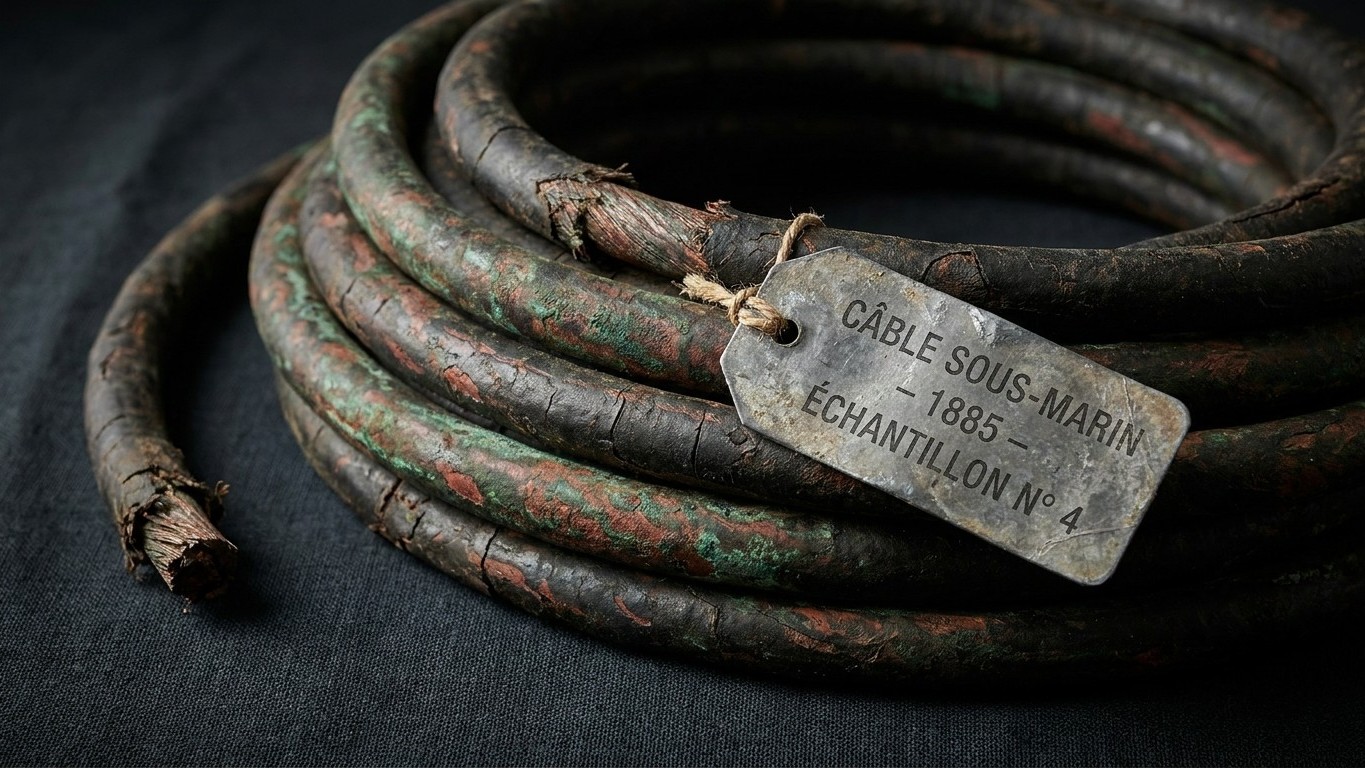
The press caught fire. The Times of London would go so far as to write: “The Atlantic is dried up, and we become in reality as well as in wish one country.” An Atlantic dried by a copper and gutta-percha thread: the formula says everything about the era’s enthusiasm. The success even exceeded the diplomatic scope. The company that laid the cable, once the feat was accomplished, found itself with excess cable to dispose of. Tiffany & Company bought up the surplus and converted it into commemorative ten-centimeter segments, sold for fifty cents each. The souvenir sold like a piece of future packaged and sold.
The Breakage That Came from the Man Supposed to Run the Cable
Three weeks. That is how long the achievement would last before becoming a fiasco. This first transatlantic cable functioned for only three weeks: the signal weakened significantly, and the cable was damaged by undersea faults and an overvoltage. The man in charge bore a name almost too perfect for the history of science: Wildman Whitehouse.
A trained surgeon and an amateur electronics enthusiast, he had been hired as chief electrician for the Atlantic Telegraph Company. Convinced that the current had to be pushed to carry a signal over such a distance, he began injecting up to 2,000 volts into the cable, a voltage entirely unnecessary that damaged a cable already weakened by the laying. Two thousand volts, in insulation designed for much more modest voltages: as if watering an indoor plant with a fire hydrant.
The worst part is that Whitehouse knew another path existed. Lord Kelvin, a renowned physicist present at the other end of the cable, advocated a radically different approach, based on ultra-sensitive instruments rather than brute force of the current. Whitehouse chose his own method: as a legible Morse code appeared on the mirror galvanometer installed on the Irish side, he insisted on disconnecting that device and replacing it with his own, far less sensitive recorder. To compensate for the weakness of his instrument, he increased the voltage still further. A wholly human, circular trap, where technique alone might have sufficed.
The degradation did not appear all at once. According to records, the cable did manage to transmit several hundred messages before dying, a total of 732 messages exchanged during the three weeks of operation, according to the work of historian Allison Marsh. But the signal weakened inexorably. Toward the end, sending a simple half-page of text could take an entire day.
Then, in September 1858, after several days of progressive insulation deterioration and cable corrosion, the link finally failed for good. The ensuing inquiry did not pull any punches: Dr. Whitehouse was held responsible for the failure, and the company bore the criticism of entrusting such an ambitious project to an engineer with no recognized electrical qualifications.
From Failure Emerged the Cable That Really Held Up
The story might have stopped there. It did not. It would take until 1866 for a durable cable to be laid, this time by faithfully applying Lord Kelvin’s recommendations, using far lower tensions and ultra-sensitive measuring instruments. The lesson of 1858, costly as it was, eventually paid off: in the following three decades, five more cables were added between Valentia and Heart’s Content, where a transatlantic communication station would operate continuously until 1965.
Whitehouse, for his part, faded from technical accounts almost as quickly as he had entered them, left as living proof that a misplaced conviction can burn in a few weeks what decades of engineering have spent to build. There remains, however, a tangible and amusing trace of that first attempt: somewhere, in collectors’ drawers or museum display cases, ten-centimeter pieces of cable sold by Tiffany continue to circulate, souvenirs of an achievement that lasted only the summer.
Sources: thehenryford.org | nimareja.fr
