
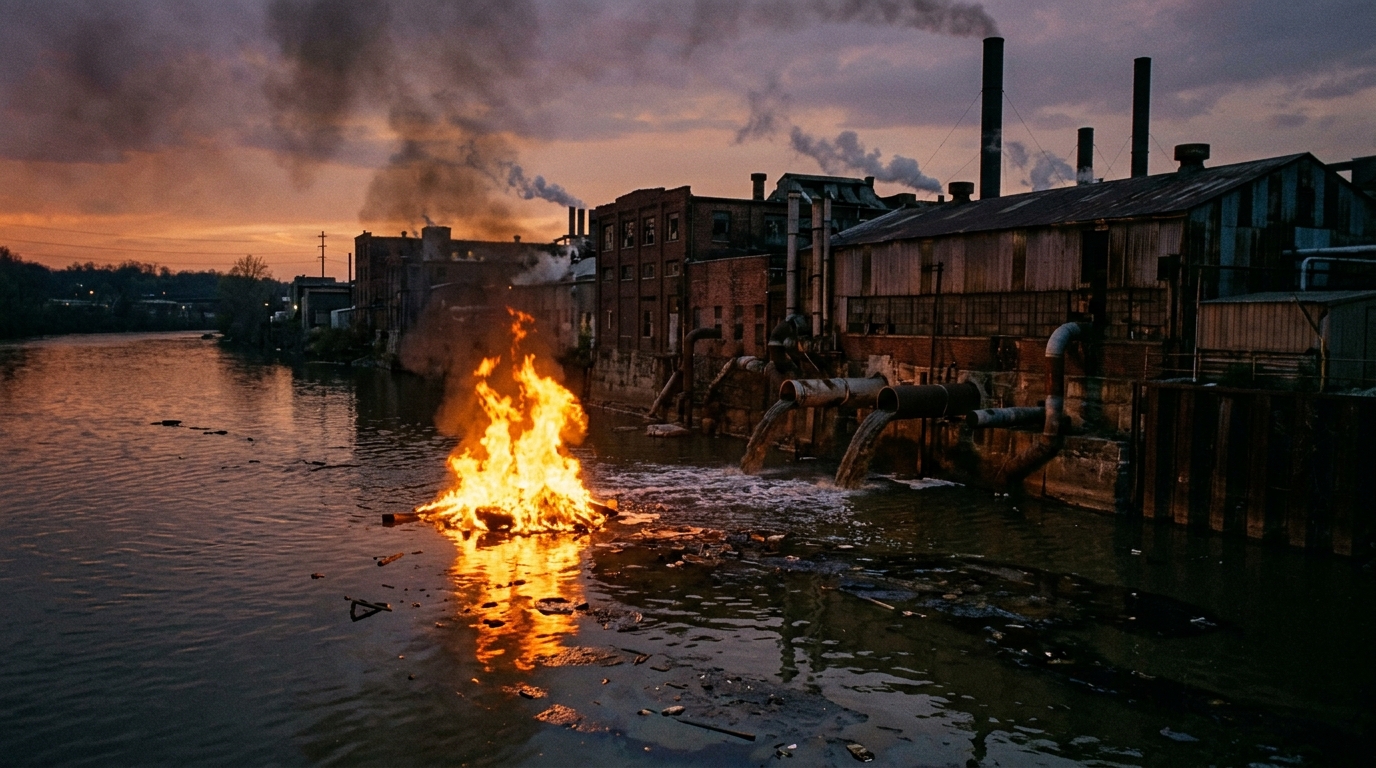
Imagine for a moment that water itself could burn. Not oil spilled on its surface, not a solitary slick, but the entire river, as if nature had tipped into an absurd logic. Yet this is exactly what happened in the United States, in a river that ended up, against its own nature, becoming the emblem of a major environmental awakening. For decades, industry and municipalities treated this waterway as a mere open sewer, until the buildup of waste, oils and solvents transformed the river into a true giant wick. The story that follows reads like a fable, but it is real, and it permanently changed the way a nation views its rivers.
A River So Polluted It Had Been Burning for Decades
The Cuyahoga, the river winding through Ohio before emptying into Lake Erie, did not catch fire by a mere accident. This watercourse had since the early twentieth century run through one of the country’s largest industrial hubs, in Cleveland, where steel mills, refineries, and chemical plants dumped their residues directly into the riverbed. Waste oils, industrial solvents, organic debris, and toxic sludge piled up year after year, forming a thick, inflammable layer on the surface of the water.
What makes this story even more troubling is that the 1969 fire was not the first. Similar flare-ups had struck the river several times since the late nineteenth century, some more destructive, causing substantial property damage and injuries. But none of those earlier episodes elicited a national response comparable to what would follow. Pollution had become so commonplace, so embedded in the industrial landscape, that Cleveland residents had come to regard these sporadic flames as an almost ordinary fate.
The Day Oil and Waste Caught Fire in Cleveland
It happened in June 1969—the moment that would mark American environmental history. Sparks, probably from a train crossing a bridge that spanned the river, came into contact with the oily debris floating on the surface. In an instant, flames rose, consuming the residues piled up to about ten meters high in places. The fire lasted only about thirty minutes, quickly brought under control by local firefighters, but the damage was done: the Cuyahoga River had officially burned in the heart of a major American metropolis.
What stands out in retrospect is the stark contrast between the brevity of the event and the scale of its consequences. A simple fire, extinguished almost as quickly as it had begun, would nevertheless become the catalyst for a profound transformation of American environmental policy. The river itself, at that moment, was probably unaware that it was writing a page of history.
A Photo That Wasn’t Even the Right One, But It Was Enough
Perhaps the most fascinating aspect of this story lies in how it was covered by the media. Time magazine, seeking to illustrate the magnitude of the disaster for a piece on pollution in American waterways, published a dramatic photograph of flames rising above a river. The problem is that this image did not depict the 1969 fire, but a much more violent episode from years earlier, in 1952, when flames reached striking heights and caused far greater damage.
No matter the accuracy of the image: the photograph circulated across the country and burned itself into the collective memory as the ultimate symbol of industrial irresponsibility. This journalistic mix-up, far from diminishing the story’s impact, actually amplified it. Americans learned, shocked, that a river could literally burn because of human negligence, and that awareness would prove far more enduring than the photograph itself.
From the Fire to the Law: How Cleveland Changed America
The shockwave unleashed by this fire, amplified by national media coverage, directly contributed to a sweeping legislative pivot. As early as 1970, the American federal government created the Environmental Protection Agency, better known by its acronym EPA, charged with monitoring and regulating pollutant discharges across the country. Two years later, the Clean Water Act reinforced this framework by imposing strict standards on the quality of American waters.
What might have appeared to be only a local, almost anecdotal incident given how common river fires had been in the past, thus transformed into a catalyst for a nationwide environmental reform. Today, the Cuyahoga hosts a renewed and diverse aquatic life, and its banks welcome walkers and anglers instead of columns of smoke. This revival illustrates how a catastrophe, even limited in time, can sometimes be enough to shift public attitudes and public policy.
This story, as surprising as it may seem, recalls a truth that remains relevant: ecosystems we deem inexhaustible or endlessly resilient do have their limits, and sometimes a striking image, even a rough one, is needed to trigger a genuine collective response. The Cuyahoga has finally quieted down, but the question remains: how many other rivers, elsewhere in the world, are waiting for their own spark to finally be taken seriously?
