
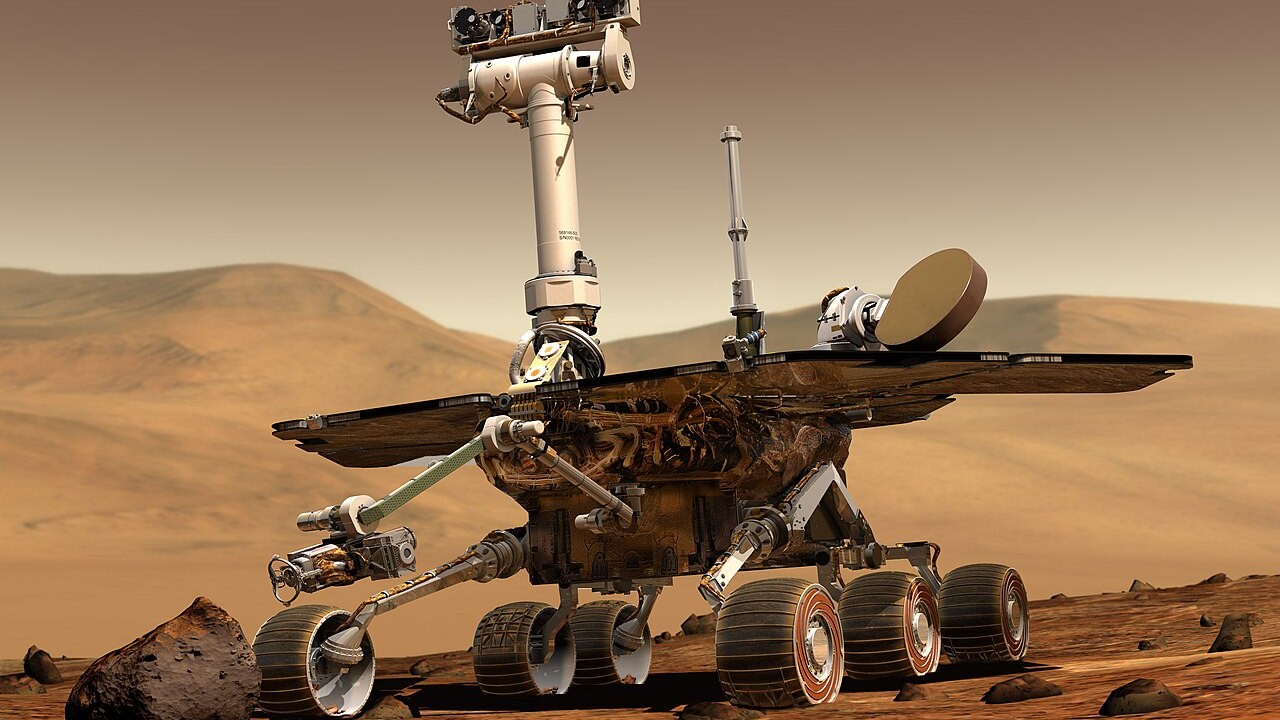
Ninety Martian days. That was the brief NASA laid out for Opportunity at the moment of its landing on Mars, January 25, 2004. A short, almost symbolic contract designed for a robot expected to roll for a few hundred meters before dying. Reality took a very different turn: the rover operated for fourteen years, traveled more than 45 kilometers, and breathed its last only in 2018, a victim of a planet-wide dust storm. The gap between promise and reality here isn’t measured in percentages. It’s measured in generations of engineers who had to reinvent, year after year, how to pilot a machine that refused to die.
Key takeaways
- A miniature robot programmed for a three-month mission on one of the most hostile planets
- Martian winds that quietly cleanse its solar panels year after year
- A planetary dust storm that shattered a record once unimaginable
A specification crafted for the ephemeral
In the beginning, no one at NASA imagined that Opportunity would become a milestone in space history. The rover, paired with its twin Spirit, which had been placed on the opposite side of the planet a few weeks earlier, was tasked with probing Martian geology in search of traces of ancient water. When Opportunity landed on Mars in January 2004, alongside its twin Spirit, NASA engineers did not foresee that they were launching one of the most enduring missions in space history, designed to operate for 90 Martian days, this golf-cart-sized rover would defy all forecasts. A motorized golf cart sent millions of kilometers away, with the lifespan of a campfire.
True to form, Spirit’s fate provides a measure of what could have happened to Opportunity. With a planned 90-day lifespan, Spirit operated until it became stuck in 2009 and ceased all communication in 2010. A classic, almost expected scenario. Opportunity, however, followed a completely different arc, as if the engineers had underestimated, unknowingly, the resilience of their own creation.
When the exception becomes the rule
How can a device designed for three months persist for fourteen years in the most hostile environment in the solar system? The answer lies in two words: margin and adaptation. This prudent approach allowed Opportunity to run 57 times longer than its expected lifespan, surpassing the initial plan by 14 years and 47 days in Earth time. Fifty-seven times. To put it in perspective, it’s like a light bulb guaranteed for three months continuing to illuminate your living room fourteen years later, without ever burning out.
Mars’ winds played a quiet yet decisive role in this longevity. They regularly cleaned the rover’s solar panels, restoring a charging capacity that no one had anticipated. The batteries, too, held an astonishing cycle rate of charge and discharge without collapsing. On the ground, this manifested as steady progress: Opportunity explored the Eagle crater where it landed, then moved toward Endurance, before reaching the colossal Endeavour crater, where it finally crossed the symbolic marathon threshold. Opportunity logged 45.16 kilometers on the Red Planet, a distance unmatched to date by any rover on the Moon or on Mars. No other craft, Russian, American, on the Moon or on Mars, has ever rolled so far from Earth.
The storm that overwhelmed everything
The mechanism that had saved Opportunity for years eventually turned against it. In June 2018, an unprecedented dust storm engulfed the planet. It likely coated the rover’s solar panels with a layer of dust thick enough to prevent battery recharge, with Martian winds not being strong enough this time to clean them. Irony of fate: the very wind that had granted the rover a multi-year reprieve would end up organizing its downfall by piling sediments impossible to dislodge.
Communication was lost on June 10, 2018, as the robot descended Perseverance Valley on the rim of Endeavour crater. NASA did not throw in the towel immediately. It wasn’t for lack of trying to wake it up in the eight months that followed, but more than 1,000 attempts were not enough to restore contact with the rover. It was only in February 2019, eight months after the silence, that the agency officially ended the mission. A long administrative mourning for a robot that had exceeded all expectations.
An legacy that continues to roll
Opportunity did not merely set a distance record. It redefined what one might expect from a Martian mission, proving that a tight budget and a modest schedule could yield a scientific adventure spanning more than a decade. Every mission launched since, from Curiosity to Perseverance, builds on the lessons learned during those fourteen years of remote piloting: energy management, autonomous navigation, storm anticipation.
The most satisfying wink of fate is that Opportunity’s successor eventually exceeded its own cruising pace. Perseverance completed the same distance as a Martian marathon in a fraction of the time it took its elder to reach it. A sign that technology has advanced, certainly, but also that the original bet on Opportunity, that a few months of exploration would suffice, remains one of the most spectacular underestimations in space history.
Sources: science.nasa.gov | futura-sciences.com
