
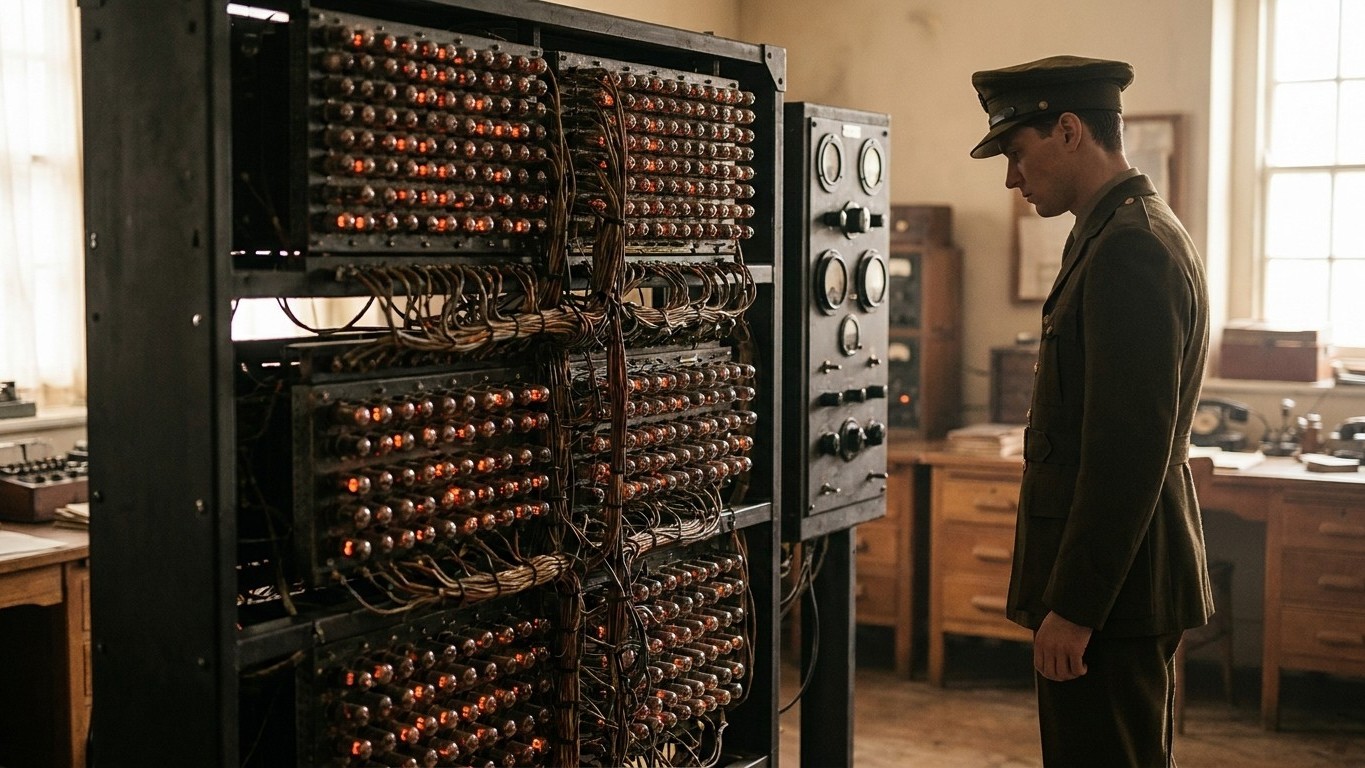
Ten machines capable of breaking, in a matter of hours, a code that the German army deemed inviolable. By the end of the war, eight had been dismantled, while two Mark II units were transferred to GCHQ and used well into the 1960s. After 1945, all information about Colossus remained highly classified, and it is said that Winston Churchill himself personally ordered their destruction. A decision that wiped away, for more than three decades, one of the most defining chapters in the history of computing.
The paradox remains striking. These colossal calculators, packed with vacuum tubes, helped shorten the war. Yet eight were destroyed in the name of state secrecy; the two survivors continued to operate, hidden in the shadows.
Key takeaways
- Ten fully functional Colossi were built, but almost no trace remains
- Tommy Flowers was ordered to burn the plans for his own invention himself
- A full reconstruction in 2007 proved necessary to demonstrate that these machines really existed
A machine born to crack Lorenz
Colossus did not spring from a solitary stroke of genius. Conceived by engineer Tommy Flowers and his team within the precursor to the GCHQ, the first Colossus Mark I, completed in December 1943, became operational in early 1944 at Bletchley Park, where it was tasked with deciphering messages encoded with the Lorenz SZ40/42 machine, nicknamed “Tunny” by the Allies. A year earlier, the British were already employing electromecanical devices far slower, the so‑called Heath Robinson machines. Colossus radically changed the scale of computation.
The enhanced version followed rapidly. An improved Colossus Mark II, employing shifting registers to quintuple processing speed, ran for the first time on 1 June 1944, just in time for the D‑Day landings. The timing was hardly incidental: Colossus fed the Allies with direct intelligence on German high‑command communications, only days before Europe’s most pivotal operation unfolded.
These machines grew in number at a brisk pace. By April 1945, ten Colossi operated continuously within the Newmanry. In fact, a eleventh unit was near readiness at war’s end, according to several historical sources. Technically, the machine housed between 1,500 and 2,400 vacuum tubes depending on the model—a staggering figure for the era, making it as much a heat and power sink as a marvel of rapid calculation.
Running these giants around the clock demanded a battalion of labor. About 250 Wrens, members of the Royal Navy’s women’s service, kept the ten Colossi at Bletchley Park running 24 hours a day. Some operators had already handled the Heath Robinson predecessors, the mechanical forebears of the beast.
The 1945 order: dispersal, dismantling, silence
The war in Europe comes to an end. And with it, the very existence of Colossus becomes a liability rather than a badge of achievement. After the war ends in 1945, Prime Minister Winston Churchill orders the destruction of the Colossus machines to safeguard the secrecy of Britain’s decrypting capabilities; eight of the ten Colossi are dismantled in early 1946 at Eastcote, the site to which the decryption work had been relocated from Bletchley Park.
Two machines escape the fate that befalls the rest for a time. Two of the Mark II units are moved to the GCHQ headquarters at Eastcote, then on to Cheltenham, before being dismantled themselves. These two would survive into the 1960s, continuing, for a while, a quiet intelligence function in the deepest shadows.
The grim truth is not only the destruction of the machines themselves. The plans vanish as well. Most of the Colossi were destroyed, and Tommy Flowers received explicit orders to burn the schematics and operating manuals. The man who designed the first programmable computer was told to erase the trace of his own creation. It is hard to imagine a more ironic fate for an engineer.
What remains physically? Fragments. An optical lens element was recovered from a scrap pile dumped in 1970, later donated to the Bletchley Park Trust more than four decades later. Other pieces have found more practical uses: certain components of the dismantled Colossi were reused by the Manchester University Computing Laboratory, where the Manchester “Baby,” the world’s first stored‑program electronic computer, would be built. Colossus, erased from the official historical record, thus continued to live on in the circuitry of other pioneering machines.
The secret endures for decades, carried by thousands who kept their vow. The roughly ten thousand men and women who worked at Bletchley Park, bound by secrecy and a strict “need to know” policy, observed their commitment so rigorously that few beyond the project knew of the decryption work for more than thirty years after the war’s end. It would take until 1974 for the veil to lift officially, with a book by a former Bletchley Park employee.
Rebuilding a ghost: the 2007 reconstruction
Such a story, buried so deeply, deserved a resurrection worthy of the task. It emerged from the hands of a dedicated engineer, Tony Sale, curator at the Science Museum in London. In 1991, while working on restoring antique British computers at the Science Museum, he joined the campaign to spare Bletchley Park from demolition by developers, and he conceived that Colossus might be rebuilt. Nobody believed him.
The starting point bordered on a scientific miracle. In 1993, he gathered all available information: eight period photographs taken of Colossus in 1945 and a handful of circuit diagrams that some engineers had retained, albeit illegally. Eight photographs. That was officially all that remained of a machine that had ten units in operation.
The project began in earnest at Bletchley Park. In July 1994, the Duke of Kent opened the Bletchley Park museums and officially launched the Colossus reconstruction. It would take another thirteen years of research, trial and error, and careful historical bricolage to bring the project to fruition. The volunteer team, led for fourteen years, finally delivered a fully functional Mark II Colossus in 2007, now operating at the National Museum of Computing at Bletchley Park.
The rebuilt machine did not remain a static museum piece. In 2007, it was tested during the Colossus Cipher Challenge, an international competition, and it again succeeded in cracking the Lorenz code, this time in 3.5 hours. It was nonetheless outpaced in the challenge by a software engineer who, with a modest PC and a custom program, cracked the ciphertext in 46 seconds. A fitting nod: what ten machines and 250 operators achieved around the clock in 1944 now fits within the formidable, but forgotten, power of a desktop computer. The true achievement of Colossus was not speed by today’s standards, but the mere fact of its existence, its operation, and its impact on the war—before being sacrificed on the altar of secrecy.
Sources: feeds.bbci.co.uk | tnmoc.org
