
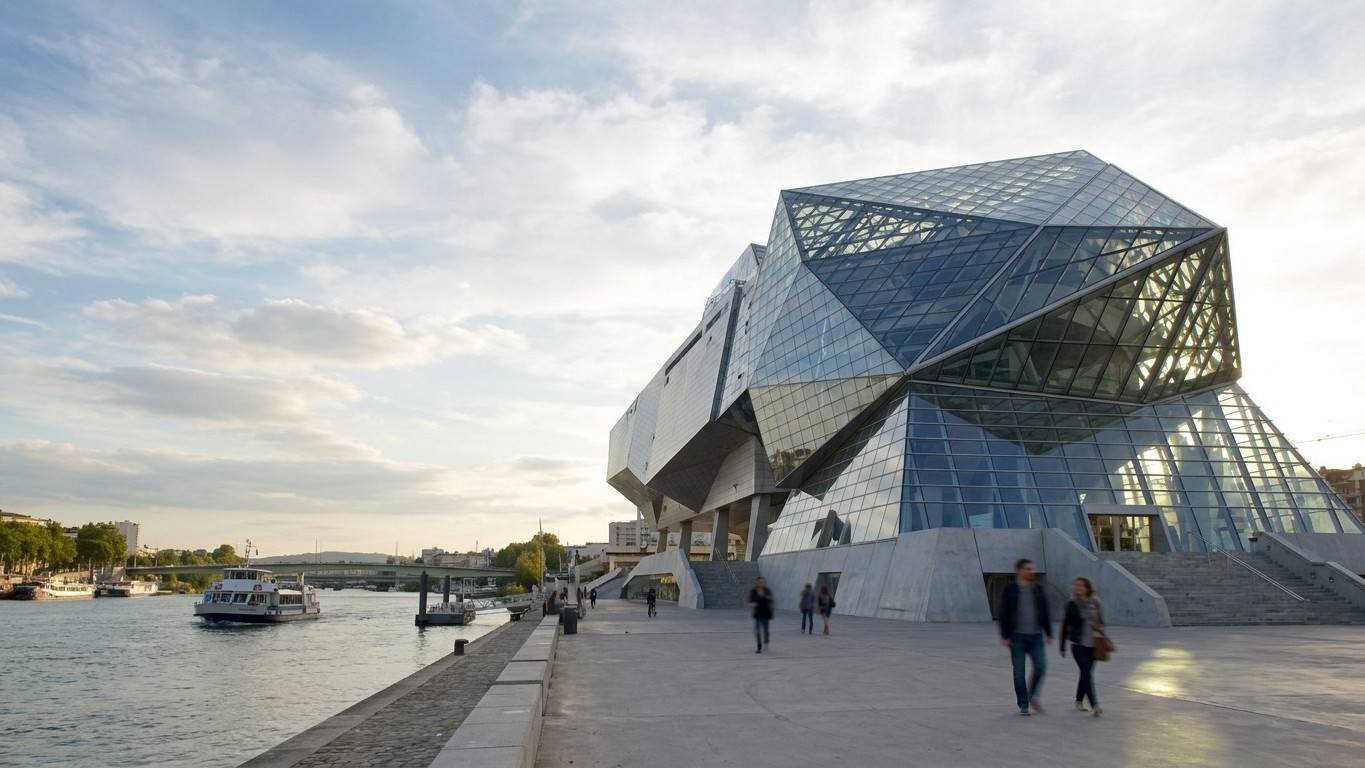
Three hundred fourteen million euros. That is the amount the Rhône General Council sank into constructing the Musée des Confluences before handing over the keys of the building to the newly created Metropolis of Lyon in 2015. A figure confirmed in black and white by the Auvergne-Rhône-Alpes Regional Court of Audit in a report published in October 2024, which scrutinized the management of this cultural institution that, despite itself, became a symbol of budgetary drift.
The building was constructed by the Rhône General Council at a cost of €314 million and became the property of the Metropolis of Lyon in 2015 upon its creation. A transfer of ownership that took place behind the scenes, just a few weeks after the museum’s inauguration. Following a project initiated in the 1990s, the museum, closed since 2007, reopened its doors in December 2014 in the new building to which it had been allocated.
Key takeaways
- Why did a building estimated at €61 million end up costing more than €314 million?
- How did the Rhône Department manage to pass this enormous burden to the young Metropolis of Lyon?
- Can a world-renowned museum survive without state support?
A project that derailed for thirteen years
Let’s go back. The project dates back to 1999, propelled by Michel Mercier, then president of the Rhône General Council. At the time, the first estimates were still in francs: 400 million, roughly 61 million euros. A figure that today seems almost comical given how much the final bill exploded.
The actual bill was revealed at the end of 2015 when the Metropolis of Lyon voted a decree updating the remuneration of the Rhône and Lyon Equipment Company, the contractor in charge of the works. €256,845,189.50 excluding tax, i.e., about €306,980,575.20 including tax, according to the decree passed on Monday, which updates the remuneration of the Rhône and Lyon Equipment Company (SERL) responsible for the works. The taxpayers’ association Canol, for its part, went further by including land and related developments, bringing the total up to €328 million. In the end, the museum cost 411% more than its initial estimate. A ratio that would make any chief financial officer blanch, and which made the Musée des Confluences a case study cited in debates on the control of large public projects.
The building itself is not blameless. Designed by the Austrian firm Coop Himmelb(l)au, this “crystal cloud” perched at the confluence of the Rhône and the Saône multiplied technical complications. A thirteen-year saga, much longer than expected and filled with vicissitudes, with the stoppage and restart of the project by Vinci, the company ultimately tasked with finishing this structure of unprecedented complexity. Hard not to see here a recurring symptom of France’s major cultural facilities: architectural audacity is often paid for at a high price, and local taxpayers rarely benefit from the savings.
An inheritance transferred to the Metropolis, without consultation
The timing is telling. The Rhône General Council, which had carried the project since 1999, transferred ownership of the museum to the new Metropolis of Lyon at its creation in early 2015, a few weeks after the opening. The department built, spent, incurred debt, then handed over the reins at the precise moment the new authority came into being. A timing that is not a mere administrative accident.
This transfer did not only involve the walls. This handover placed on the new authority the burden of paying down the debt, but also the burden of day-to-day operations, with budgets initially fluctuating between €16 million and €18.5 million annually, while some associations feared the bill could climb to €30 million. The Metropolis thus inherited a double load: the loans contracted for the construction, and an operating cost whose real magnitude was not truly known. A situation that veteran observers of the dossier described, frankly, as a poisoned gift.
Eleven years later, the bill still weighs
The report from the Regional Audit Court does not settle past accounts. It notes a persistent anomaly: the Metropolis of Lyon remains, today as well, the sole financier of the establishment. This highly unusual situation, which the metropolis inherited from the Rhône Department, makes the Musée des Confluences an establishment with no effective cooperation with the city of Lyon and other local authorities, nor even with the State, which should participate given its regional and national prominence.
Concretely, in 2022 the museum had an operating budget of €19.9 million, of which €14.4 million, reduced to €13.4 million in 2024, came from subsidies paid by the Metropolis of Lyon, the sole public contributor. A total dependence that worries the financial magistrates, even if the picture is not entirely bleak. The management review highlighted a healthy financial situation for the establishment, while underscoring its excellent attendance. It houses more than three million objects and since its reopening has hosted more than six million visitors to date, i.e., about 630,000 visitors per year, making it, outside Paris, one of the most visited museums in France.
One question remains unanswered by the Regional Audit Court: why does an institution of such national stature receive no financial support from the State or from any other local authority besides the Metropolis? The report recommends clarifying the establishment’s statutes to open the door to new funders, region and State. A path that, ten years after the end of construction, shows that the Musée des Confluences dossier has not yet finished fueling Lyon’s budget debates.
Sources: lyonmag.com | lyon-entreprises.com
