
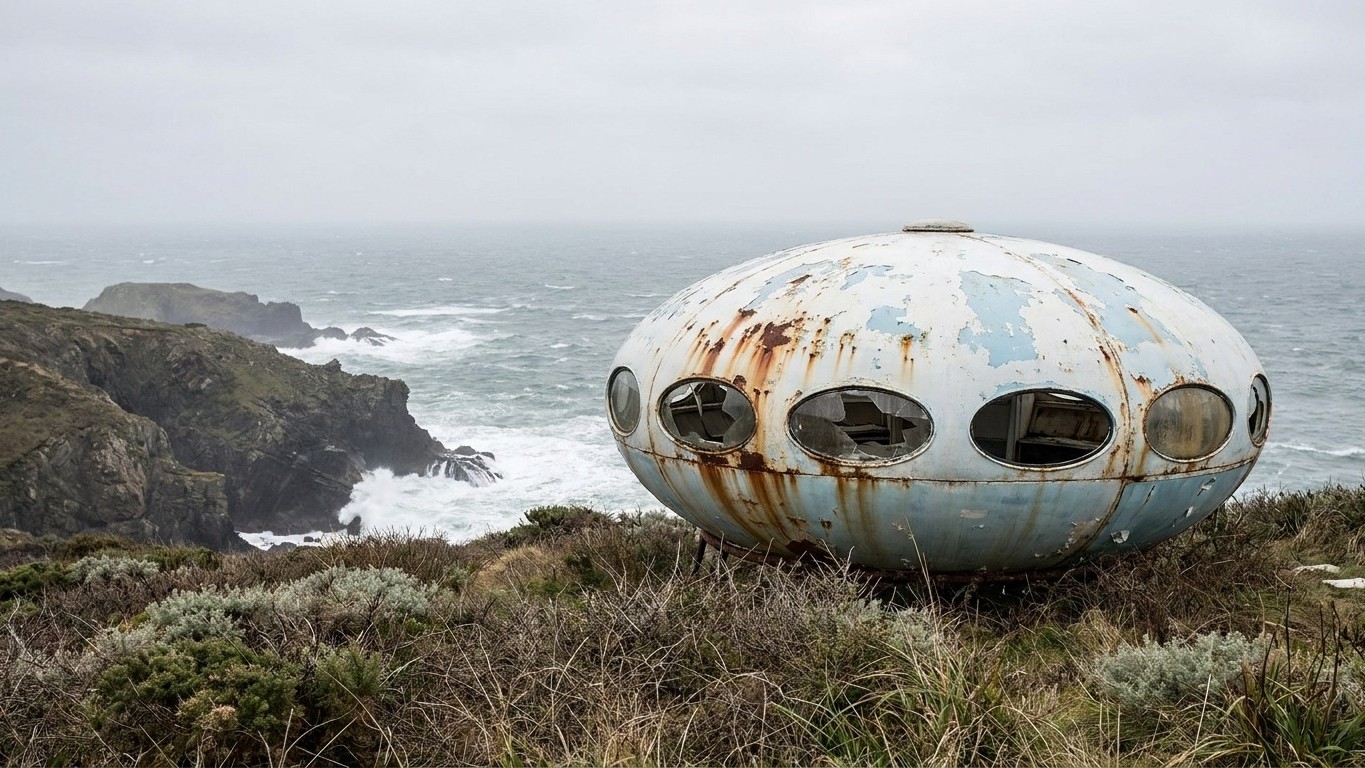
Dozens of empty, rusted, and cracked shells lined up facing the sea like a washed-out B-movie set. On Taiwan’s northern coast, in the Sanzhi district, these UFO-shaped houses never welcomed a single tourist. Construction began in 1978 with the aim of turning them into a vacation complex, but the site was abandoned in 1980, and demolition did not begin until 2008, despite a petition to save at least one building as a museum. For almost thirty years, these colorful pods rotted under tropical rains, and not a single guest ever crossed their threshold.
Key takeaways
- Dozens of uninhabited architectural pods rotted facing the ocean for three decades
- A string of deaths and a legend of a curse sealed the project’s fate from the start
- These photogenic ruins of the future drew urban explorers and filmmakers before vanishing without a trace
A construction site that went wrong from the start
Construction of these UFO houses began in 1978 on a stretch of the northern coast adjacent to Tamsui, with marketing aimed at American military officers stationed in East Asia. The project belonged to the Hung Kuo group, which had bet big on a concept inspired by Futuro houses—disc-shaped prefab flying-saucer homes imagined by Finnish architect Matti Suuronen. The idea was alluring: compact, modular bubbles, stackable if demand rose, facing the sea with a water park included as a bonus.
By the late 1970s, everything seemed in place: high-tech equipment, water slides, and a region considered among the most economically promising. Then everything stopped abruptly. The project was abandoned in 1980 after investment losses and a string of fatal accidents as well as worker suicides on site. The associated promoter, Yu-Chuo, went bankrupt, dragging Hung Kuo down financially.
The legend of the curse
What might have remained merely a tale of real estate bankruptcy became a stubborn urban legend. The abandonment of the project was partly attributed to an ill-omened act: splitting a Chinese dragon sculpture near the complex’s gates to widen the road leading to the buildings. In Chinese culture, breaking a dragon—an emblem of prosperity and good fortune—is never a trivial matter. Some locals saw this as the direct cause of the string of misfortunes that struck the site.
Another, darker rumor circulated for decades. Some accounts claimed the site was once a Dutch soldiers’ cemetery, with figures that chill: as many as 20,000 bones unearthed during excavations, an estimate never confirmed but repeated in local folklore. True or not, the effect was the same: for years, no one wanted to come near the site.
A renewed attempt at revival occurred at the end of the following decade. After a decade of abandonment, Tsai Chin-Hsien, president of Haicheng Tien, approached Hung Kuo in 1989 to restart the project. It proved a misstep: studies showed that the reinforced-plastic-coated concrete structure was not designed to endure earthquakes, a critical flaw on an island regularly shaken. The project was abandoned again, deemed too risky in a region with significant seismic activity.
Thirty years of photogenic ruins, then nothing else
With no vacationers, Sanzhi found another audience: photographers, urban explorers, and curious visitors from around the world. These pod-shaped buildings became a minor tourist draw thanks to their unusual architecture; they featured in a film and served as a set for MTV shoots. Images of these pastel shells, corroded by rot and overgrown vegetation, circulated online under the label “ruins of the future,” a future that never arrived.
The turning point came at the end of the 2000s. Demolition of the site began on December 29, 2008, with the aim of converting the area into a tourist attraction featuring hotels and a beach park. By 2010, all the UFO houses had been razed, and the land was being transformed into a commercial seaside complex with a water park. Three decades after the first spade blows, the loop closed, almost exactly as the original plan had envisioned.
What remains of Sanzhi today
There is no physical trace left of the pods. After being completely demolished in 2010, the site preserves no remnants today. Only urbex photographs from the 1990s and 2000s testify to this forward-looking architecture, perched between Cold War optimism and local superstition. Ironically, another company has since rented the land with the intention of turning it into a tourist complex, which is rather ironic since that had been the original ambition.
One question that Nou-f air Metropolitan Taipei guides carefully avoid: why did no one ever attempt to preserve even a single pod, while replicas of Futuro homes survive elsewhere in the world—from Finland to the United States? In Sanzhi, there is literally nothing to visit anymore, save a parking lot and tourist signs that recount, without a trace, the story of a future that failed before it could begin.
Sources: failedarchitecture.com | worldabandoned.com
