
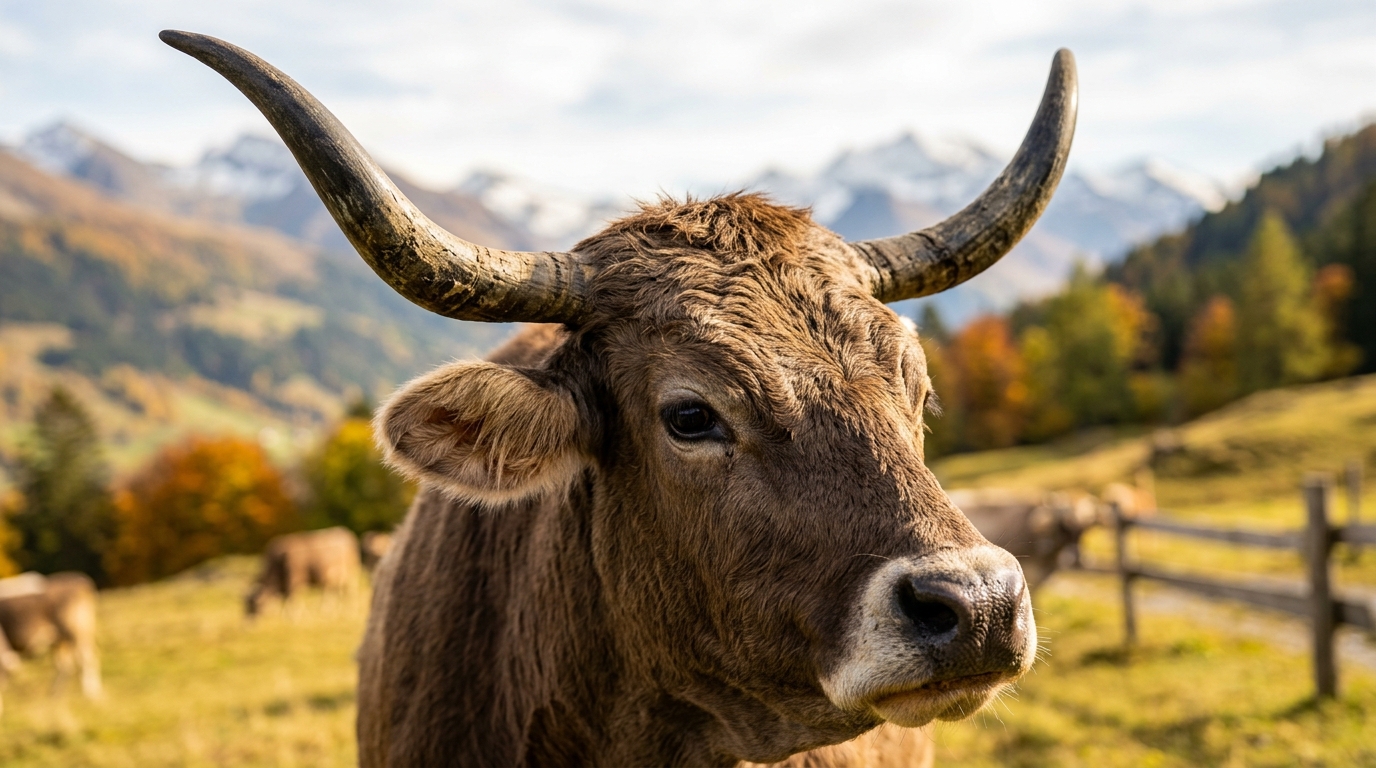
What if direct democracy also hinged on the tip of a cow’s horns? In Switzerland, this question is far from absurd. The country did indeed organize a national referendum on the issue, with several millions of francs in agricultural subsidies at stake. The result was tight, the debate passionate, and a real-life, large-scale lesson in agriculture.
- The initiative “For the Dignity of Farm Livestock,” led by farmer Armin Capaul, proposed a premium for breeders who let their animals retain their horns.
- On November 25, 2018, the text was rejected by 54.7% of voters, with only six cantons or half-cantons approving it.
- In 2022, an attempt to revive the “horn franc” via a motion was rejected by the National Council, leaving the issue open.
- Three quarters of Swiss cows no longer have horns
- 190 francs per cow: the strange calculation behind the vote
- How 54.7% of Swiss said no to their own farmers
Three quarters of Swiss cows no longer have horns
Before even talking about the vote, one must grasp a technical detail that changed everything in this debate. In Switzerland, the vast majority of the livestock already no longer bears horns. It is estimated that about three-quarters of cows and a third of goats in the country have been dehorned, often from a very young age.
This practice is not merely anecdotal for farmers. Horns cause injuries. An unfortunate clash in a crowded barn can injure another animal, or even a person passing by at the wrong moment. As a result, many farms have gotten into the habit of removing this risk at the source, by cauterization on young animals.
But not everyone agreed on the exact figures. The initiators of the vote argued that only 10% of Swiss cows still retained their horns, while the Confederation spoke of around 25%. Even today, there is no official statistic on the matter: the Swiss Farmers’ Union continues to assert 10% for dairy cows. A numerical ambiguity that says a lot about the difficulty of settling a debate that is nonetheless very concrete.
190 francs per cow: the strange calculation behind the vote
The initiative bore a name that sounds almost philosophical: “For the Dignity of Agricultural Livestock.” Behind this wording lay a very concrete request, championed by Swiss farmer Armin Capaul, convinced that horns were an integral part of the animal’s identity and well-being.
Concretely, the text proposed paying breeders a premium to allow the horns to grow rather than remove them. The proponents estimated this compensation at at least 190 francs per cow per year, and 38 francs per goat, for a total annual cost of around 15 million francs.
The Federal Council, by contrast, saw things on a grander scale, with potential bills estimated between 10 and 30 million francs per year, to be drawn from the existing budget allocated to agriculture. For the Swiss government, keeping or not horns was primarily a decision for farmers to make, and not a matter requiring state intervention. It also warned of a perverse effect: by changing the economic equation, the measure risked pushing more breeders toward tethered stabling, where animals are kept permanently restrained, a practice deemed less favorable to animal welfare than free-stall housing.
How 54.7% of Swiss said no to their own farmers
On November 25, 2018, the Swiss voters headed to the polls to decide this issue that had far surpassed the agricultural world. The verdict was not surprising to observers accustomed to federal referendums: 54.7% of voters rejected the initiative, compared with 45.3% who voted yes. In raw numbers, that’s 1,384,027 no votes against 1,144,845 yes votes, with a turnout of 48.3%.
The rejection was also confirmed at the cantonal level, a key condition for a popular initiative to be accepted in Switzerland. Only four cantons voted in favor of the text, Geneva, Ticino, Glarus, and Schaffhausen, joined by two half-cantons, Basel-Stadt and Basel-Landschaft. A clear majority from rural and German-speaking Switzerland thus preferred to leave the decisions to the farmers themselves.
The story did not end at the ballot box. In 2022, the Council of States attempted to revive the idea in a lighter form, via a motion by the Solothurn-based Roberto Zanetti. The aim was to amend the payment-directive and raise the financial cap to about 20 million francs per year, without going through a new popular vote. But the National Council ultimately rejected this “horn franc,” refusing to embed it in agricultural regulations. The horn dossier remains open, as a symbol of the ongoing tensions between traditional farming, animal welfare, and economic rationality.
This referendum beautifully illustrates the unique mechanism of Swiss democracy, capable of mobilizing a whole country around a topic as precise as the morphology of cattle. It also reminds us that a question that appears trivial can crystallize broader debates, spanning agricultural economics, animal welfare, and the vision of rural life. The horns of Swiss cows will likely continue to fuel discussions for a long time to come.
