
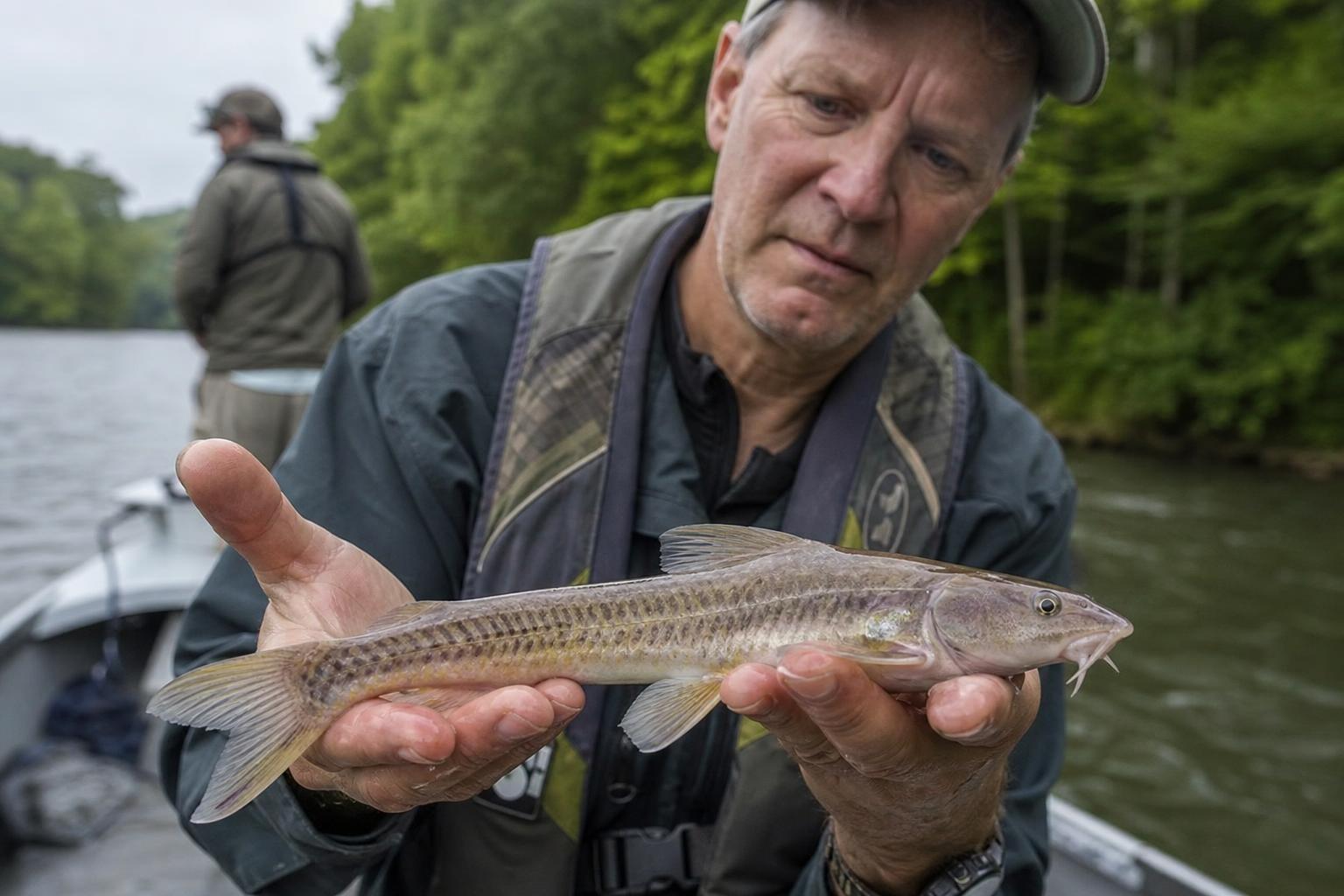
A fish once written off as gone has surfaced in a Tennessee river, upending assumptions and electrifying biologists who had marked the species as a ghost of the past. The rediscovery arrived not with fanfare but with a flicker of movement in shallow riffles—one small, fiercely alive body glinting against gravel and current.
State crews were in the water for a routine survey when the net closed around a slender, thumb-length fish with a speckled flank and amber fins. “We all just froze,” said one field technician. “It was like the river had whispered a secret.” Within hours, images were circulating through labs, inboxes, and text threads. A surprise had become a fact, and a rumor had turned real.
River memory, species silence
For years, the species—an inconspicuous darter from the perch family—existed only in field guides and museum drawers. Habitat fragmentation, silt-choked tributaries, and chemical runoff had painted a grim arc that seemed terminal. Crews returned season after season, pressing against currents and expectations, and still found nothing.
But rivers keep memory in unexpected eddies. Gravel bars shift, headwater seeps reconnect, and pockets of oxygen-rich water persist where maps say they shouldn’t. “We design models to simplify complexity,” said a fisheries biologist with the Tennessee Wildlife Resources Agency. “The river keeps reminding us it’s more complicated than that.”
How the rediscovery happened
On a bright, windless morning, a team worked a braid of shoals below a low, mossy bridge. Seine nets arced, boots bit into cobble, and field trays filled with sculpins, shiners, and leaf-stained water. Then came the tell: a quick, sickle-shaped movement anchoring tight to the bottom.
The specimen was gently lifted into a chilled observation box, its opercules pulsing, its lateral line stitched like fine script. “Two spots on the tail, a dusky band—that’s when my heart jumped,” said the crew lead. A second sweep landed another individual, then a third, each from a ribbon of current the width of a bootlace.
Back at the truck, a portable scope confirmed the field hunch. Emails flew with still-wet photos. “We’re staring at a species we had mourned, and it’s staring back,” one message read.
The mystery of survival
Experts are cautious, almost hushed, about assigning causes to such a comeback. Survival could have hinged on microrefugia—cold seeps, underrun banks, or spring-fed side channels that stayed clean while the main stem suffered. Genetic resilience may have played a role, along with sheer, improbable luck.
“We still don’t know how it made it through,” said a university ecologist. “Maybe the answer is a dozen small answers—habitat fragments that lined up just right, at just the right time.”
Possible ingredients, according to the team:
- Subtle improvements in water quality tied to upgrades in infrastructure
- Low-flow years that reduced predation and competition in marginal habitats
- A remnant population cloistered in inaccessible, spring-fed pockets
“We tend to expect recoveries to be loud and linear,” the ecologist added. “This one crept under the radar, then tapped us on the shoulder.”
What happens next
Rediscovery is not the finish line; it’s the starting gun. Crews will fan out across tributaries with environmental DNA kits, drift nets, and fine-mesh seines. The goal: define the species’ current footprint, estimate abundance, and identify the threads of habitat that kept it alive.
Managers are already considering emergency measures—seasonal work moratoriums on key reaches, fast-tracked riparian plantings, and targeted erosion controls. County planners have been briefed on culvert retrofits to restore bottom continuity and allow fish passage beneath older, perched crossings.
“Momentum matters,” said a senior agency official. “If we move quickly, we can convert this spark into durable protections. If we move slowly, the river will make its own decision.”
Science in the spotlight
The find is a gift to science. Tissue samples will feed population genetics analyses to determine whether the rediscovered fish represent a single, isolated lineage or multiple, long-hidden pockets. Stable isotope work could sketch their seasonal diet, while otolith readings may reveal growth rates and longevity.
“This is a rare second chance,” said a lab director preparing the assays. “It lets us test long-held assumptions about extinction risk, detectability, and the resilience of small-bodied fishes in flashy, temperate streams.”
A river’s reminder
News of the discovery has traveled through bait shops, classrooms, and neighborhood feeds, resonating beyond the scientific circle. Anglers are spreading the word to watch their wading, volunteers are signing up for weekend plantings, and a fourth-grade class in Knoxville has adopted the species as a semester-long project.
Hope, however, is not a management plan. Rivers in the region still carry legacy sediments, heat spikes during droughts, and the pressure of rapid development. The fish is not “back” so much as it is present, for now, asking for time and space.
Standing in knee-deep water, one biologist watched the rediscovered fish slip into a riffle, vanish, then reappear half a meter downstream. “It’s not a miracle,” she said, voice low. “It’s a window. And windows don’t stay open by accident.”
