
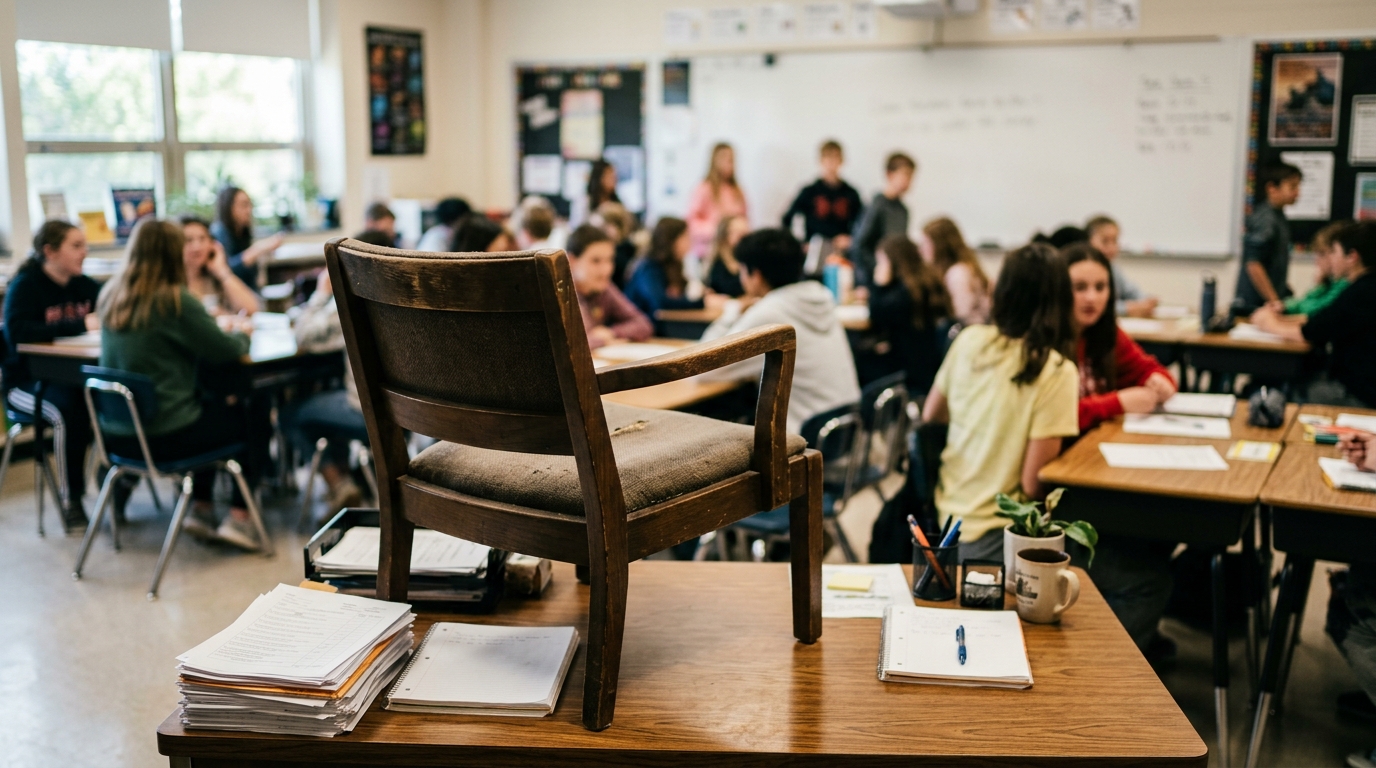
Attention, the figures that follow may make you uncomfortable if you have children in secondary school. Each new school year, the same promises reappear: more resources, more substitutes, fewer classes left to themselves. Yet behind the reassuring talk, a recent report from the Cour des comptes reminds us of a stubborn reality: a substitute system for absent teachers that, despite substantial investments, continues to leave thousands of students without a teacher in front of them. A problem that is not new, but that seems resistant to the reforms pursued in recent years.
- In 2024, about 9% of class hours in middle schools were not covered, a rate well above the 3% objective set by the finance law.
- Only 10% of short-term absences are replaced, compared with 96% for long absences and nearly 80% in primary education.
- The Cour des comptes recommends a new target of 36% replacement of short absences by 2026, through better management of substitute pools and a revalorisation of overtime.
- A costly scheme that misses its mark
- Why short absences escape the system
- Classes without teachers, students who disengage
- What the Court of Auditors recommends to fill the gaps
A costly scheme that misses its mark
On paper, the ambition was clear: to ensure that no absent teacher leaves a class without supervision. To achieve this, the state put in place the teacher pact, a mechanism based on overtime offered to voluntary teachers to cover their colleagues’ absences. The stated objective was ambitious: to replace 20.5% of short-term absences starting with the 2023-2024 school year. A figure that may seem modest, and yet, even this threshold was not reached, despite a real six-point increase compared with previous years.
The Cour des comptes does not mince its words in its late-2025 report: in 2024, nearly 9% of class hours were simply not covered in public middle schools. The main cause remained, unsurprisingly, the failure to replace absent teachers. A figure all the more striking as it far exceeds the target set by the finance law, which planned to bring this rate down to 3%. In 2022 already, the gap between the objective and reality stood at 5.7%, evidence that the problem has become entrenched rather than resolved.
Why short absences escape the system
This is where the real flaw of the scheme lies. Long absences, those lasting more than fifteen days, are rather well managed: the replacement rate reached 96% according to 2018-2019 data. Logical, since the administration has time to organize a replacement, hire a contractor, or reorganize timetables. The problem arises with short absences, those lasting only a few days, often unpredictable, linked to a sick leave or last-minute training.
To gain a clearer view, the state created in 2023 a monitoring tool called SI-RCD, established by decree and clarified by a ministerial order dated August of the same year. Its role: to measure precisely the effectiveness of short-term replacements. The first analyses transmitted to the Senate show that only 10% of these absences would have actually been covered by a replacement, despite a tripling of the coverage rate since the baseline year 2022-2023. A real progression, therefore, but starting from such a low base that it still does not suffice to fill the gap in front of the students.
A previous Cour des comptes report, published in 2021, painted a similarly revealing picture of the scale of the phenomenon: out of 2.5 million hours of missed class time due to short absences, only 500,000 hours were replaced, i.e., about a fifth of the total. In other words, even then, four short absences out of five found no substitute teacher. It is precisely this ratio, one in five absences covered, that inspired the idea of a class day on five without anyone in front of the pupils, a portrayal that sums up the system’s faltering mechanism.
Classes without teachers, students who disengage
Behind these percentages lies a very concrete reality, experienced every week in middle schools. A crowded study hall, an improvised study period, sometimes even a simple note on the door announcing the teacher’s absence with no replacement solution. For students, these lost hours are never trivial: they accumulate over the school year and end up widening gaps in the curriculum that are hard to catch up, particularly in subjects where pedagogical progression is linear, such as mathematics or languages.
The situation contrasts sharply with what happens in the primary level. At primary school, the replacement of teachers works much better, with nearly 80% of absences covered from the first day. A difference partly explained by more centralized organization and by the presence of dedicated substitute brigades, a luxury that secondary schools still struggle to offer on a large scale.
What the Court of Auditors recommends to fill the gaps
Faced with this assessment, the Cour des comptes does not simply point to the failures: it puts forward recommendations to get back on track. The teacher pact now sets a new, more ambitious target, with 36% replacement of short absences by 2026. A milestone that requires greater participation from volunteering teachers, but also better anticipation of needs thanks to the data collected by the SI-RCD system.
Among the proposed measures are also a more incentive-driven revalorization of overtime hours, finer management of replacement pools by academy, and more robust monitoring of long-term absences, whose replacement rate has nevertheless deteriorated since 2019, contrary to what one might expect. The Court also stresses the importance of measuring results over the long term, rather than settling for a one-off improvement that would mask the persistence of the underlying problem.
Ultimately, this dossier illustrates a distinctly French paradox: a State capable of creating schemes, indicators and numerical targets, yet not always able to translate these tools into tangible results for students. As the new school year unfolds in schools, the question remains: how much longer will it take for an empty classroom to become the exception rather than the rule?
