
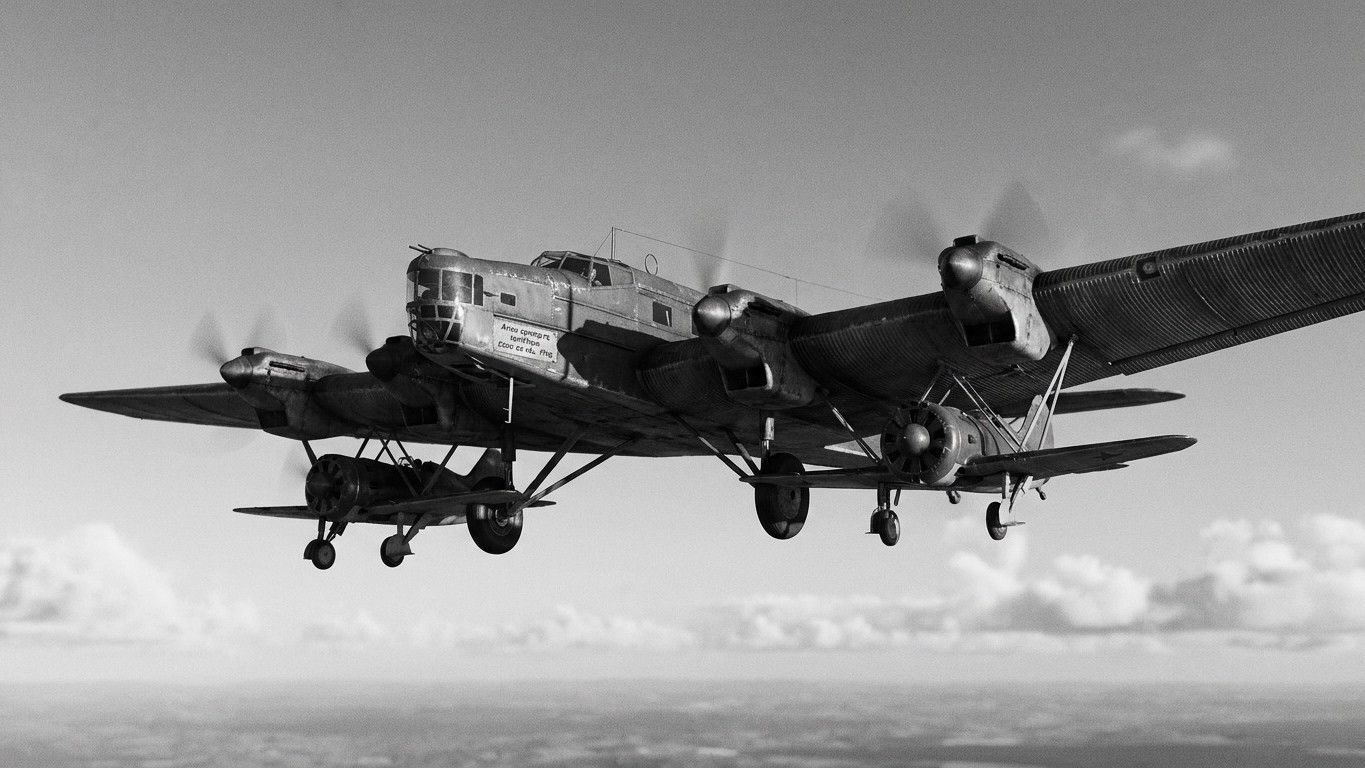
Two Polikarpov I-16 fighters, each loaded with two 250-kilogram bombs, lifted off the ground while hanging under the wings of a four-engine bomber. Once aloft, they detached, swooped onto their target, dropped their payloads, and then returned to their base alone, powered by their own engines. This wasn’t a scenario from a science fiction film but a real mission carried out by the Soviet Navy aviation in August 1941 against the Cernavodă bridge in Romania. In August 1941, these configurations flew during the only combat missions ever undertaken by parasite fighters, TB-3 transports carrying Polikarpov I-16SPB in a dive that attacked the Cernavodă bridge and the Constanța docks in Romania.
The concept might seem absurd from today’s perspective, almost the stuff of an aviation cartoon. Yet it rested on a precise military logic: a lone fighter lacks either the range or the payload to strike distant strategic targets. Attached beneath the wing of a heavy bomber, it becomes something else entirely. A precision tool carried free to the edge of the objective, before transforming into an autonomous dive-bomber.
Key takeaways
- Fighters took off strapped beneath a bomber — how did they detach in flight?
- The Cernavodă bridge withstood all conventional bombing, but three missions changed the equation
- This revolutionary weapon vanished as quickly as it appeared — why did Stalin refuse its development?
A Decade of Experimentation Before the War
The idea did not originate in the heat of battle. Between 1931 and 1940, engineer Vladimir Vakhmistrov developed a whole family of composite aircraft: a TB-3 4AM-34FRN heavy bomber strapped to I-16 fighters on their bomb-rack stations, with aims of ferrying fighters beyond their usual range, extending the escort aircraft’s reach, and enabling fighters to carry bombs heavier than they could normally lift.
Tests proliferated throughout the decade, with progressively bolder configurations. The Zveno-6 variant, a TB-3 accompanied by two Polikarpov I-16s attached to the fixed gear, made its first flight in August 1935, with Stefanovskiy piloting the TB-3 and Budakov and Nikashin aboard the I-16s. Some variants pushed the concept even further. In a scheme devised by Vakhmistrov, the TB-3 would take off with two I-16s under its wings, while six other fighters would join in flight, detach and reattach in turn, and even refuel from the bomber. A handful of successful in-flight detachments and fuel transfers occurred in 1938, but the eight-fighter arrangement never reached completion. A literal flying circus, of which only the simpler version—two fighters under the wings—ultimately went to combat.
This definitive version bore an evocative code name. “SPB” stood for Sostavnoi Pikiruyuschiy Bombardirovschik, “composite dive bomber”: the parasite I-16s served as dive bombers, each carrying two bombs of 100 or 250 kilograms that they could not have lifted on their own. Carried this way, the I-16 parasite could bear a payload five times larger than normal, and its range increased by about 80%. The attachment under the bomber’s wings did not merely conserve fuel: it made possible a mission that the fighter alone could never have accomplished.
The Cernavodă Bridge, an Impossible Target for Conventional Bombers
When Germany invaded the USSR in June 1941, this experimental weapon, tested since 1937 and approved in 1938, finally entered active service. Five SPB combinations were integrated into the 2nd Special Squadron of the 32nd Fighter Aviation Regiment, within the Black Sea Fleet’s aviation branch, based at Eupatoria in Crimea and commanded by Arseny Shubikov.
The first combat sortie occurred quietly on July 26, 1941. Two Zveno-SPB aircraft departed in broad daylight—a bold choice given the greater risk of enemy detection—toward the Constanța oil depot. The fighters, each carrying heavy bombs, detached from the TB-3s about 40 kilometers from the target, then proceeded to approach the depot alone, carry out their bombardment, and return to their base using only their own power. A first success that validated the concept in real conditions.
The real standout came fifteen days later. The King Carol I Bridge at Cernavodă carried the pipeline linking Ploiești to Constanța, making it a vital strategic target. Conventional Soviet bombers had failed to hit it on multiple occasions, so the I-16 parasites were used instead. Dropped from roughly 40 kilometers away, they bombed the bridge in a dive and returned home under their own power. A return mission days later yielded even clearer results. Targeting the King Carol I railway bridge spanning the Danube at Cernavodă on August 10 and 13, the first mission damaged the structure and an adjacent pipeline, while the second destroyed a 140-meter steel span with direct fire from six I-16s. A bridge that conventional aviation had failed to pierce was reduced to pieces by a handful of fighters strapped to the wings of an old bomber.
A Weapon Undone by Its Own Vulnerability
The success could have triggered a ramp-up. Yet, on August 16, 1941, Admiral Kuznetsov asked Stalin for additional TB-3 aircraft equipped with the AM-34FRN engines necessary to convert them into Zveno-SPB carriers, but the request was refused because of the heavy losses suffered by the air forces in the war’s early weeks. The wartime context, with the Red Army in retreat on nearly every front, left little room for a program so demanding in engines.
The squadron nevertheless pressed on with operations, even striking a target on Soviet soil now held by the enemy: a tactical attack on a bridge over the Dnieper River at Zaporojie, captured by advancing German troops. But the fate of the TB-3 as a carrier was sealed. The TB-3 was slow and extraordinarily vulnerable, and newer aircraft with the range needed to strike such targets directly entered service. By the end of 1941, the wooden-portable carrier had fulfilled its role and was withdrawn. The last operational examples were scrapped in 1942, closing definitively the only combat chapter in the history of parasite fighters.
What stands out in hindsight is not the boldness of the technical concept so much as the human record behind it. Zveno remains almost the only project of its kind to actually see combat, strike its targets, and bring back nearly all of its crews. Other attempts at bombers carrying fighters—such as the American airships Akron and Macon carrying Sparrowhawk, or the later XF-85 Goblin—remained experiments without an operational outcome. The Zveno-SPB, however, truly made a one-way journey to the front, once, before vanishing as quickly as it had appeared.
Sources: planehistoria.com | secretprojects.co.uk
