
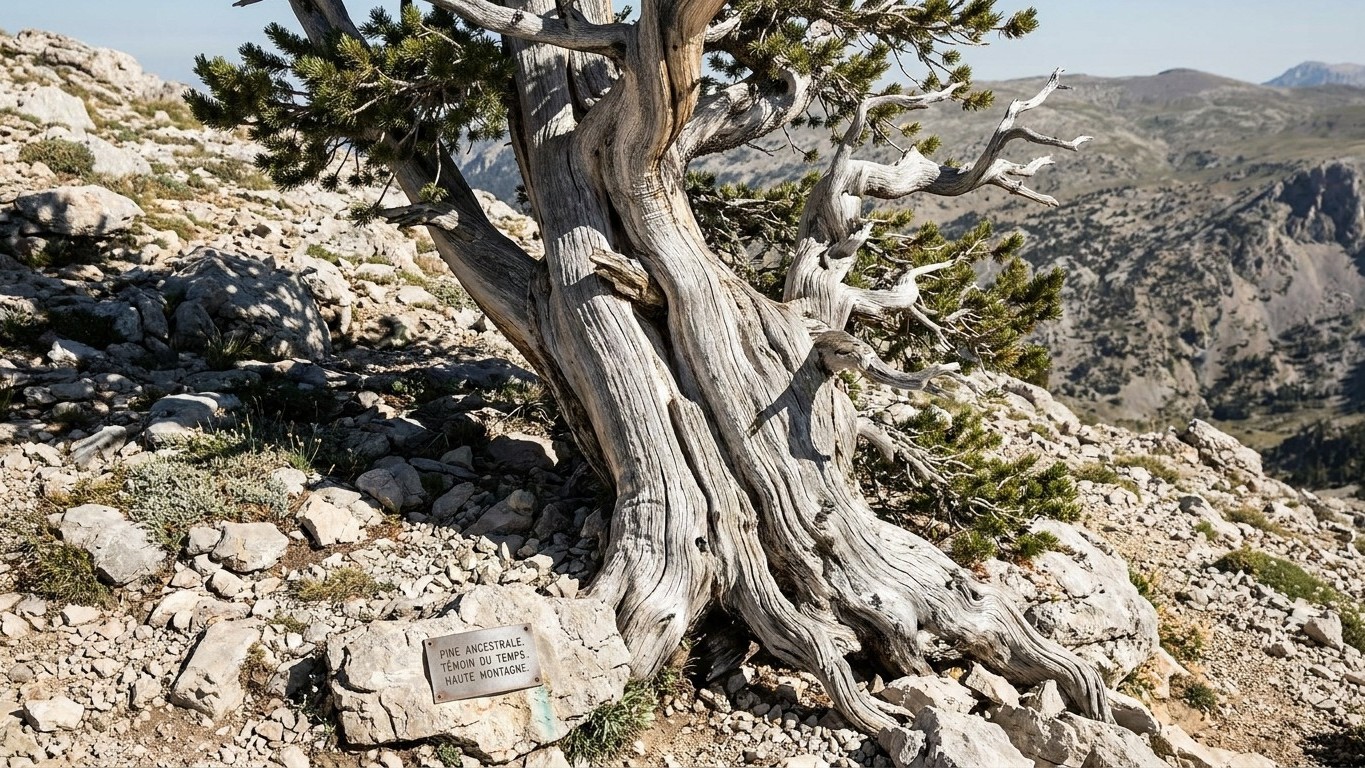
Atop the White Mountains, in the eastern part of California, a pine has stood for almost 4,800 years, a silent witness to a human story that had not yet begun when its first needles cut through the thin air of high altitude. Named Methuselah, this Great Basin pine (Pinus longaeva) holds the record as the oldest living non-clonal organism known on Earth, a status that comes with unusual protection: no one, aside from a handful of forest rangers, knows its exact location.
this Great Basin pine, perched on a calcareous slope more than 3,000 meters above sea level in the White Mountains of California, was confirmed to be about 4,855 years old in 2025, making it the oldest known living non-clonal organism on Earth. The dendrochronologist Edmund Schulman, a researcher at the Tree Ring Research Laboratory at the University of Arizona, studied it in the 1950s. When Schulman and his colleague Tom Harlan took samples from the tree in 1957, they discovered it was 4,789 years old. It is believed the tree germinated around 2832 BCE, which places Methuselah among the oldest living beings and non-clonal organisms known worldwide. Stonehenge did not yet exist. The pyramids of Giza were not there either.
Key takeaways
- A 4,855-year-old California pine has kept its identity hidden from the public for decades
- In 1964, a scientist inadvertently felled the oldest documented tree in the world at that time
- This catastrophe forever changed the protection of ancient trees on American federal lands
A Secret Jealously Guarded by the Forest Rangers
Despite its fame, the exact location of the Methuselah Tree is kept secret by the U.S. Forest Service to protect it from vandalism and from foot traffic. Visitors can take the trail named for it, a 4.5-mile loop through the heart of the ancient Bristlecone Pine Forest managed by the Inyo National Forest. Somewhere along this trail, you pass by the tree without realizing it. Signage dots the route, but none designate the venerable pine among its peers, equally gnarled and carved by millennia of wind.
This caution is not merely theoretical. An arson fire in 2008 destroyed the visitor center and several pines. More recently, in 2021, online photographs leaked that appeared to reveal the tree’s location, but the agency has not confirmed which tree it was. The Forest Service prefers to keep doubt instead of inviting a crowd armed with knives or cans of paint. The bark is fragile, dead wood exposed is brittle, and a determined vandal with a knife could destroy in seconds what took five millennia to grow.
1964: The Year Science Brought Down the Elder
This fixation with secrecy did not spring from administrative caution alone. It was born of a tragedy that occurred a few hundred kilometers away, on the Nevada side of the Great Basin, at the foot of Wheeler Peak. There grew another Bristlecone, nicknamed Prometheus by local climbers, probably even older than Methuselah.
Donald Currey, a 30-year-old student from the University of North Carolina, arrived at Wheeler Peak in eastern Nevada in the summer of 1964 to study ancient climate patterns through tree-ring records. He attempted four times to core Prometheus, but the wood was extraordinarily hard and resin-saturated, resisting his tools, and his 28-inch pole snapped twice. With no usable sample, his research stalled. Currey then formally requested from the district forest ranger Donald E. Cox permission to fell the tree to extract complete sections—a request the Forest Service treated as a routine research act and approved.
On August 6, 1964, Currey joined a Forest Service crew on Wheeler Peak, equipped with chainsaws, to cut down this Bristlecone that had lived nearly 5,000 years. Back in his motel room, Currey sat with a cross-section of the trunk, 30 centimeters thick, and began counting rings: the tally passed 4,000, then 4,500, then 4,600—the oldest age ever published for a Bristlecone at that time. The tree was at least 4,862 years old, and perhaps more than 5,000. Currey, unknowingly, had felled the oldest documented tree in the world.
A Lesson Carved in Bark, a Protection Turned National
The Prometheus episode redrew the federal protections for ancient trees: the National Park Service now guards the locations of the oldest living Bristlecone pines, and even dead wood and fallen trunks remain protected within park boundaries, preserved for the climate data they still contain. Bristlecone pines are now protected across all federal lands. It is this lesson, learned at the expense of the elder at the time, that explains why rangers with the Inyo National Forest today refuse to reveal Methuselah’s whereabouts: better a mystery than a second stump exposed to the mountain’s quartzites.
Only Prometheus’ stump remains among the quartzite blocks of Wheeler Peak’s grove, which visitors often pass by without noticing as the worn wood blends into the surrounding rock, while a cross-section of the trunk is displayed at the Great Basin National Park Visitor Center. Methuselah, meanwhile, continues to live, sustained by a living strip of bark wound around a heart largely made of dead wood. The dendrochronology team from the University of Arizona continues their measurements in the White Mountains, convinced that an even older pine than Methuselah waits somewhere along these calcareous slopes, nameless, unplaqueed, and for now without a nearby chainsaw.
Sources : spacedaily.com | reviewjournal.com
