
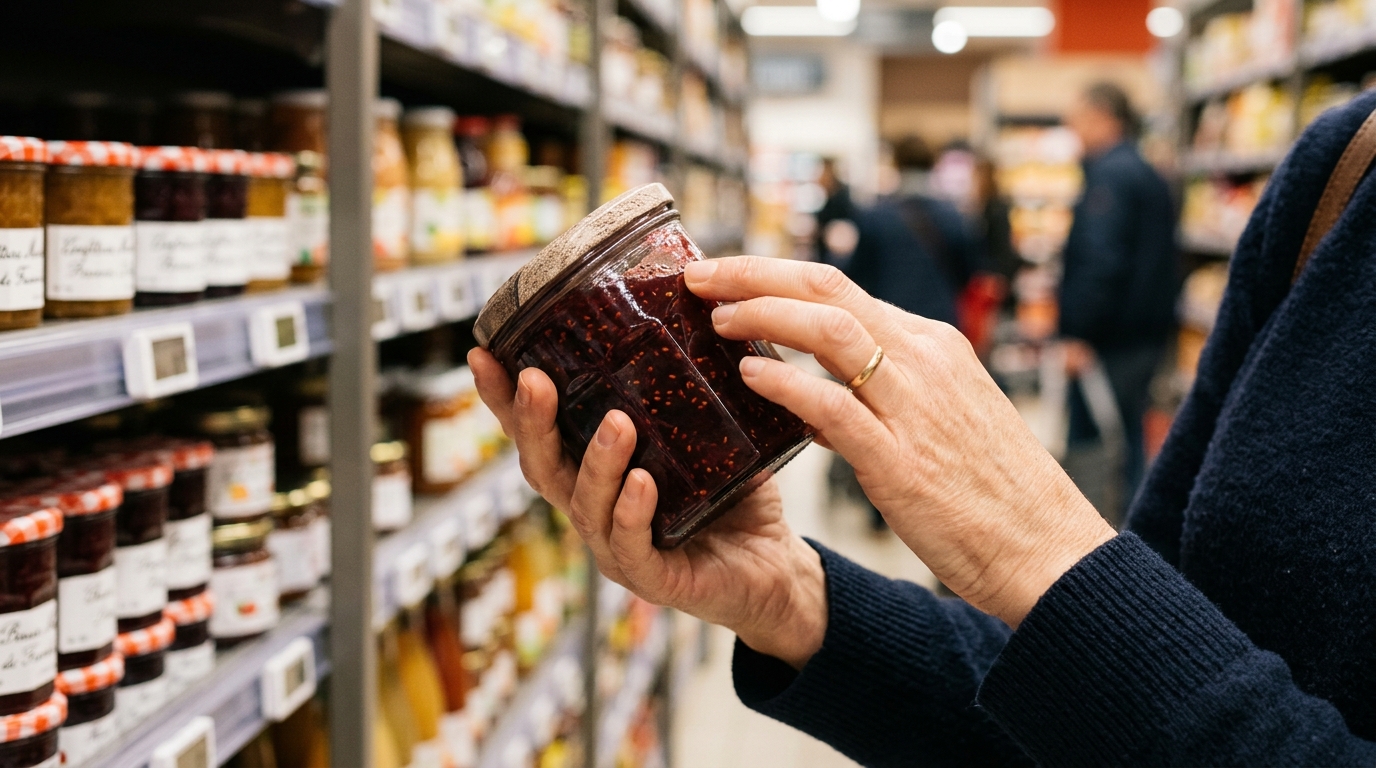
A new European regulation has profoundly reshaped the labels on the products that fill our breakfasts. A jar of jam, a honey bear, a carton of fruit juice: these everyday items sit in every cupboard without us paying them much mind. Yet since June 2026, their labels tell a completely different story, far more precise than the simple price tag shown on the shelf. Foodwatch is sounding the alarm about these changes, which redefine consumer trust in products we thought we knew well.
- Since June 2026, honey jars must display all countries of origin with their exact percentage in the blend.
- The minimum fruit content in jams rises from 350 to 450 g/kg (500 g for the “extra” designation).
- The reform improves labeling information but does not strengthen controls or sanctions against fraud.
- Honey under scrutiny: origin finally detailed on the label
- Jams: more fruit, less sugar in the recipe
- Beyond the jar: chestnut cream, fruit juice and the limits of the reform
Honey under scrutiny: origin finally detailed on the label
No more the artistic blur of “Origin: EU and non-EU” that didn’t tell us much anyway. Now, each jar of honey must display, in its main visual area, all countries of harvest with their exact percentage in the blend. A concrete example provided by Foodwatch illustrates the shift: France 45%, Italy 35%, Vietnam 20%. A margin of error of 5% remains permissible for these percentages, and very small packages—such as hotel mini-portions—can rely on two-letter codes. This requirement is not trivial: according to the European Commission, 46% of samples of honey imported from outside the EU raised fraud suspicions, notably the addition of sugar syrups. Beekeepers themselves had pressed for this transparency. One caveat, however: the directive does not strengthen controls or penalties, so the risk of seeing a label that says “France” on honey that originated elsewhere persists until fraud is detected.
Jams: more fruit, less sugar in the recipe
For jam, the change lies in the recipe itself. The minimum fruit threshold rises from 350 to 450 grams per kilogram for a classic jam, and reaches 500 grams for the “extra” designation. In other words, it is 100 more grams of fruit per kilo that must now compose the jar. Manufacturers will also have to indicate the amount of fruit used per 100 grams of finished product, and list the fruits in order of importance, so you finally know whether strawberry really leads or if it’s just marking time. The expected consequence: recipes with more fruit and less added sugar. A distinctly French curiosity: the term “marmalade” remains prohibited here to designate these products, while other European countries use it without hesitation.
Beyond the jar: chestnut cream, fruit juice and the limits of the reform
Chestnut cream is not exempt from this major labeling overhaul: the country of origin of the chestnuts used in this sweet purée that we eagerly spread in winter must now be stated. Fruit juices are also affected, with the introduction of new categories showing – 30% sugars, a signal rather encouraging for those who monitor morning sugar intake. This so-called “breakfast” directive, which took effect on June 14, 2026 and was transposed into French law by decree in April of the same year, aims above all to strengthen label transparency and combat food fraud. It also extends, in a more limited fashion and described further, to dehydrated milks. A major caveat remains: this reform changes the information available, not the means to verify it. Without strengthened controls or new sanctions, consumer vigilance remains, more than ever, the best ally of these now more talkative labels.
In the end, the shelf price loses a bit of its status as the default reflex. Between the origin of honey, the fruit proportion in jam, and the sugar content of fruit juice, there is now far more to read on these labels than a simple euro figure.
