
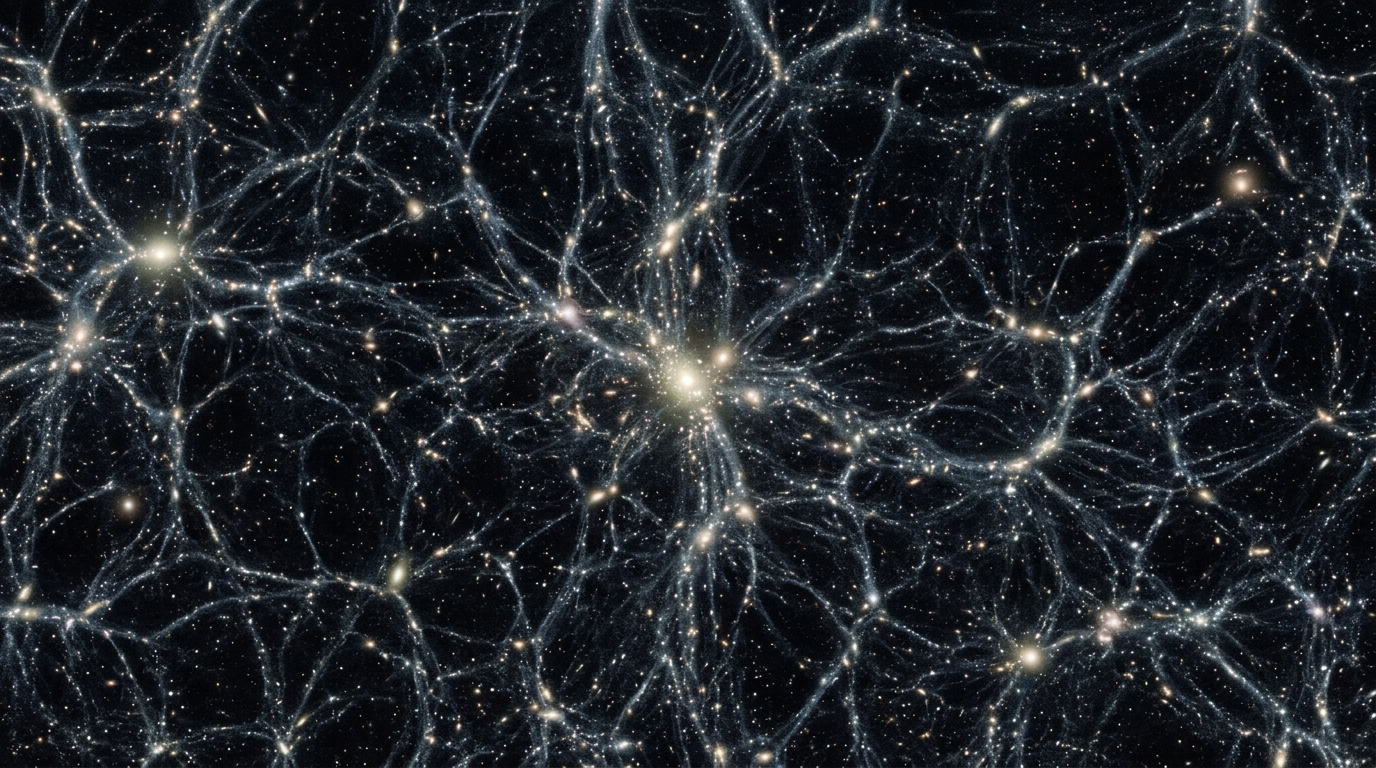
Imagine a scar etched into the very fabric of space, so vast that light would take ten billion years to traverse its length. Understanding its existence could compel us to revisit portions of the equations that have described our universe for decades. Nestled between the Hercules and Corona Borealis constellations, a cosmic structure has defied since 2013 everything modern cosmology believed to be settled. Neither theoretical models nor numerical simulations had anticipated that such a giant could form. And yet, it is there, lurking in the night sky, invisible to the naked eye but perfectly real in the data from space-based telescopes.
- Discovered in 2013 thanks to an abnormal concentration of gamma-ray bursts, the Hercules-Corona Borealis Great Wall spans more than 10 billion light-years, making it the largest known structure in the observable universe.
- Its size surpasses by a factor of almost ten the homogeneity limit set by the standard cosmological principle, challenging a fundamental pillar of cosmology.
- The existence of this structure remains debated by some scientists who point to statistical biases, but the ESA’s upcoming THESEUS mission could help confirm its reality and detect others.
- The day gamma-ray bursts revealed a cosmic secret
- Ten billion light-years: when size becomes a problem
- The standard cosmological principle brought to its knees
- What this anomaly reveals about our misunderstanding of the universe
The day when gamma-ray bursts betrayed a cosmic secret
Everything begins with gamma-ray bursts, these explosions among the most violent in the universe, capable of releasing in a few seconds as much energy as the Sun will emit over its entire lifetime. In November 2013, a team led by István Horváth, Jon Hakkila, and Zsolt Bagoly undertook a methodical task: map the distribution of these bursts across the sky using the data gathered by the space telescopes SWIFT and GLAST. The idea was not to search for a giant structure, but simply to gain a better understanding of the statistical distribution of these distant phenomena.
But while analyzing a catalog of 542 gamma-ray bursts collected over more than two decades of observations, the researchers noticed a troubling anomaly: an unusual concentration of these events in a particular region of the sky, between Hercules and Corona Borealis. Jon Hakkila himself admitted he had doubted the reality of this structure before being persuaded by the magnitude of the observed concentration. This initial doubt was not trivial; it reflected how much the discovery unsettled the expectations of an entire field.
Ten billion light-years: when size becomes a problem
The Hercules-Corona Borealis Great Wall, as it has been named, stretches over more than 10 billion light-years, making it the largest and most massive structure known in the observable universe. Some more audacious estimates even speak of an extension reaching up to 15 billion light-years, with a width of about 7.2 billion light-years. By comparison, the entire observable universe measures roughly 93 billion light-years in diameter: this single structure would therefore occupy nearly one-tenth of all that we can observe from Earth.
Such an enormous scale defies human comprehension. It is not a cluster of galaxies in isolation, nor even a classic supercluster, but a pattern of matter so vast that it seems to contradict the notion that, on large scales, the universe should appear relatively uniform. A newer analysis published in 2025 even suggests the Great Wall could be even more extended than initial estimates, further intensifying the unease felt by the scientific community.
The standard cosmological principle brought to its knees
To understand why this discovery makes so much noise, one must revisit a fundamental pillar of modern cosmology: the cosmological principle. This principle posits that on very large scales, the universe is homogeneous and isotropic, meaning it looks the same everywhere and there is no privileged direction or structure beyond a certain scale. This theoretical limit of homogeneity is typically set between 400 and 600 million light-years, and some more permissive models push it to at most 1.2 billion light-years.
Yet the Hercules-Corona Borealis Great Wall exceeds this limit by nearly a factor of ten. That is precisely what made the structure look “simply impossible” to cosmologists at the time of its discovery. In 2020, several independent teams revisited the matter with larger data sets, hoping perhaps that the anomaly would dissolve into statistical noise. It did not: the structure was confirmed, reinforcing the idea that it was not an observational artefact but a physical reality that still resists a satisfying explanation.
What this anomaly reveals about our lack of knowledge of the universe
We should state this honestly: the very existence of this structure remains debated within the scientific community. Some researchers believe the concentration of gamma-ray bursts could result from statistical biases or poorly understood selection effects, rather than from a truly coherent physical structure. But if the Great Wall is indeed real, then no known physical mechanism today explains how such a structure could have formed within the time elapsed since the Big Bang.
This is where the future THESEUS mission from the European Space Agency enters, touted as a tool capable of refining the mapping of such structures and, potentially, of detecting others of the same kind elsewhere in the sky. As autumn arrives and cosmological forecasts for the years ahead are already being scrutinized, projects like THESEUS could offer unprecedented answers. Because behind this anomaly lies a far grander question: what if our standard model of the universe, solid as it may seem, still has blind spots we have not anticipated?
The Hercules-Corona Borealis Great Wall may ultimately be only the visible part of a much larger phenomenon we have yet to master. Between growing confirmation and legitimate skepticism, this structure continues to fascinate as much as it unsettles. It remains to be seen whether forthcoming observations will definitively settle the debate, or whether they will simply open the door to other cosmic giants, equally improbable, lurking somewhere in the outskirts of the observable universe.
