
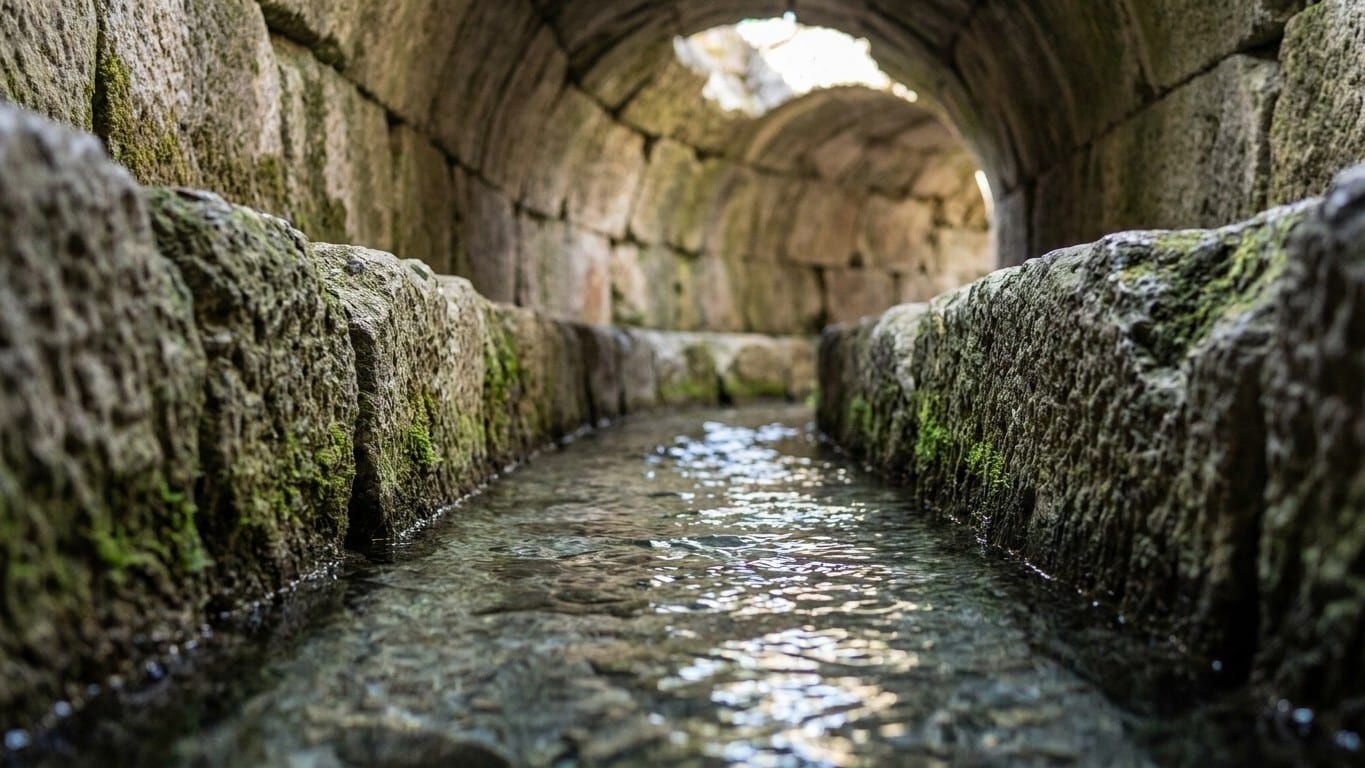
Every day, roughly 3,000 euros rain down into this basin. Thousands of hands turn over, eyes sometimes closed, as they cast a coin over the left shoulder. Behind this everyday tourist gesture lies a reality that almost no one notices: the water receiving these coins travels from a source dug underground more than two millennia ago by a Roman general whose name has faded from memory. Marcus Agrippa. Right-hand man to Augustus, architect of the Pantheon, and an overlooked father of the world’s most photographed fountain.
Key takeaways
- An underground Roman aqueduct has fed one of the world’s most-visited fountains for 2,000 years
- Acqua Vergine has endured barbarian invasions, wars, and the wear of time thanks to clever engineering
- The coins tossed daily fund charitable works in Rome, but the water itself flows from Augustus’s era
A Lead Pipe, Then a Baroque Masterpiece
In 19 BCE, the general Marcus Vipsanius Agrippa had an aqueduct built to bring water to the baths near the Pantheon. It wasn’t yet a fountain in the proper sense. The original “fountain” was merely a lead pipe delivering fresh water into medieval Rome. Plain. Functional. Roman, in short.
The aqueduct was called Aqua Virgo, meaning “Virgin Water,” and today it goes by Acqua Vergine. The name stems from a centuries-old legend that has survived intact: Agrippa had his fountain engineers fetch water from the Salone and Trebium region. During their search, they met a local girl who pointed out the presence of a spring. True or imagined, the tale left such a mark that it can still be seen sculpted in bas-relief on the current fountain.
This aqueduct, about 20.5 kilometers long, ran underground for most of its route (except for 2 kilometers), making it hard to attack by Rome’s enemies or to erode with time. The result? It survived nearly everything. It was one of Rome’s main water sources until the Ostrogoths sacked the city in 537 and destroyed almost all the aqueducts. Although the Goths caused much damage, a little water still came from the Acqua Vergine—a stubborn resilience indeed.
The Baroque fountain we know today is much later. It took until Pope Clement XII to revive the monumental project, and after a competition, sculptor Nicolo Salvi won the commission. Construction lasted 30 years, and the fountain was inaugurated by Pope Clement XIII in 1762. Salvi did not live to see its completion: he died in 1751, eleven years before the inauguration. This colossal project was partly funded by proceeds from the lottery, reintroduced for the occasion. The Church and chance, allied to erect a monument to the glory of water.
The Most Tenacious Aqueduct of Antiquity
Thanks to regular restorations, this aqueduct is the only one still functioning after more than 2,000 years. Not a museum. Not a reconstruction. A genuine ancient water conduit that, as of 2026, still feeds one of the most frequented squares on the planet. With a daily flow of 1,202 liters per second and a maximum gradient of only 30 centimeters per kilometer, it stands as an extraordinary feat of hydraulic engineering. By comparison, the Seine in Paris descends 30 to 50 times faster in its urban stretches.
Today, the Acquedotto Vergine feeds several monumental fountains, including the Barcaccia at Piazza di Spagna, the Fountain of the Four Rivers at Piazza Navona, and the Trevi Fountain. Three UNESCO World Heritage monuments, all fed by the same network conceived under Augustus. Because of infiltration and urban development, the water is no longer potable, but it continues to sculpt the jets and to glitter the coins of tourists.
What many visitors do not know is that they can descend to see this aqueduct with their own eyes. In the early 2000s, portions of the antique aqueduct feeding the Trevi Fountain were uncovered during the construction of a new building. The site has since become an archaeological point of interest that can be visited. Two minutes on foot from the fountain, Vicus Caprarius opens a window onto Rome underneath: ruins of Roman houses, visible channels, water still flows. And, in the basement of a nearby department store, one can see a large section of the Acqua Vergine aqueduct. A short film and a light show sometimes loop, projected directly onto the ruins and recounting the aqueduct’s history. An absurd and magnificent experience: from ancient engineering to the ground floor of a fashion retailer.
Three Thousand Euros a Day, and an Unexpected Destination
The coin-tossing tradition goes back to the 19th century, but cinema made it worldwide. The ritual was popularized by the 1954 film “Three Coins in the Fountain,” and it is believed to guarantee a visitor’s return to the Eternal City. Then Fellini, in 1960, filmed Anita Ekberg in the basin in a evening dress, sealing the matter for good. The rule is strict: back turned to the fountain, with the right hand thrown over the left shoulder, eyes closed. This gesture seals the promise of a return to Rome. Some people add their own interpretations: two coins to find love, three to secure a lasting marriage.
What the wish funds, however, is far from romantic. In 2022, the amount collected reached 1,432,953.74 euros, roughly 33,000 kilograms of coins. In 2023, collections were expected to approach 1,600,000 euros. Since 2001, the city of Rome donates the collected coins each year to Caritas Roma, a Catholic charity, which uses the money to fund soup kitchens, emergency shelter for the homeless, and other social projects. The average annual sum of around 1.5 million euros represents about 10% of Caritas Rome’s budget, supporting initiatives such as Empori della Solidarietà, a network of solidarity markets, and aiding nearly 2,000 families each year.
Acea, the multi-utility company that manages public hygiene in the capital, in collaboration with the local police, retrieves the coins at least three times a week. Among the regular finds in the basin are glasses, keychains, religious medallions, and even dentures, according to a Caritas member. No one tosses teeth over the shoulder while making a wish, but Rome accepts everything.
Since February 1, 2026, access to the basin edge has become paid (2 euros per person), allowing people to get close and take photos calmly. A twist of irony for a monument whose water has traveled freely beneath Rome since Augustus’s time. The aqueduct, for its part, does not accept tips.
Sources: telegrafi.com | rts.ch
