
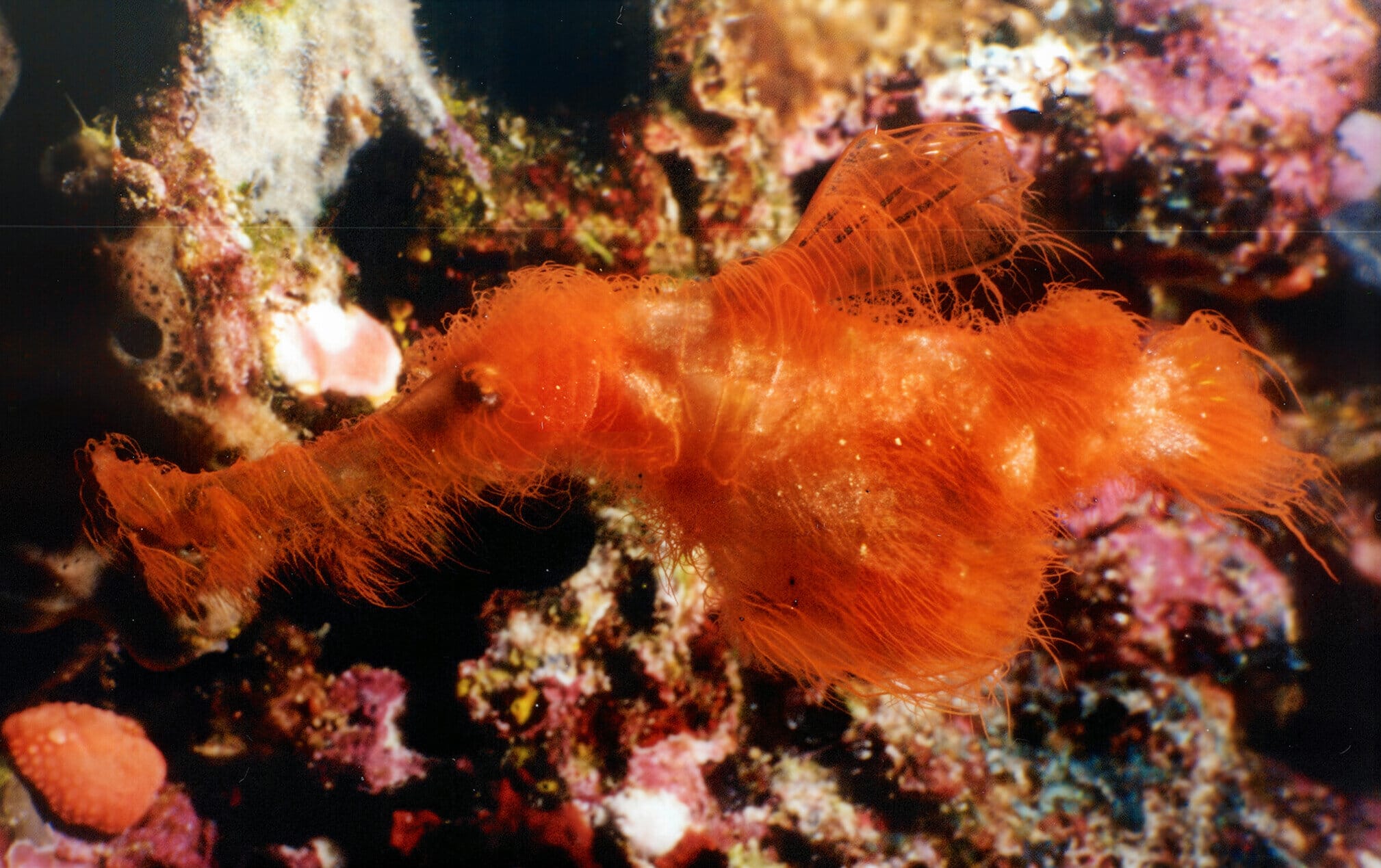
Deep within the depths of the Great Barrier Reef, an improbably looking creature has just emerged from obscurity. Resembling the famous shaggy character from Sesame Street, the ghost fish known as the “Snuffleupagus” (Solenostomus snuffleupagus) long deceived scientists with its camouflage. Although photographed repeatedly by divers, this species was routinely mistaken for its close cousins. A study published in the Journal of Fish Biology has now put the record straight, revealing a unique genetic signature and a skeletal structure hidden beneath its long orange filaments.
What you will learn
-
How citizen science platforms (Facebook, iNaturalist) guided researchers to the discovery.
-
Molecular evidence and the high-resolution 3D micro-CT scanning that distinguish this species.
-
The unique physical features, including star-shaped bone structures.
A Master of Camouflage Unmasked by DNA
Ghost pipefishes are the masters of illusion. Close relatives of seahorses, they develop skin projections that mimic seaweed or coral to vanish from the eyes of predators. It is this mimetic ability that allowed the Solenostomus snuffleupagus to remain “hidden” while being showcased on social networks and citizen-science sites.
Marine biologist David Harasti and his colleague Graham Short suspected a misclassification by noting consistent differences on divers’ photographs. To settle the matter, they analyzed the mitochondrial DNA of the specimens: the verdict was unequivocal with a genetic difference of 22% compared with the rugose ghost fish, its closest relative. Such a margin confirms that this is indeed a distinct lineage.
3D technology in the service of osteology
Beyond its shaggy appearance, the fish’s inner architecture holds its greatest secrets. Researchers employed high-resolution micro-CT scanners to reconstruct the animal’s skeleton in 3D. This analysis revealed details invisible to the naked eye:
-
An excess of vertebrae: Where its relatives have 32 to 34, the new species possesses 36.
-
“Starry” bones: The scan revealed tiny star-shaped bone structures embedded directly in the skin, a remarkable morphological feature.
-
A stout body: Standard biometric measurements confirm this fish is more compact and robust than other members of the genus Solenostomus.
The Ocean: A Boundless Reservoir of Surprises
The discovery of the hairy ghost fish serves as a reminder that even the planet’s most explored realms, like the Great Barrier Reef, still harbor unknown species. The combination of 3D imaging and molecular analyses now allows scientists to redefine marine biodiversity with surgical precision.
This study also underscores the importance of recreational divers and underwater photographers. By sharing their shots on platforms such as iNaturalist, they provide scientists with a real-time global database, essential for spotting morphological anomalies that lead, as in this case, to the description of a new member of the Syngnathiformes family.
👉 A small gesture for Space Group? Follow us on Google, add us to your favorites and find us on Google News so you won’t miss any discoveries.
