
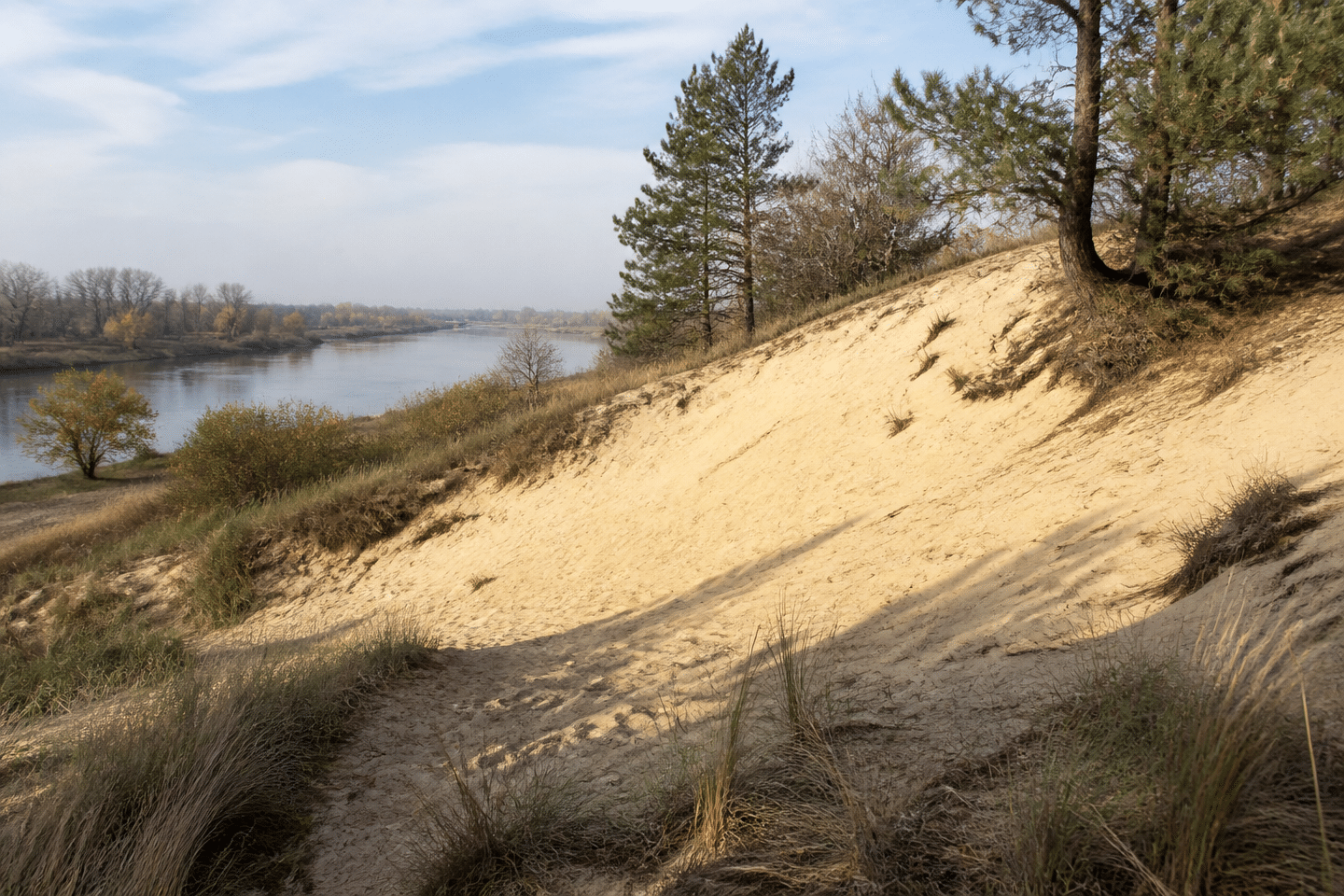
A stone’s throw from the Saône, an unlikely landscape unfolds over several dozen hectares. Sand dunes, lichen, a peat bog, and carnivorous plants share space just a few meters above ground level, far from any coastline. This scenery, evoking more the Scandinavian tundra than the Bresse, hides a geological history as ancient as it is surprising.
- The La Truchère-Ratenelle dunes formed about 5,000 years ago due to wind acting on the Saône’s alluvium, never connected to the sea.
- The site brings together contrasting habitats within a compact area, including a bog that shelters carnivorous plants such as sundews.
- Designated a national nature reserve since 1980, it covers 93 hectares and is the only national nature reserve in Saône-et-Loire.
- A dune born 5,000 years ago, far from any shore
- The mystery of a bog cohabiting with sand
- 93 hectares under protection: what this biodiversity sanctuary hides
A dune born 5,000 years ago, far from any shore
The sand immediately evokes the sea. Yet here, no wave has ever shaped this landscape. The dunes of La Truchère-Ratenelle formed about 5,000 years ago, well after the last glaciation, from the alluvium carried by the Saône valley.
The mechanism is fairly straightforward. The wind picked up the sandy deposits left by the river, then piled them into successive ridges, just as it would on a coastline. The difference is that there is no sea nearby.
This phenomenon, termed a continental dune, remains rare in France. It yields a poor, dry and acidic soil, very far from the agricultural lands that usually surround the Bresse. It is precisely this singularity that warranted stronger protection for the site.
The report broadcast by France 3 Bourgogne-Franche-Comté in July 2025 emphasized this puzzling aspect. Journalists described a landscape of sand and lichens evoking tundra, a striking image for a site located only a few kilometers from the Saône riverbed.
The mystery of a bog cohabiting with sand
Just a few meters from the dunes, a second ecosystem asserts itself, just as unexpected. A wooded bog occupies part of the site, a habitat typically associated with higher altitudes or northern regions.
Its presence at such a low altitude is one of the reserve’s most studied features. It can be explained by a buildup of stagnant water, favored by the sandy soil’s configuration and by the nearby pond that covers 23.2 hectares of the site.
In the lower part of this bog, sphagnum moss forms a characteristic vegetative mat, trapping moisture like a natural sponge. It is in this water-saturated environment that sundews thrive, carnivorous plants capable of trapping small insects with their sticky leaves.
This coexistence of dry sand and peat saturated with water creates a striking contrast over a relatively small area. Few sites in France bring together, at such a short distance, two ecological environments so opposite.
93 hectares under protection: what this biodiversity sanctuary conceals
Established by a decree on December 3, 1980, the La Truchère-Ratenelle National Nature Reserve now covers 93 hectares, distributed as 67.8 hectares in the municipality of La Truchère and 25.2 hectares in Ratenelle. It remains, to date, the only national nature reserve in the Saône-et-Loire department.
The site stretches across the municipalities of La Truchère and Ratenelle, near the confluence of the Saône and the Seille, in the heart of the Bresse. This geographic position partly explains the soil richness and the diversity of habitats observed.
According to the France 3 Bourgogne-Franche-Comté report, the reserve would shelter biodiversity typically associated with shorelines, a rare finding for a territory so far from any coast. Dunes, bog, and pond thus form a set of refuges for species that, elsewhere, would not find the conditions necessary for their survival.
Since 1990, the Conservatoire des Sites Naturels de Bourgogne has managed this space, after being designated by the Saône-et-Loire prefect. A management plan covering 2016 to 2025 guides on-the-ground actions, whether scientific monitoring or the preservation of the most fragile habitats.
This methodical organization clearly illustrates a commitment: to protect a site whose value does not lie in its size, but in the exceptional concentration of rare geological and biological phenomena. La Truchère-Ratenelle reminds us that landscapes worthy of great natural spaces can nest just a few kilometers from a country road, if we take the time to stop and observe.
👉 A small gesture for Space Group? Follow us on Google, add us to your bookmarks, and find us on Google News so you do not miss any discoveries.
