
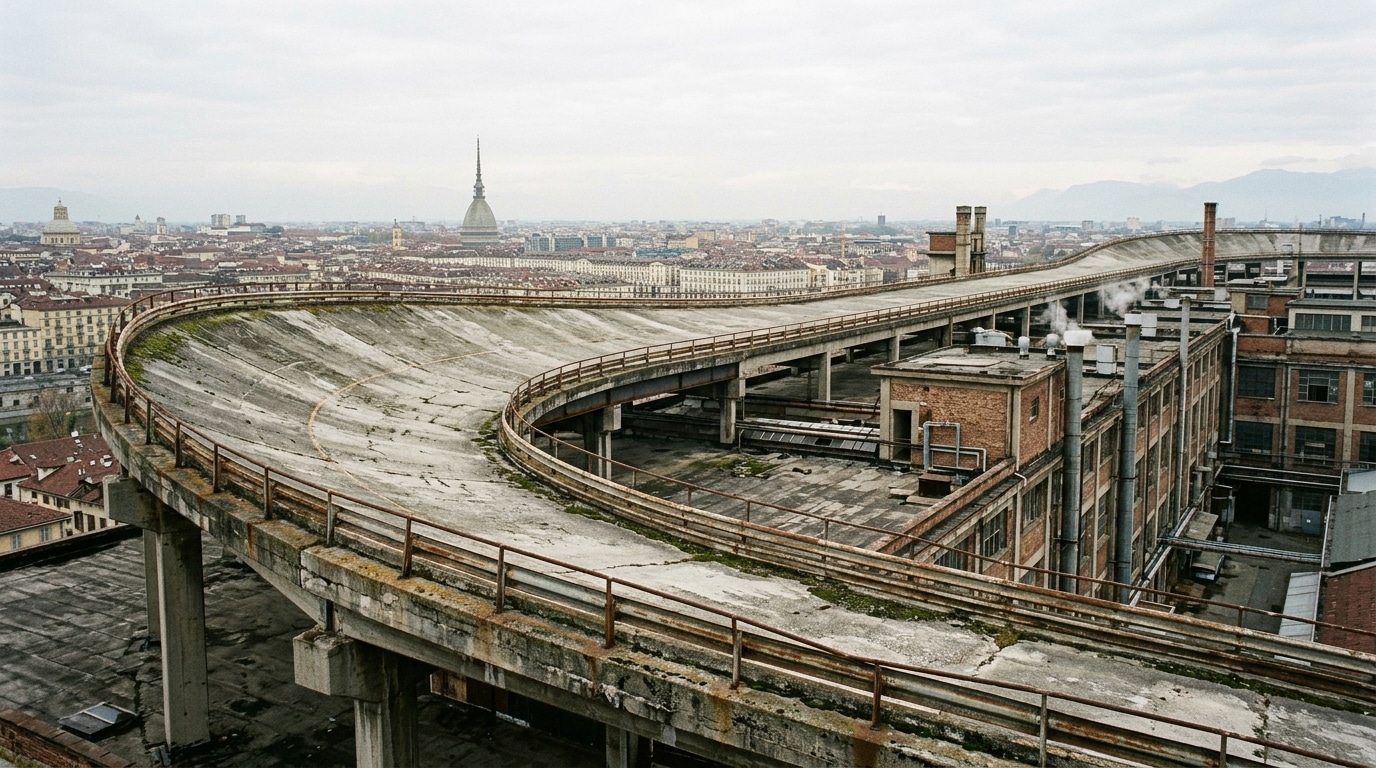
Imagine workers lifting cars five stories high along spiral ramps to a roof converted into a test track. This isn’t a mere anecdote; it’s Fiat’s Lingotto factory in Turin. Since 1923, 1,068 meters of reinforced concrete wind their way up there, intact, even though no car has been assembled on site for decades.
- The Lingotto Fiat factory, built between 1916 and 1923, featured a 1,068-meter test track on its roof, accessible via spiral reinforced ramps that crossed the five floors of the building.
- Automotive production ceased in 1982, but from 1985 architect Renzo Piano repurposed the site into a hotel, theater, concert hall, and exhibition spaces while preserving the track.
- In 2021, the track was transformed into a hanging garden named La Pista 500, with over 40,000 plants spanning more than 7,000 square meters, now open to pedestrians, bicycles, and electric vehicles.
- A five-story suspended circuit: the audacious bet of the 1923 architects
- When cars climbed the spiral ramps before rolling onto the roof
- From the end of production in 1982 to redevelopment: how the track escaped demolition
A five-story suspended circuit: the audacious bet of the 1923 architects
Back then, building a car factory that looked like a tiered cake was almost provocative. Engineer Giacomo Matte-Trucco nonetheless devised this concept for Fiat: bring raw materials in at ground level, then raise the assembly line, floor by floor, to the building’s top. Construction began in 1916 and concluded in 1923, the year when King Victor Emmanuel III officially opened the site, alongside Senator Giovanni Agnelli, founder of the brand.
The result still overwhelms today with its scale. The main body of the factory stretches nearly 500 meters in length, covering a total area of about 354,000 square meters. In other words, enough space to fit several dozen football pitches under one roof. Yet the Lingotto’s true singularity isn’t inside: it lies literally above everything else.
On that flat roof, architects designed a reinforced concrete ring spanning 1,068 meters, enhanced at the ends by two raised paraboloid curves. The idea is as simple as it is radical: to transform the apex of a factory into a genuine test track, far from the noise and dust of the workshops. An architectural move that, a century later, continues to fascinate enthusiasts of industrial heritage.
When cars climbed the spiral ramps before rolling onto the roof
To reach this perched track, one had to ascend spiral reinforced concrete ramps, true corkscrews cutting through the factory’s five levels. Newly assembled vehicles climbed, turn after turn, until the roof, where they underwent their first real driving tests. A journey that almost feels like a rite of passage for every car exiting the Lingotto’s assembly lines.
This track wasn’t merely a dramatic backdrop. It hosted real technical tests, including the Fiat Turbina, a prototype powered by a gas turbine, tested on this circuit in 1954. It’s easy to imagine the scene: an experimental speedster racing across a factory roof, under Turin’s sky, far from the public eye.
The two curved parabola turns allowed vehicles to accelerate without skidding, a bit like a velodrome, but in automobile form. This engineering choice, bold for its era, illustrates Fiat’s ambition to control the entire production chain, from raw sheet metal to final testing, without ever leaving its own building.
From the end of production in 1982 to redevelopment: how the track escaped demolition
Automotive production came to a definitive halt at the Lingotto in 1982, with Fiat relocating its production line to the Mirafiori plant in Turin. A building of that size, rendered obsolete for modern manufacturing, might have ended up under the wrecking ball. Yet that was never the case, and perhaps this is where the Lingotto story becomes the most intriguing.
From 1985 onward, architect Renzo Piano was tasked with rethinking the site entirely. Rather than razing the factory, he chose to give it new life by housing a hotel, a theater, a concert hall, and exhibition spaces. The rooftop track, for its part, is preserved as an architectural testimony, a deliberately safeguarded remnant amid this redevelopment.
In 2021, Fiat, now part of Stellantis, marked another milestone by inaugurating on the same track the hanging garden named La Pista 500. More than 40,000 plants representing 300 species now cover just over 7,000 square meters distributed across 28 islets at a height of 28 meters. Fiat CEO Olivier François summarized the transformation with a memorable line, describing the shift from a once-secret, inaccessible track to a space now open to the public.
Since then, the century-old concrete hosts walkers rather than prototypes, with use strictly limited to electric vehicles, bicycles, and scooters. A rather elegant way to reconcile industrial memory with contemporary concerns, on a circuit that has never truly ceased to fascinate those who gaze up at this roof that is unlike any other.
👉 Un petit geste pour Space Group ? Follow us on Google, add us to your favorites and find us on Google News so you don’t miss any discoveries.
