
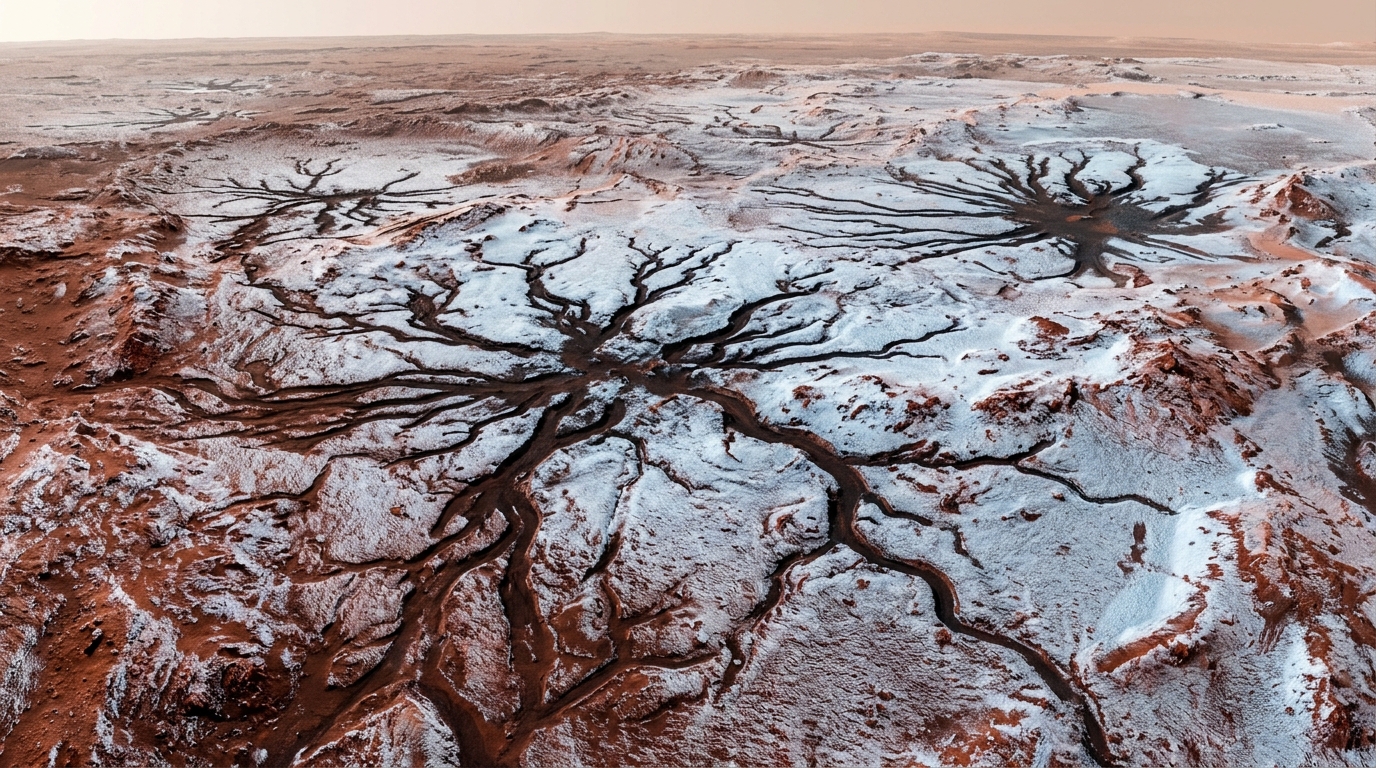
A thousand meters long, sometimes more: this is the scale that some of these dark grooves carving Mars’ southern polar cap can attain. Since the first orbital glimpses of this region, scientists have confronted a major mystery, a pattern that looks so much like a fabric woven by an army of giant spiders. No driving rain, no river, not even a gust of wind powerful enough to account for this troubled landscape. The answer, as astonishing as it is fascinating, lies beneath the surface itself, in a chemical and physical process with no known analogue anywhere else in our solar system.
- Spider-shaped grooves (araneiformes) arise from the sublimation of CO2 ice trapped beneath the surface that fractures the cap in spring, according to the Kieffer mechanism
- The gas released under pressure drags dust and dark sand that settle in radial patterns, carving the grooves through annual repetition of the phenomenon
- This cycle, observed by Mars Express and ExoMars Trace Gas Orbiter, is unique in the solar system because it relies solely on solar energy, with no water or hydrothermal activity
- The Martian spider mystery that has intrigued scientists for years
- How CO2 ice transforms into a geological time bomb
- The Kieffer mechanism: when the sun triggers an underground eruption
- What these icy grooves reveal about Mars’ current and past climate
The Martian Spider Mystery That Has Intrigued Scientists for Years
These formations, which researchers have nicknamed araneiformes in reference to their resemblance to arachnid legs, concentrate in a very specific zone: the high latitudes of Mars’ southern pole. They appear as networks of branched grooves, emanating from a central point and radiating outward like a star over several hundred meters. Seen from orbit, they form a striking, almost organic pattern that has long fueled the most varied speculations about their origin.
For a long time, no conventional explanation could hold. Erosion by wind, though ubiquitous on Mars, does not produce this kind of regular branching. Liquid water is simply ruled out in this region where temperatures never permit it. It was necessary to observe the phenomenon directly at the moment it occurs, thanks to the European probes Mars Express and ExoMars Trace Gas Orbiter, to begin to pierce the secret of these strange patterns that reappear and thicken every Martian spring.
How CO2 Ice Transforms into a Geological Time Bomb
Everything begins during the Martian austral winter, a season of extreme cold in which atmospheric carbon dioxide condenses directly onto the ground to form a translucent ice layer. This seasonal cap, sometimes several tens of centimeters thick, literally covers the terrain like an airtight lid. Beneath this frozen shell, the ground—darker and more absorbent—continues to receive a little solar light that passes through the translucent ice.
With the return of spring, solar radiation grows more intense. The ground, heated from below, starts to cause the sublimation of the CO2 ice right at contact, meaning it passes from a solid to a gas without ever becoming liquid again. The issue is that this newly formed gas remains trapped between the ground and the surface ice still intact. A pressure pocket gradually forms, much like a stew pot with a lid whose steam has nowhere to escape.
The Kieffer Mechanism: When the Sun Triggers an Underground Eruption
This scenario, now widely validated by the scientific community, bears the name of its principal theorist. It describes precisely the critical instant when the pressure of the accumulated gas surpasses the mechanical resistance of the surface ice. The layer then fractures abruptly, releasing a jet of carbon dioxide gas that vents into the atmosphere at high speed, somewhat like a terrestrial geyser, except there is neither water nor internal planetary heat involved here.
This jet carries with it dust and dark sand ripped from the Martian surface. These materials are hurled into the air before settling around the fracture point, etching onto the remaining ice the characteristic dark radial patterns. It is precisely the repetition of this phenomenon, year after year, as fractures open at slightly different locations, that ultimately engraves the ground permanently and hollows out the branched spider-shaped grooves. What astonishes researchers is the speed of the process: some networks form in a few days to a few months, a remarkable pace in geological terms.
What These Icy Grooves Reveal About Mars’ Current and Past Climate
Beyond their spectacular appearance, these Martian spiders constitute a real natural laboratory for understanding the seasonal CO2 cycle on the red planet, a cycle that has no Earth analogue since the famous geysers on Earth are always linked to hydrothermal activity tied to the planet’s internal heat. On Mars, it is solely solar energy, combined with the very particular composition of the atmosphere, that orchestrates this springtime ballet.
It is interesting to note that this same region at the south pole also hosts another geological oddity, the structure nicknamed the Inca City, a network of regular ridges observed by the same European instruments. Two neighboring mysteries, two different explanations, but a single field of study that continues to yield its secrets as the orbiters refine their observations. While autumn is slowly arriving here on Earth, Mars is experiencing its spring in the southern hemisphere, and it is precisely at this moment that these carbon dioxide geysers begin to sculpt the polar landscape once again.
Ultimately, these spider-shaped grooves are neither the product of biological activity nor the result of a hydrothermal mechanism as once imagined. They merely attest to a fragile balance between the extreme cold of Martian winter and the gradual return of the sun, a cycle that repeats faithfully each year without ever producing exactly the same patterns. It is hard not to wonder what other surprises this icy, desolate world still holds in store, as our technological eyes learn to better observe it.
👉 A small gesture for Space Group? Follow us on Google, add us to your favorites, and find us on Google News so you don’t miss any discoveries.
