
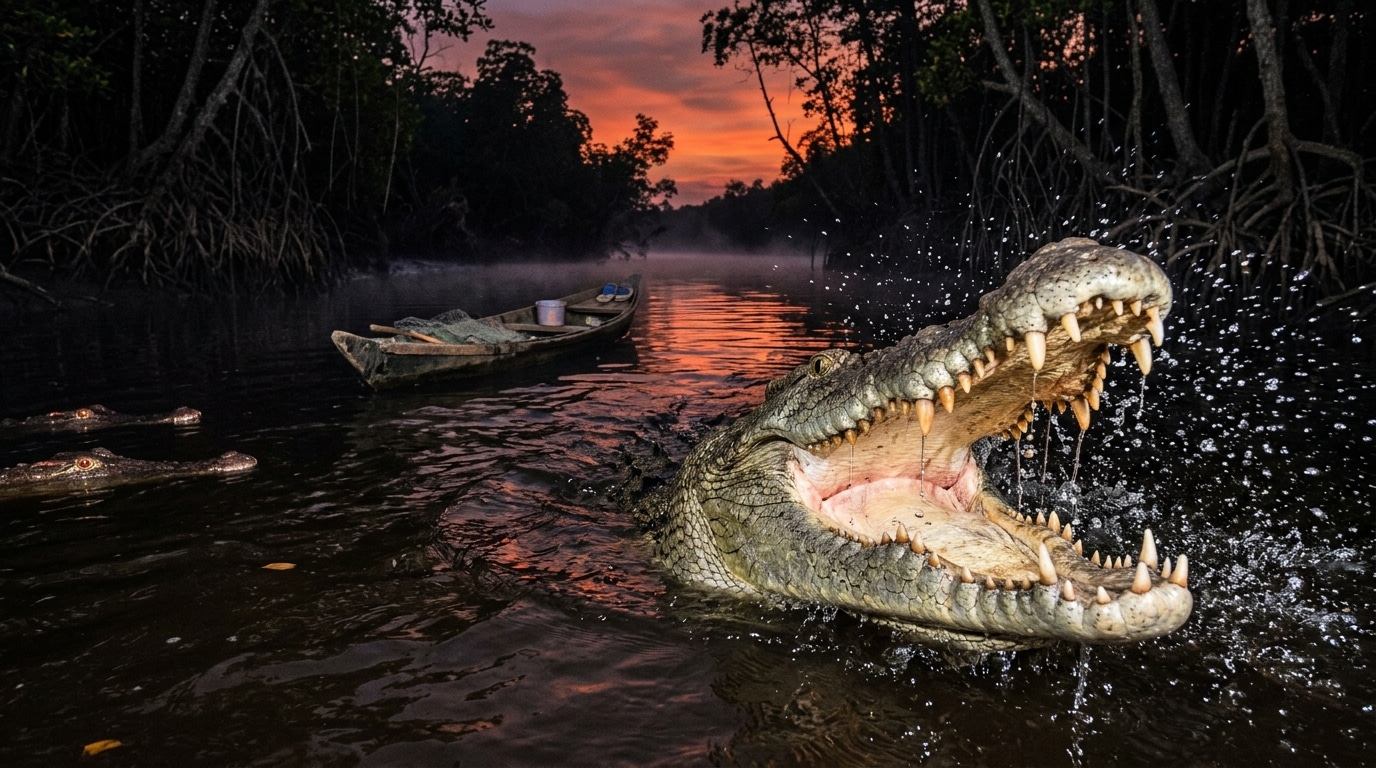
Ninety-six crocodiles in 1977, 1,826 in 2025: the Bhitarkanika mangrove has witnessed its saltwater crocodile population soar over fifty years. A conservation success celebrated worldwide, yet it turns into a tragedy for Kendrapara’s residents, who regularly face deadly attacks in the creeks where they fish.
- The conservation program launched in 1975 at Dangmal, based on egg collection and controlled rearing, was officially halted in 2024 due to habitat saturation.
- The forest services record 24 crocodile-related deaths in six years in Kendrapara district, a toll some residents consider seriously underestimated.
- The state pays compensation of 1 million rupees to the families of victims, such as Hemalata Das, killed while shrimp fishing in the Galia creek.
- 1975-2024: how 96 crocodiles became an army of 1,826 reptiles
- Dangmal, the secret nursery where the most feared crocodiles in India are born
- Kendrapara under strain: when ecological success turns into a village nightmare
1975-2024: how 96 crocodiles became an army of 1,826 reptiles
It all began in 1975 when the Odisha Forest Department launched a conservation program with technical support from FAO and UNDP. The saltwater crocodile, Crocodylus porosus for insiders, was then on the verge of extinction in the region. The assessment by researcher Sudhakar Kar, during the winter census of 1976-1977, was unequivocal: only 96 individuals survived in the sanctuary, of whom barely 35 were adults.
The method used at the time was a bold bet. Rather than waiting for a precarious natural reproduction, teams collected eggs directly from the mangrove, hatched them under controlled conditions, and released the juveniles once they had a real chance of survival. The first release took place in April 1977 in the Dangmal Creek, with 15 young crocodiles already exceeding a meter in length.
Fifty years later, the numbers are dizzying. The 2025 forest department census counted 1,826 saltwater crocodiles at Bhitarkanika, compared with 1,811 the previous year, including 18 particularly rare albino specimens. The most recent count, conducted in early January with 24 teams covering 54 river and creek segments, pushed the total to 1,858 individuals. The population had recovered so well that the breeding and release program was officially halted in 2024, as the habitat had become saturated.
Dangmal, the secret nursery where the most feared crocodiles in India are born
If Bhitarkanika owes its reputation to its giant reptiles, the backstage work happens at Dangmal. This site was chosen from the project’s outset for its strategic position in the heart of the mangrove, under the technical direction of Dr. H. R. Bustard. The very first clutch collected, in July 1975 on Kalibhanjdian Island, consisted of 48 eggs and gave birth to 24 newborns the following month.
The operation of this nursery is nearly clockwork. Forest officers locate nests in the mangrove mud, retrieve the eggs with utmost care, then transfer them to incubators at Dangmal where temperature and humidity are closely monitored. A deviation of a few degrees is enough to unbalance the male-female ratio, a well-known phenomenon among crocodilians.
Population monitoring today relies on tools far more sophisticated than those used in Bustard’s day. The 2025 census took place January 19–21, by day and night, with 22 teams equipped with an app named Timestamp Camera, capable of timestamping each observation to the millisecond and geolocating it via GPS. This precision made it possible to construct a detailed age pyramid: 585 newborns, 403 one-year-olds, 328 older juveniles, 164 subadults, and 346 adults over 2.40 meters.
Kendrapara under strain: when ecological success turns into a village nightmare
Behind the flattering statistical curves hides a much darker reality for the residents of Kendrapara district. Hemalata Das, a 57-year-old woman, was killed by a crocodile while shrimp fishing with other women in the Galia creek near the village of Kharinashi. The attack occurred in the late afternoon within the Mahakalapada forest zone; she died from her injuries at Kendrapara Hospital.
This tragedy is far from isolated. Forest services already recorded eight crocodile-attack deaths around Bhitarkanika in the past eighteen months. In response to this tally, the state announced compensation of 1 million rupees to the victim’s family, an amount equivalent to several years’ income for a rural household in the region.
Official records show 24 crocodile-related deaths in the district over six years. Many residents consider this figure a substantial undercount, with some arguing the real toll exceeds 50 victims. The gap is partly explained by attacks occurring far from forest posts, in remote creeks where bodies are not always recovered or reported to authorities.
This paradox illustrates a familiar challenge in successful conservation programs: what to do when a protected species thrives to the point of directly threatening the communities living beside it? In Bhitarkanika, the mangrove remains a shared territory between fishers and predators, where every boat outing now carries a risk that even the most precise statistics cannot fully erase.
👉 A small gesture for Space Group? Follow us on Google, add us to your favorites, and find us on Google News so you don’t miss any discovery.
