
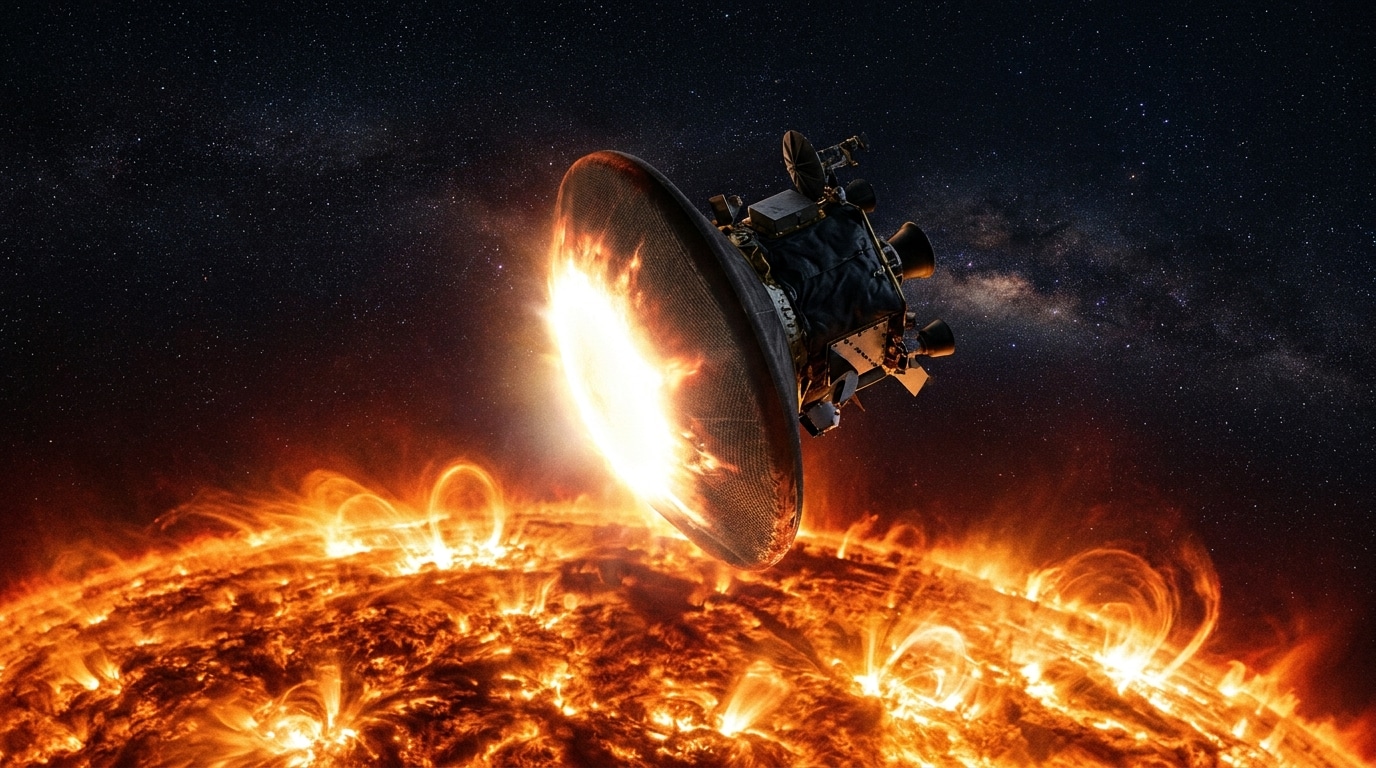
A spacecraft is an unmanned vessel designed to explore environments inaccessible to humans. The Parker Solar Probe stands as the most extreme example: it skimmed the Sun at 6.1 million kilometers, enduring 1,377°C on its frontline shield while its instruments just behind remained nearly at ambient temperature.
- On December 24, 2024, Parker Solar Probe achieved a record perihelion of 6.1 million kilometers at 692,000 km/h, confirmed operational a few days later by a control signal.
- The Thermal Protection System, 11.43 cm thick, consists of a carbon foam core sandwiched between two carbon-carbon sheets, estimated at about 1,377°C on the Sun-facing side due to the lack of a direct sensor, a later June 2025 pass measuring 870–930°C.
- Thanks to autonomous software that keeps the shield facing the Sun, the mission has been extended to 2029, with a 29th close approach matching the same distance and speed records.
- A plunge at 6.1 million km: the maneuver that defies all rules of spaceflight prudence
- 1,377°C on one side, 29°C on the other: the thermal feat of a simple 11.4 cm shield
- Carbon versus carbon: the secrets of an architecture designed to tame the solar hell
A plunge at 6.1 million km: the maneuver that defies all rules of spaceflight prudence
In astronomy, perihelion is the point of an orbit where an object is closest to the Sun. For Parker Solar Probe, this point reached a value never approached by a human-made craft: 6.1 million kilometers, less than nine solar radii from the Sun.
To give a sense of scale, it’s as if Earth suddenly found itself at a microscopic distance from the Sun relative to its usual orbit. The probe was traveling at 692,000 km/h, beating its own previous record of 635,000 km/h, set at 7.26 million kilometers.
Such a maneuver leaves no room for improvisation. Everything is calculated, anticipated, locked in months beforehand, because the slightest orientation error would expose the spacecraft to heat capable of vaporizing it in seconds.
A few days after this pass, NASA teams received a control signal confirming the probe was functioning normally. A sigh of relief, as the radio silence during the critical phase always leaves doubt about the outcome of the operation.
1,377°C on one side, 29°C on the other: the thermal feat of a simple 11.4 cm shield
Here is the figure that encapsulates the entire technical achievement of this mission: an 11.43 cm-thick thermal shield endures temperatures near 1,377°C on the Sun-facing side, while the scientific instruments tucked just behind operate around 29°C, a temperature akin to a hot summer day.
This Thermal Protection System, by its technical name, weighs 73 kg for a diameter of about 2.3 meters. It acts like a giant parasol, permanently oriented toward the Sun to protect everything in its shadow.
However, one must nuance the most spectacular figure. According to John Wirzburger, an engineer at the Applied Physics Laboratory, the probe has no temperature sensor directly at the front of the shield. The figure of around 1,377°C remains an estimate derived from thermal models, not a direct measurement.
Moreover, during the next pass in June 2025, ground teams estimated the shield’s temperature between 870 and 930°C, well below the design limit. This provides reassurance about the safety margins maintained by the engineers.
Carbon versus carbon: the secrets of an architecture designed to tame the solar hell
The secret to this resilience lies in a carefully chosen material sandwich. The shield’s core is a carbon foam made of 97% air, sandwiched between two carbon-carbon sheets, a composite renowned for its ability to withstand extreme thermal differentials without deforming.
This carbon-carbon isn’t a novelty sprung from nowhere. It derives directly from the material that protected the leading edges of the wings of the old American space shuttles, where reentry friction generated tremendous heat. The panels used on Parker Solar Probe were manufactured by the Texas-based company Carbon-Carbon Advanced Technologies.
Yet even the most efficient shield would be useless if not perfectly oriented. An autonomous software system, coupled with hydrazine thrusters, continually adjusts the spacecraft’s attitude to keep the shield squarely facing the Sun, thereby maintaining the instrument zone around 30°C.
This combination of materials and automated control proved so effective that the mission was extended to 2029 following the Heliophysics Senior Review. A 29th close approach also matched the same distance and speed records, proof that the technology withstands proximity over time.
What Parker Solar Probe achieves is less science fiction than meticulously engineered reality, designed in every detail. Between the carbon foam, the shuttle-derived panels, and the perpetual software control, each element of the shield plays a precise role in turning a furnace of over 1,300°C into a simple line of data that researchers can study, comfortably cooled on the other side of the shield.
👉 A small gesture for Space Group? Follow us on Google, add us to your favorites, and find us on Google News so you never miss a discovery.
