
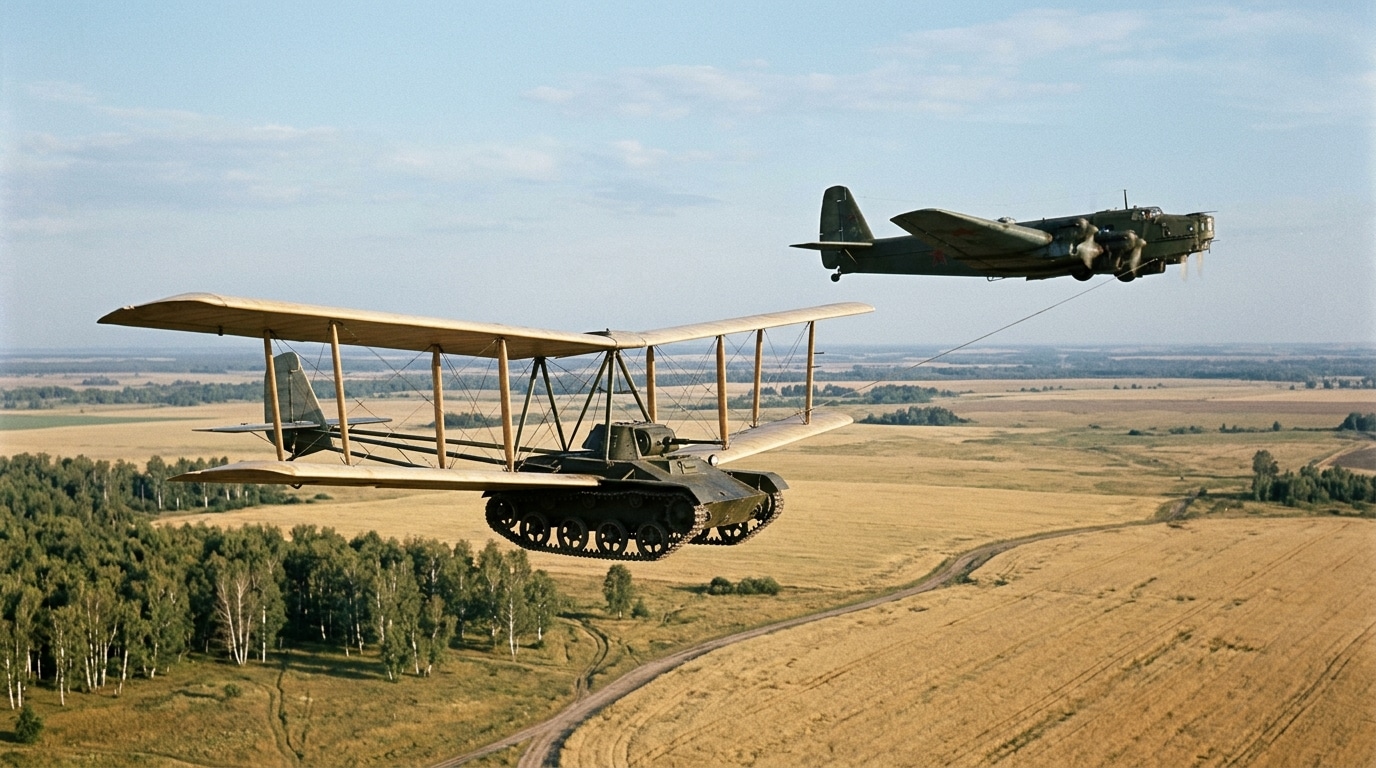
In 1942, the Red Army attempted to transform a combat tank into a glider by grafting onto it two 18-meter wings and a detachable tail assembly. The device, named Antonov A-40, did indeed take off, towed by a bomber. But physics soon asserted itself, and the story took a turn as perilous as it was astonishing.
- In 1942, the engineer Oleg Antonov transformed a light T-60 tank into a glider by attaching an 18-meter wingspan biplane and a two-boom tail assembly, in a project named A-40 or KT (Krylia Tanka, “Wings of the Tank”).
- Piloted by Sergei Anokhin and towed by a TB-3 bomber, the craft did lift off, but excessive drag forced the crew to drop the tank mid-flight, which landed by itself before returning to its base on its tracks.
- Only the Petlyakov Pe-8, mobilized for high-priority missions, could have provided the required towing speed, which led to the cancellation of the program after a single example was built and tested.
- A Soviet tank that dreamed of flying without any engine
- 18 meters of wingspan for 7 tons of steel: the crazy bet of the A-40
- When the only aircraft powerful enough remained grounded for other missions
A Soviet Tank That Dreamed of Flying Without Any Engine
During World War II, the Red Army faced a recurring logistical dilemma: how to rapidly deposit armored vehicles behind enemy lines, as close as possible to airborne troops. Unlike other nations that experimented with loading small tanks into giant gliders, the Soviets opted for a solution that was more artisanal, yet no less spectacular.
Even before the appearance of the A-40, Soviet airborne forces literally strapped small T-27 crawlers to the bellies of heavy bombers. The idea on paper was simple: fly to an enemy airfield or a remote site, then place the vehicle directly on the tarmac, without parachuting or the kind of handling that would expose the vehicle to danger.
It was in this context that an engineer named Oleg Antonov, who would later become a global reference in aviation with his famous design bureau, proposed an even bolder idea. Rather than transporting a tank beneath an aircraft, why not transform the tank itself into a glider? The aircraft would receive its own wings and tail, and would be able to detach from its towing aircraft and descend to the ground as a proper aerial vehicle, capable of joining the airspace on its own power.
The choice fell on the T-60, a light tank already produced in series by the USSR, compact enough to be considered for such a conversion. The project was named the Antonov A-40, sometimes also referred to as KT, for Krylia Tanka, literally “Wings of the Tank.” The ambition was clear: deliver an armored vehicle directly onto the battlefield, without resorting to a risky parachute drop or the vulnerability of an aircraft touchdown.
18 Meters of Wingspan for 7 Tons of Steel: the Crazy Bet of the A-40
On paper, the T-60 hardly seemed an aircraft glider candidate. The base tank weighed 5.8 tons, measured 4.10 meters in length, and was powered by a modest 70-horsepower GAZ-202 six-cylinder engine—hardly the makings of flight. To even hope to take off, engineers had to add a flight structure nearly as imposing as the vehicle itself.
The chosen solution was a large biplane wing with roughly an 18-meter wingspan, yielding a total lifting surface of about 85 square meters, complemented by a twin-boom tail mounted at the rear of the hull. The entire system, tank included, approached 7 tons once the aeronautical structure was added, a weight that was enormous for a wing of this size, even when built from light materials such as wood and canvas.
To minimize mass, the teams stripped away everything nonessential to flight: armament, ammunition, lights, and even most of the fuel, leaving only a minimal amount in the tank’s fuel tank. A completely disarmed combat vehicle, ultra-light, ready to become, for the duration of a test, an improbable glider.
When the day arrived, it was test pilot Sergei Anokhin who took the helm for the A-40’s sole test flight, conducted not far from Moscow according to available sources, with the precise site details varying between documents. Towable by a TB-3 bomber, the winged tank truly left the ground, a spectacle that must have felt surreal to onlookers that day.
When the Only Aircraft Powerful Enough Was Kept Grounded for Other Missions
The flight of the A-40 was a partial success, and therein lies the paradox of this tale. The craft did lift off and stay aloft; Anokhin managed to pilot it. Yet the drag produced by the hull, even in its minimized form, proved so extreme that the TB-3 tow aircraft could not sustain the required speed for long. To prevent the bomber from crashing, the crew had to drop the glider mid-flight.
Left to its own devices, the winged T-60 touched down in a field near the airfield. Once on the ground, the wings and twin-boom tail were dropped, returning the tank to its normal silhouette. What followed was perhaps the most astonishing aspect: the driver simply restarted the GAZ-202 engine and dragged the armored vehicle back to its base on its tracks, as if nothing unusual had occurred.
This improvised landing underscored the project’s fundamental problem: power-to-tow. To pull the A-40 up to the necessary speed of 160 kilometers per hour, only an aircraft powerful enough to do so would suffice, and the Soviet Army had only one serious candidate for that job—the Petlyakov Pe-8. Yet this heavy bomber, one of the few of its class in the Soviet arsenal, was then mobilized for strategic bombing missions deemed far more critical than experimentally towing a flying tank.
With the Pe-8 unavailable, and facing the obvious limitations of the TB-3, the program was deemed impractical. Only one unit was ever built and tested, after which the project status was simply noted as “canceled.”
Today, this episode remains a charming anecdote in Soviet military history, and a telling symbol of the sometimes unrestrained ingenuity of design bureaus during wartime. The A-40 never fulfilled its tactical mission, yet it stands as one of the rare, well-documented examples of a combat tank that actually took to the air, even if only for a single test flight.
👉 A small gesture for Space Group? Follow us on Google, add us to your favorites, and find us on Google News so you won’t miss any discoveries.
