
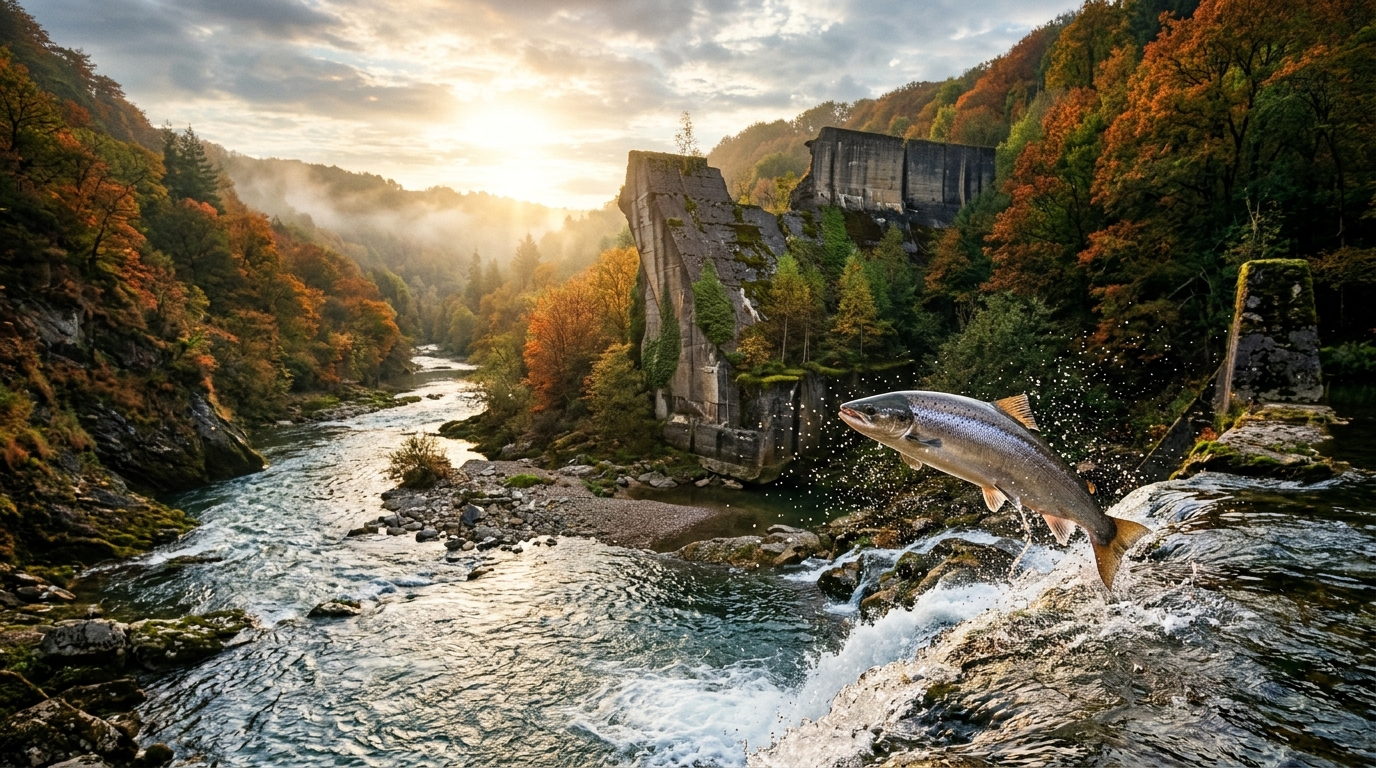
A 36-metre-high concrete wall locked a Norman river for nearly a century. In 2020, the state removed it in just a few months, as part of the largest dam-removal operation ever carried out in Europe. Result: salmon now swim up the Sélune to its sources, for the first time since the 1930s. A story worth dwelling on, illustrating how nature can reclaim its rights when you simply give it the chance.
- The Vezins dam (36 m), built between 1929 and 1932, was dismantled in 2019-2020, followed by the Roche-qui-Boit dam completed in late 2022, in the largest operation of this type ever carried out in Europe
- INRAE officially confirmed the return of Atlantic salmon to the Sélune on 8 November 2023, with young salmon born directly upstream in a free-flowing river
- 90 kilometres of river have been reopened to biodiversity and researchers estimate the Sélune could host up to 5,000 Atlantic salmon
- Vezins, the dam that split the Sélune in two for 90 years
- The largest dam demolition ever carried out in Europe
- The salmon returns to a river it had never known
- The Sélune, a living laboratory for a river brought back to life
It is hard to imagine today that a peaceful watercourse on the English Channel could have for decades been one of the most striking symbols of the fragmentation of French rivers. Yet that is what the Sélune—the coastal river winding between Mont-Saint-Michel and the Norman bocages—experienced before the State decided on a titanic project whose effects are still felt today.
Vezins, the dam that split the Sélune in two for 90 years
Constructed between 1929 and 1932, the Vezins dam was not merely a hydraulic structure. With its 36-metre height, it required the use of 2,000 tonnes of iron, 10,000 tonnes of cement and more than 25,000 cubic metres of stones—a colossal project for its era. Located 17 kilometres from the sea, it, along with a second structure, Roche-qui-Boit, situated 12 kilometres from the mouth, formed a double lock almost impenetrable for migratory fish.
For nearly nine decades, these two concrete barriers thus blocked all upstream movement of Atlantic salmon to their historical spawning grounds, gravelly zones upstream where the fish naturally come to reproduce. The Sélune, once renowned for its salmon populations, gradually became a river cut off from its upper reaches and from the biodiversity that should have traversed it.
The largest dam demolition ever carried out in Europe
It was in 2019 that the dismantling work on the Vezins dam began in earnest, lasting into the following year. Roche-qui-Boit would follow the same path, with destruction completed by the end of 2022. An extraordinary project, regarded as the most significant dam dismantling ever conducted in Europe, and not trivial given the scale of the technical challenges encountered.
The main obstacle was not so much the demolition itself as the management of the 2 million cubic metres of sediment accumulated in Vezins’ reservoir over decades, not counting the additional amounts mobilisable in the riverbed and its tributaries. A precision job, carried out with the financial support of the Seine-Normandy Water Agency, which mobilised no less than 56 million euros in aid for this project. From 2021, the Ministry of Ecological Transition announced that 90 kilometres of river would be fully reopened to biodiversity, a promise that would soon be borne out in the field.
The salmon returns to a river it had never known
On 8 November 2023, INRAE officially recorded the return of the Atlantic salmon to the Sélune, an event all the more symbolic as it follows more than a century of absence in this stretch of river. But perhaps the most remarkable is this: in the autumn following the completion of the works, juvenile salmon born upstream of the old dams demonstrated that reproduction had already resumed, without waiting. These fish had therefore never known the obstacle that blocked their ancestors; they were born directly in a free river.
The salmon is not the only beneficiary of this reopening. The European eel and the marine lamprey, two species equally dependent on the long migrations between sea and river, also benefit from the re-opened watercourse, with migratory cycles gradually reestablishing. A hopeful sign for the entire aquatic ecosystem of the region.
The Sélune, a living laboratory for a river brought back to life
Beyond the naturalist anecdote, the Sélune has become a genuine pilot site for understanding how a river regenerates once freed from its barriers. The Sélune Programme, which scientifically tracks changes in biodiversity and water quality in this area, enables real-time observation of the ecological recovery mechanisms at work.
Projections are still ambitious: according to estimates by researchers from the former INRA and the former ONEMA, the Sélune could one day host up to 5,000 Atlantic salmon, a population that would carry valuable genetic potential for the entire French Atlantic coast. In this autumn season, a period favorable to adult fish ascending to their spawning grounds, this figure takes on its full meaning: every fish now crossing the former dam sites contributes to rebuilding a population once threatened with local extinction.
What the story of the Sélune ultimately shows is that a strong political decision, however costly and complex to implement, can reverse ecological dynamics thought to be locked in place in a few years. It remains to be seen whether other French rivers, still blocked by similar structures, will one day experience the same fate. The question deserves to be asked, given the results obtained here seem to speak for themselves.
