
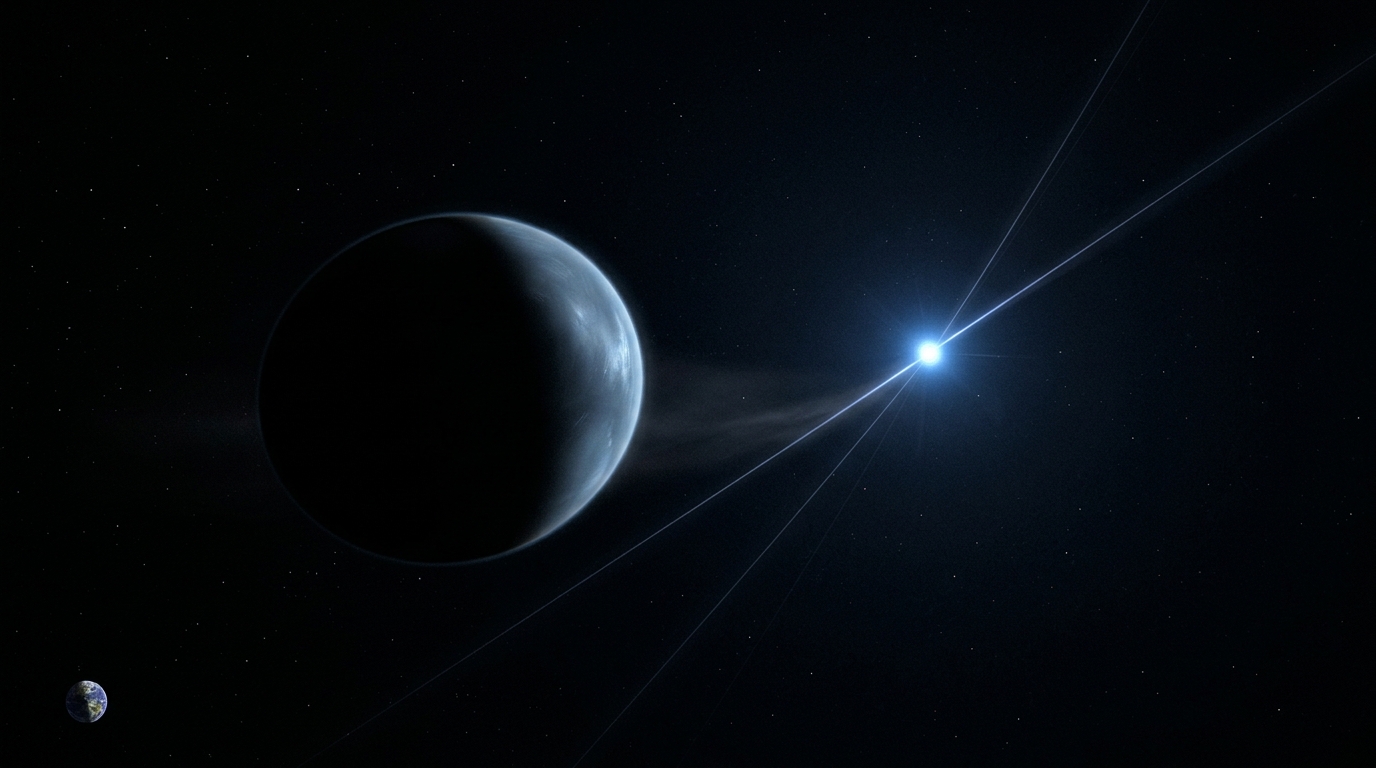
Two hours and ten minutes. It is the time it takes for this Jupiter-mass planet to complete an entire year around its star, skimming a stellar corpse that spins on itself more than ten thousand times per minute. And what if its extreme density actually hides a crystalline carbon core, in other words a planet-sized diamond?
- Discovered in 2009 by the Parkes radio telescope, PSR J1719-1438 b orbits in 2 hours 10 minutes around a millisecond pulsar at a distance of only 600,000 km
- With a density of 23 g/cm³, nearly twenty times that of Jupiter, this planet cannot be explained by any conventional planetary-formation scenario
- It would actually be the leftover core of a white dwarf, stripped of about 99% of its mass by the pulsar, with carbon that could have crystallized into a diamond
- An Impossible Orbit Around a Stellar Remnant
- The Mystery of a Planet Born from the Ashes of a Star
- A Carbon Core That Could Shine Like a Diamond
- What PSR J1719-1438 b Reveals About the Death of Stars
During this season when autumn skies darken earlier and invite us to lift our eyes toward the stars, there exist celestial objects that defy almost everything we think we know about planet formation. Somewhere in the Serpens constellation, about 4,000 light-years from Earth, a system as unobtrusive as it is extraordinary continues to intrigue astronomers more than a decade after its discovery. Its name, PSR J1719-1438, may not mean much to the general public, but its story deserves attention: that of a planet that never should have existed, born from the charred remnants of a star consumed by its stellar companion.
An Impossible Orbit Around a Stellar Remnant
Everything begins in 2009, when the Parkes radio telescope of CSIRO in Australia captures the signals of a millisecond pulsar hitherto unknown. A pulsar, for reference, is the ultra-compact remnant of a massive star that collapsed on itself after exhausting its nuclear fuel. It measures only about 20 kilometers in diameter, barely the size of a large town, yet concentrates a mass equivalent to 1.4 times that of our Sun. It spins on itself at a dizzying rate, performing more than ten thousand rotations per minute.
It is by meticulously analyzing the radio pulses emitted by this star that the team led by Professor Matthew Bailes, from Swinburne University, notices an anomaly. The arrival times of the signals are not perfectly regular: they are slightly modulated, as if an invisible force disturbed the pulsar’s rhythm. The most plausible explanation? A companion object, orbiting so closely that its gravitational pull directly influences the pulsar’s behavior. Calculations then reveal a complete orbit in only two hours and ten minutes, at a distance of barely 600,000 kilometers, slightly less than the radius of our own Sun. The discovery is published in the journal Science in August 2011 and immediately stirs the scientific community.
The Mystery of a Planet Born from the Ashes of a Star
On paper, this planet, named PSR J1719-1438 b, looks almost like a Jupiter cousin: its mass is estimated at about 1.2 times that of the gas giant in our solar system. But that is precisely where the mystery begins. Astronomers calculate its minimum density from its mass and volume, and the result is staggering: 23 grams per cubic centimeter, versus barely 2 grams per cubic centimeter for Jupiter. In other words, this planet is almost twenty times denser than the planet that shares its name in terms of mass.
Such density makes the hypothesis of a classical gas giant absolutely impossible. None of the usual planetary-formation scenarios, whether by accretion of gas around a young star or by the collapse of a protoplanetary disk, can produce an object so compact with such a mass. We therefore had to look elsewhere, toward an origin far more violent and older than that of ordinary planets.
A Carbon Core That Could Shine Like a Diamond
Complementary optical observations, made with the ten-meter Keck telescope in Hawaii, finally provide a coherent answer to this riddle. The pulsar’s companion would not be a planet in the classical sense, but rather the remnants of a white dwarf, i.e., the ultra-dense core of a star that had reached the end of its life. The scenario favored by astronomers is as spectacular as it is coherent: that star would once have formed a pair with the pulsar, until the latter, by gradually accreting material from its neighbor, stripped away its outer layers.
The result of this ruthless stellar stripping: the companion star would have lost about 99% of its initial mass, leaving behind a ultra-dense core composed essentially of carbon and oxygen. Under such extreme pressure and relatively low temperature for an object of this nature, the carbon could crystallize, adopting an atomic-scale structure akin to that of a diamond. It is this fascinating hypothesis that earned the object its media nickname of the diamond planet, a term that immediately captured the imagination of the general public as well as scientists.
What PSR J1719-1438 b Reveals About the Death of Stars
Beyond its catchy nickname, this discovery offers a rare window into the mechanisms of destruction and stellar recycling that shape our galaxy. At the time of its discovery, PSR J1719-1438 b held the record for the densest planet ever identified, a title that speaks to the brutality of the process that formed it. It wonderfully illustrates how a binary star system can evolve in a radically different way from a classic planetary system, with a pulsar acting as a true cosmic predator toward its former companion.
Moreover, this case has not remained isolated. A second system of the same type has since been spotted in the HTRU survey, displaying features surprisingly similar to PSR J1719-1438. This recurrence suggests that this phenomenon, far from being a mere statistical curiosity, could constitute a legitimate, if marginal, pathway of planetary formation in the most extreme corners of our galaxy.
From this discovery emerges a lesson in humility for anyone who thinks they know the limits of the universe: where one sought a simple exoplanet, astronomers unearthed the crystallized corpse of a star, transformed into an object as dense as it is enigmatic. One remains to wonder how many other diamond planets lie hidden in the depths of the sky, patiently waiting for a telescope to finally capture the irregular heartbeat of their pulsar host.
