
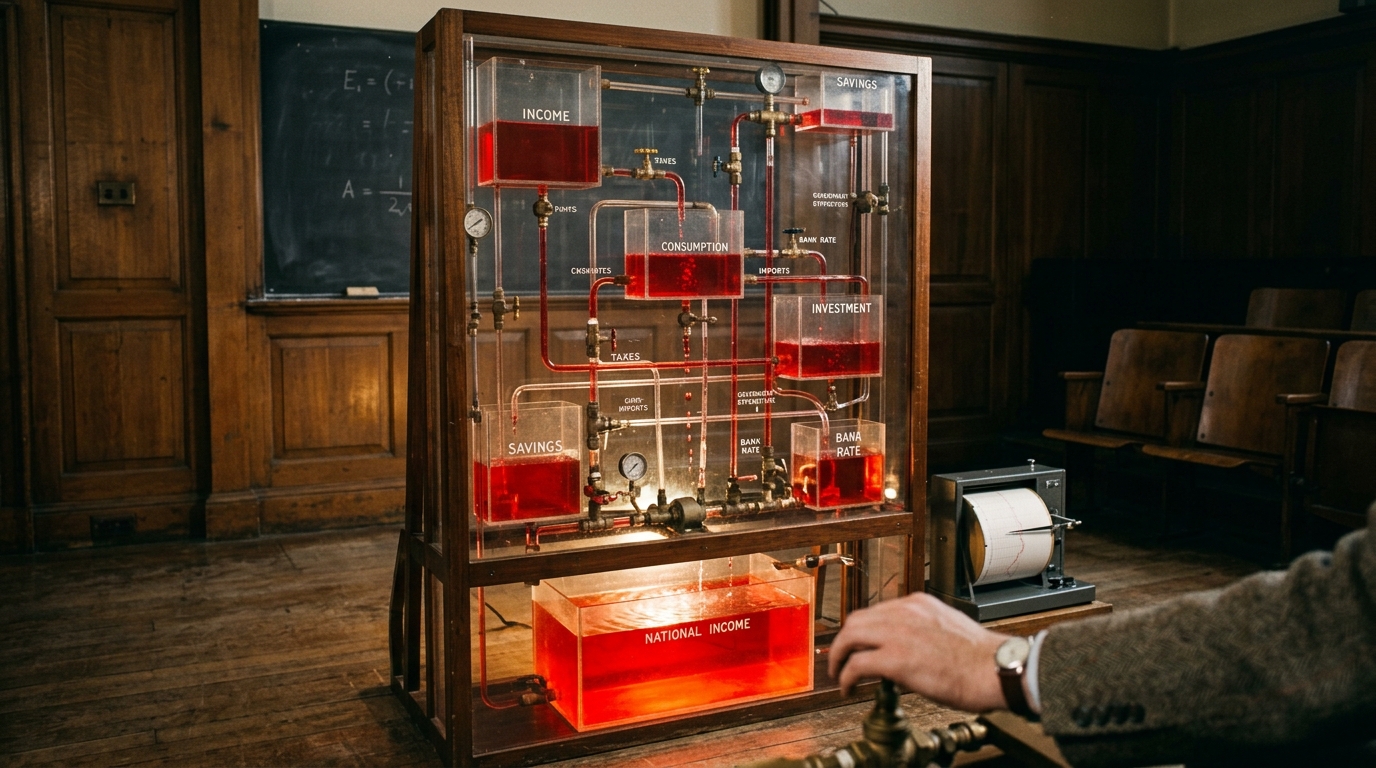
In 1949, in a modest garage on the outskirts of London, a New Zealand economist tinkered with a wooden frame and transparent tubes. Inside, colored water flowed, spilled, and pooled. It wasn’t a sculpture or a toy, but the improbable ancestor of modern economic models, capable of live-simulating the financial health of an entire country.
- In 1949, the economist Bill Phillips built in a Croydon garage the MONIAC, a hydraulic machine using colored water to model a nation’s economic flows, solving nine simultaneous differential equations through a system of reservoirs and valves.
- Fourteen units were produced and distributed to prestigious institutions such as Harvard Business School, Istanbul University, or Ford Motor Company, with an error margin of about 2%.
- Gradually surpassed by digital calculators, MONIAC remains visible today at Cambridge and at the Reserve Bank Museum of New Zealand, and inspired a digital version by the Financial Times for its 75th anniversary.
- A Croydon Garage, a Plastic-Tube Economic Revolution
- How Colored Water Simulates the Monetary Flows of a Nation
- Fourteen Units Scattered Across the Four Corners of the Academic World
- When Digital Computers Had the Last Word Over Economic Plumbing
A Croydon Garage, a Plastic-Tube Economic Revolution
The story begins almost as a tidbit. Bill Phillips, a young New Zealand economist trained at the London School of Economics, had neither a grand laboratory nor a sizable budget. It is in his landlady’s garage in Croydon that he assembles his machine with improvised means. The total cost of the operation hovered around 400 pounds at the time, about 12,000 pounds in today’s money, a modest sum for what would become one of the most original inventions in the history of economics.
A tasty detail: at the very first demonstration, Phillips activated a pump salvaged from a Lancaster bomber, the same aircraft that had roamed the European skies a few years earlier during the war. A nearly poetic symbol of conversion, where the relics of the global conflict become tools for economic understanding. The machine then received its official, somewhat technical name, the MONIAC, acronym for Monetary National Income Analogue Computer, but also a more evocative nickname: the Financephalograph.
How Colored Water Simulates the Monetary Flows of a Nation
The principle behind the MONIAC rests on a simple yet brilliant analogy. The colored water circulating through the tubes literally represents money in motion within an economy. Separate reservoirs stand for the major economic aggregates: national income, households’ savings, tax receipts, and corporate investments. Valves, carefully arranged, play the roles of interest rates, taxes, or public spending.
By opening or closing these valves, a user could observe in real time how a monetary policy decision reverberated through the entire system. The water rose or fell in the transparent columns, tracing curves directly legible thanks to floats linked to pens that inscribed the variations on graph paper. What few people realized at the time was that this ingenious plumbing actually solved nine simultaneous differential equations, in just a few minutes, a mathematical feat utterly impossible to achieve by hand with the calculating tools available in the immediate postwar era. The MONIAC thus displayed, almost before the astonished spectators’ eyes, the cross-effects on GDP, interest rates, and the level of British imports and exports.
Fourteen Units Scattered Across the Four Corners of the Academic World
The Croydon prototype’s success did not stay secret for long. Convinced of the pedagogical potential of his invention, Phillips produced up to fourteen units, each assembled and calibrated with the same artisanal care as the first. These hydraulic machines found buyers in particularly prestigious institutions: Harvard Business School in the United States, Istanbul University in Turkey, or Ford Motor Company, which saw in this tool a tangible way to teach macroeconomic mechanisms to its executives.
Each MONIAC thus became a kind of life-size showroom of Keynesian theory, allowing students to physically manipulate abstract concepts rather than discovering them only on a blackboard. To this day, traces of this hydraulic saga still exist: a working unit permanently sits in the Department of Economics at the University of Cambridge, while the museum of the Reserve Bank of New Zealand keeps its own machine, still capable of circulating colored water through its network of pipes.
When Digital Computers Ended the Era of Economic Plumbing
Despite its ingenuity, the MONIAC carried within it the seeds of its own obsolescence. Its precision, remarkable for the era with an error margin of about 2%, was not enough to sustain a lasting rivalry with the rapid rise of digital calculators in the ensuing decades. These new tools, far more flexible, allowed modeling of economic systems of growing complexity, without fear of any water leaks or valve jams.
Nevertheless, it would take several more years before nascent computing could truly match, then surpass, the sophistication of Phillips’ hydraulic model. The MONIAC gradually slipped into obscurity, relegated to the realm of a historical curiosity rather than a working instrument. Yet such a fate has not extinguished the fascination it continues to exert: seventy-five years after its unveiling, the Financial Times even chose to honor it by reimagining the Phillips Machine in a fully digital form, through an immersive mixed-reality experience, a nod across two eras of economic calculation.
From this Croydon garage to Cambridge, via Harvard and Istanbul, the MONIAC embodied for several decades a surprisingly concrete way of thinking about the abstraction of economics. In an age when our financial models rest on invisible algorithms and distant servers, there is something almost comforting in remembering that a simple game of pipes and colored water once sufficed to illuminate, at a glance, the intricate workings of a nation’s economy. The question remains whether, one day, another home-made and brilliantly ingenious invention will once again disrupt our technological certainties.
