
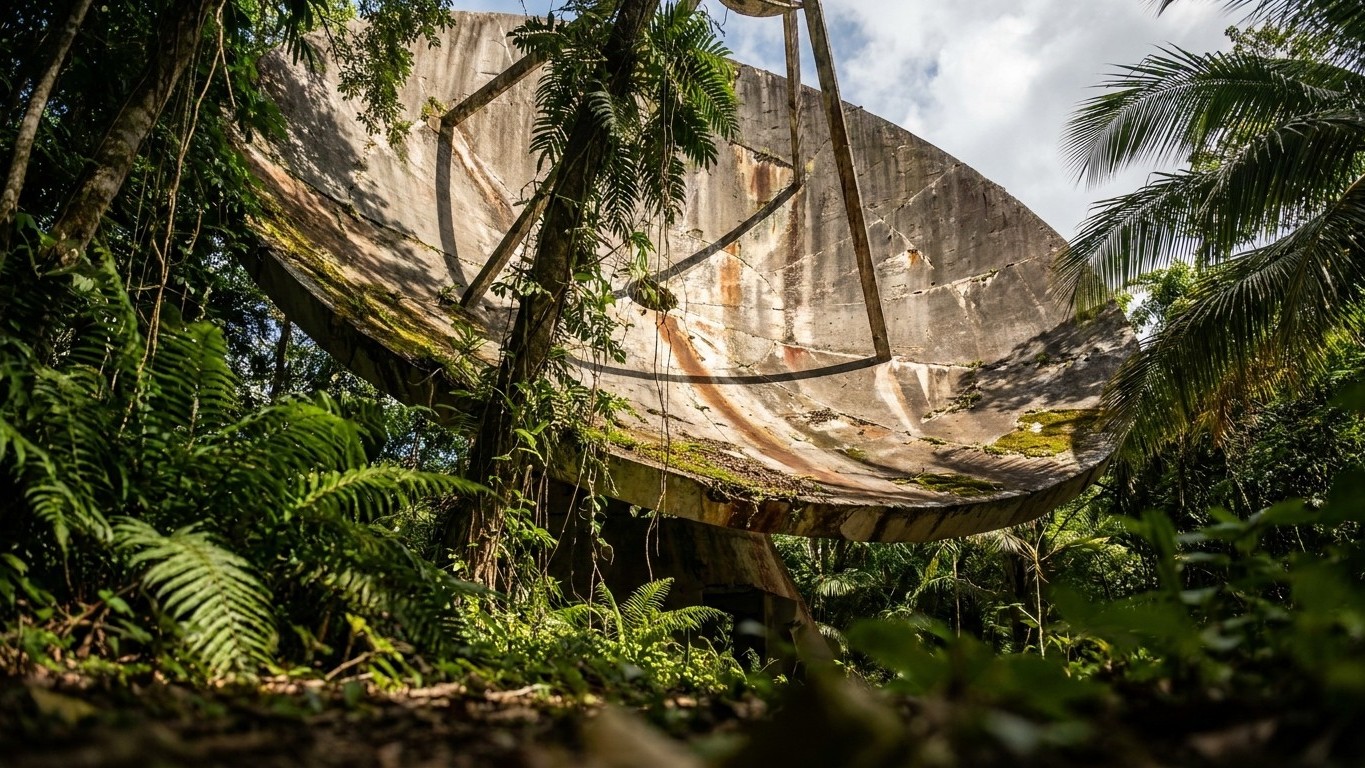
On December 1, 2020, at dawn, a 900-ton platform suspended 137 meters above a 305-meter-diameter parabolic dish plummeted into the void. In a matter of seconds, fifty-seven years of radioastronomical observations in Puerto Rico collapsed. Five years later, the National Science Foundation (NSF), owner of the site, ruled: the Arecibo radio telescope will never be rebuilt.
The story deserves to be told in detail, for it speaks volumes about the fragility of the most spectacular scientific infrastructures. A summer 2020 marked by the rupture of a supplementary cable, followed by the failure of a main supporting cable, both linking the 900-ton receiving platform to one of the three support towers, had put engineers on alert. They had determined that repairs could not be undertaken without risking further damage or, above all, compromising worker safety. The NSF had then announced its intention to dismantle the structure in a controlled manner. But gravity moved faster than human plans: at around eight o’clock in the morning of December 1, the receiving platform dropped nearly 152 meters into the 305-meter parabola below, destroying both structures in a deafening crash.
Key takeaways
- An iconic instrument that had withstood earthquakes and storms collapses in an instant
- The NSF categorically refuses to rebuild, even with NASA’s record budget rising by 18.7%
- A deafening silence settles over our surveillance capabilities for potentially dangerous asteroids
An instrument born from the Cold War, worn out by hardware fatigue
Inaugurated in 1963, the instrument had originally been conceived to probe the Earth’s ionosphere. Its construction had been launched by Professor William E. Gordon of Cornell University, who initially intended to use it to study the Earth’s ionosphere. The choice of site was no accident: Puerto Rico was at a reasonable distance from the United States, posed no political problems, possessed numerous karstic structures, and lay near the equator, allowing observations of all stars for half the time. The telescope ended up playing a far broader role than anticipated: asteroid tracking, the discovery of the first exoplanets, atmospheric exploration, and, in the public imagination, the setting for the films GoldenEye and Contact with Jodie Foster.
Technically, the structure never fully recovered from the cumulative tremors of decades. Despite surviving storms and earthquakes, the instrument endured wear to such an extent that two of its twelve supporting cables eventually snapped within a few months, damaging the dish itself. The earthquakes at the start of 2020, followed by this cascade of cable breaks, brought down an architecture that had held for nearly six decades.
Why the NSF permanently refused to rebuild
The suspense lasted nearly two years. Many hoped that a successor, more modern, would rise on the same site. In October 2022, the NSF cut short this hope: after the telescope’s collapse, many scientists hoped the NSF would eventually build a new one, but the agency announced that it would instead establish an educational center dedicated to science, technology, engineering, and mathematics on the site. The decision was unequivocally confirmed: the NSF, owner of the site, determined that despite scientists’ requests, the Arecibo Observatory would not receive any new telescope to replace the lost one.
The choice surprised even in its breadth, because it concerns not only the vanished large dish. The NSF’s funding plan also does not provide “operational support for the current scientific infrastructure” at Arecibo, such as its 12-meter radio telescope or its lidar installation. Even the instruments that survived the catastrophe find themselves without sustainable funding. The astronomical community did not hide its disappointment: many astronomers expressed disappointment, but not surprise, at the announcement, explaining that they knew the NSF would have to make a hard decision, while hoping for something somewhat better.
The budgetary argument fueled the controversy. Some argued that backing away could not be explained by a lack of resources at the agency’s scale: President Biden had proposed an 18.7% increase in the NSF’s budget, up to $10.5 billion, for fiscal year 2023. Rebuilding would, however, have represented a substantial sum: according to estimates issued after the collapse, the cost of a new Arecibo was put at around $400 million, a figure deemed disproportionate to the agency’s priorities.
What remains on the site today
The site has not become an abandoned wilderness overrun by jungle, even though aerial images of the gaping dome have circulated worldwide. The site, listed on the National Register of Historic Places, retains an education center, a visitor center, an auditorium, an exhibition space, dormitories, and offices. In 2023, four institutions were designated to lead the transition, with a project named Arecibo C3, focused on life sciences and computing.
However, funding for this reconversion remains precarious. The NSF had requested $6 million for site maintenance and transition costs for fiscal year 2024, distributed between its Astronomy and Geosciences divisions, but the 2025 budget showed no funds allocated at all, suggesting that this transitional funding was intended as temporary. Part of the scientific community continues to advocate for a next-generation instrument, in the form of a network of small antennas rather than a single dish, but no funding has been approved to date.
The void left by the vanished radio telescope is not merely symbolic. The ten-year planetary science and astrobiology report, a reference for guiding American scientific priorities, underscored a concrete consequence rarely mentioned in nostalgic tributes: the loss of the observatory’s planetary radar greatly hampers the ability to conduct follow-up characterizations of near-Earth objects. In other words, a portion of our vigilance against potentially dangerous asteroids faded away on the same morning as the concrete giant.
Sources: 24matins.fr | skyandtelescope.org
