
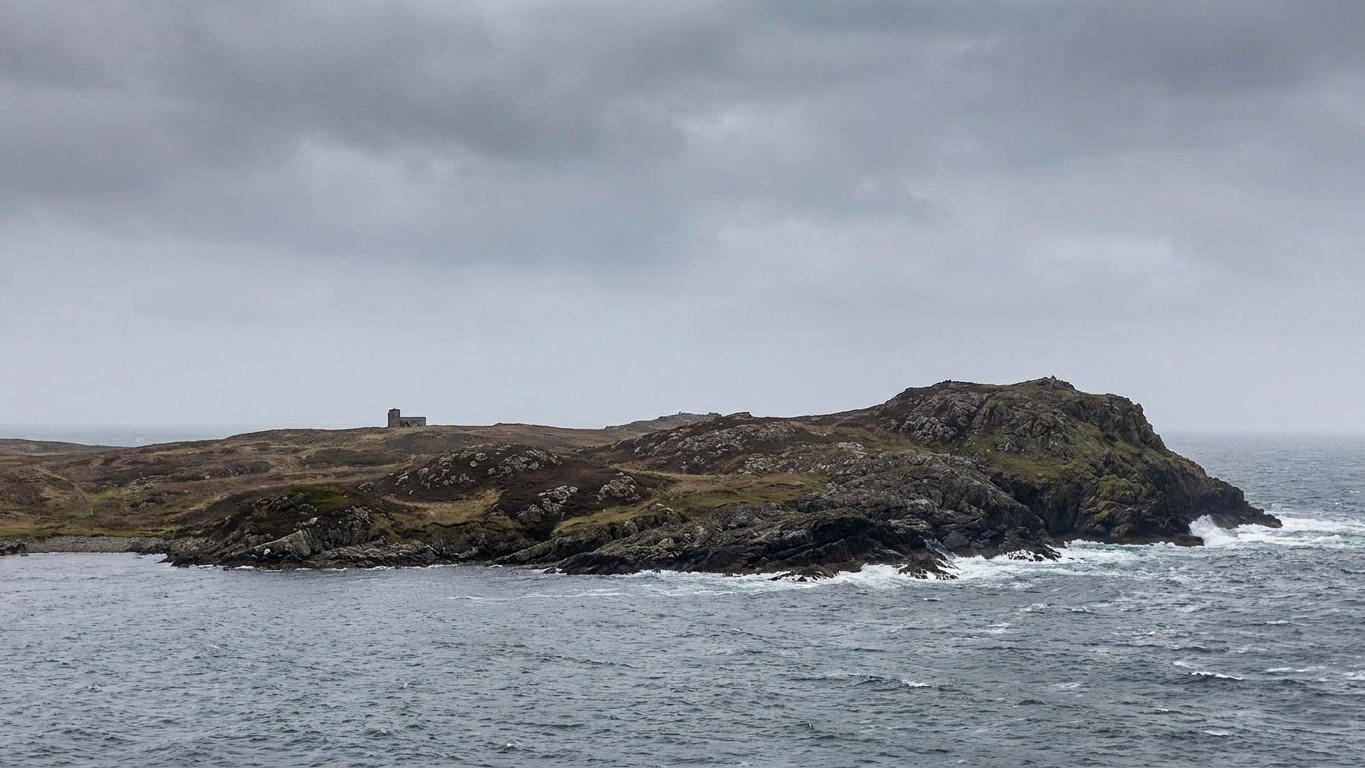
An Scottish island, purchased for £500 in 1942 and off-limits to any human presence for 48 years, rehabilitated thanks to 280 tons of formaldehyde diluted in seawater. Here is the story of Gruinard, the small island that served as an open-air laboratory for one of the UK’s most terrifying weapons ever developed.
Key takeaways
- A British island served as a secret testing ground for biological weapons during World War II
- Forty-eight years of total isolation: why did the government wait so long before acting?
- A dramatic breakthrough in 1981 forced authorities to confront their best-kept secret
An isolated island transformed into a bacteriological firing range
In the spring of 1942, as the war raged across Europe and London feared a chemical or biological strike from Hitler, the British government sought a discreet testing ground to develop its own deterrent. In 1942, with World War II at its midpoint and battles raging across Europe and beyond, senior British leaders requisitioned the island, fearing that Hitler and the Nazi regime might deploy biological weapons against the Allies. Its geographic isolation and island status made it an ideal site: the government had noted Gruinard’s remoteness, completely surrounded by water, making it perfect for containing any contamination.
The project went by the codename Operation Vegetarian, a cynically apt label for a program so macabre. The rocky, isolated Gruinard Island, off the west coast of Scotland, had been off-limits since 1942, when the British government carried out secret experiments on anthrax on the island, aiming to turn the deadly bacterium into a weapon against Nazi Germany. The deal with the owners was simple: the government took possession of the island, promising to buy it back for the sum of £500 once the trials were completed.
The tests themselves were nothing short of a zoological nightmare. Eighty sheep were brought to the island, and bombs filled with anthrax spores were exploded near tethered livestock, causing infection and death within days. The strain chosen was anything but ordinary: a highly virulent type called “Vollum 14578,” supplied by a bacteriology professor at the University of Oxford. Some scenes were even filmed at the time, only to be declassified much later, in 1997.
A toxic legacy that nobody anticipated
The conflict took another turn before the weapon was ever used in the field, yet the damage was done. The Allies reversed the tide of war with the Normandy invasion around that time, and the plan was abandoned, with the stock destroyed. But the island remained contaminated. The problem, nobody fully appreciated at the time: anthrax spores can persist in soil for centuries, a fact that was unknown in 1942.
The proof came quickly and in a gruesome way. In 1943, a dead sheep drifted onto the mainland and other animals perished as well. The government compensated the farmers but concealed the truth. For decades, Gruinard remained a ghost zone, ringed by warning signs, literally erased from official maps according to various press reports. Later analyses confirmed the scale of the issue: a more thorough investigation in the early 1980s showed that contamination was largely confined to the island’s top eight centimeters of soil, over a 2.6-hectare area out of Gruinard’s total 211 hectares.
The coup that accelerated everything
It took almost four decades and a dramatic act to spur London into action. In 1981, a mysterious group calling itself the Dark Harvest Commando struck hard. In a message sent to the Glasgow Herald, the group claimed to have landed on the island with the help of local residents and to have removed 140 kg of contaminated soil containing anthrax spores, intended to be dispersed across the United Kingdom. Samples were left near Porton Down, the military research centre, and at a Conservative party conference in Blackpool. Analyses confirmed the real presence of the bacteria in one of the packages.
The mounting media and political pressure became unbearable. Public concern and the national anxiety around anthrax pushed the authorities to decontaminate the island. The cleanup began in 1986. A treatment of 5% formaldehyde in seawater, sprayed on every square meter of terrain, proved to be the most effective method and was used for large-scale decontamination of the affected zones. In total, the British government paid to decontaminate the island by spraying 280 tonnes of formaldehyde mixed with 2,000 tonnes of seawater. It’s a staggering figure: the equivalent in weight to twenty blue whales being dumped onto a patch of Scottish ground by the winds.
Back to life, sheep included
All that remained was to prove the remedy had worked. The approach was almost common sense rural science: release sheep and observe. Sheep were reintroduced and remained healthy. The scientific verdict confirmed the remediation’s success: the efforts from 1986 to 1990 reduced the spore count by more than 10^7 per gram to undetectable levels, below 1 per 10^8, as confirmed by exhaustive sampling and animal-provocation testing.
The date of 24 April 1990 officially marks the end of this extraordinary chapter in British military history. That day, the deputy Secretary of State for Defence personally visited to formalize the news: on 24 April 1990, after 48 years of quarantine and four years after the remediation treatment, Deputy Defence Secretary Michael Neubert visited the island and announced its safety, removing the warning signs. A week later, as promised nearly half a century earlier, the island was repurchased by the original owner’s heirs for the initial sale price of £500.
Today, Gruinard is no longer a cursed relic frozen in time. The island sees limited visitation, but it hosts flocks of sheep each summer and a diverse wildlife population. One final detail is worth noting, as it illustrates the caution still surrounding this piece of land: in October 2001, as the United States faced a wave of anthrax-laden letters, the small Scottish island briefly found itself in the international media spotlight, as curiosity grew to see whether its open-air laboratory past might reemerge in current events.
Sources : thevintagenews.com | argonelectronics.com
