
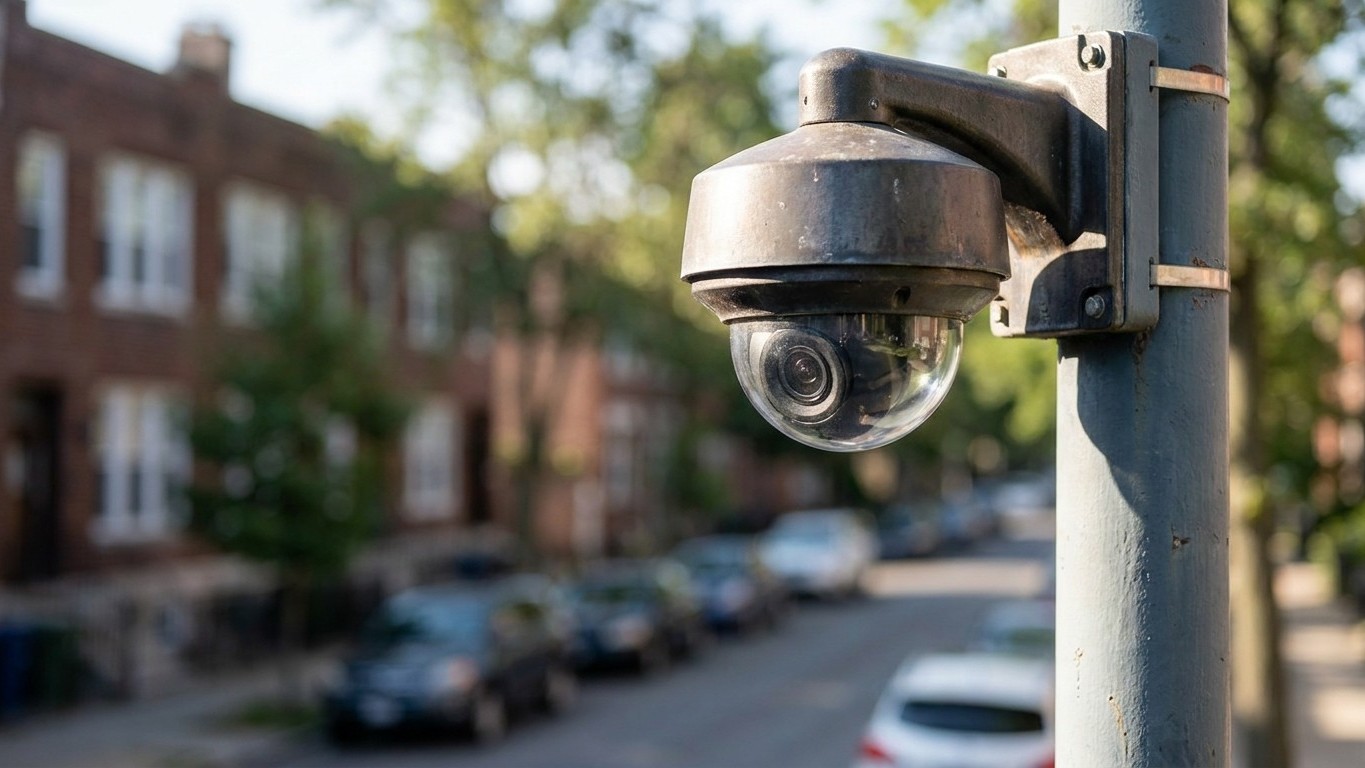
One hundred thousand pairs of electronic eyes sweep our streets, squares, and parking lots. And yet, when an investigation yields results, video surveillance images have contributed to only a handful of cases. The figure is indisputable: barely over 1% of the cases solved owe something to cameras mounted on the street poles across France. A report commissioned by the National Gendarmerie and published in 2021 scrutinized nearly 2,000 judicial dossiers to arrive at this conclusion.
Since 2007, the State has provided subsidies to municipalities through the Interministerial Fund for Crime Prevention, the FIPD, to equip streets with cameras. Over 300 million euros have been distributed to town halls over the years to finance the installation of nearly 100,000 devices on public roads. This fund was created in March 2007 to help mayors manage local security policies, then mobilized to stimulate the development of video surveillance, with the objective of tripling the number of cameras in public spaces within two years starting in 2008. A clear, budgeted political ambition, hammered out for nearly two decades in French municipal councils.
Key takeaways
- Despite 300 million euros invested, cameras resolve only a tiny portion of investigations
- No rigorous national evaluation has ever measured the true return on investment
- Witness testimonies and DNA do far more than images to solve cases
A figure that contradicts twenty years of political rhetoric
The statistical reality tells a different story. A study by the National Gendarmerie Research Center indicates that video surveillance recordings contribute to the resolution of judicial inquiries by providing clues or evidence, but in particularly slender proportions, namely a share of 1.13% across the entire corpus of observed investigations. Even when only the resolved dossiers are considered, this share barely rises to 5.87% of the adjudicated cases.
Out of one hundred inquiries closed by the police or gendarmerie, fewer than six include a camera image among the pieces of evidence. And across all open cases, solved or not, it is mainly testimonies, DNA traces, telephone analyses, and traditional investigative work that do most of the heavy lifting. The street camera, supposed to be the infallible eye of urban security, remains a marginal tool in the case-resolution chain.
This finding is not new. The Court of Audit already stated it in a 2020 report dedicated to municipal police. It affirmed that no overall correlation had been found between the existence of video surveillance devices and the level of crime on the public way, or the rates of elucidation. Six years later, nothing indicates that the situation has changed.
No serious national evaluation has ever been carried out
Here lies the crux of the problem: France has been spending for twenty years without ever seriously measuring the return on investment. As early as 2011, the Court of Accounts already recommended carrying out an evaluation of the effectiveness of street video surveillance in preventing crime and elucidating offenses, using a rigorous method, with the input of recognized researchers and experts. Fifteen years later, this national evaluation still does not exist.
The few available studies remain local, sporadic, conducted at the initiative of an isolated researcher or a specific administration, without a common methodology to compare results from one city to another. Citizens have even reported this directly on the Court of Accounts’ citizen participation platform, proposing that the institution undertake an audit measuring both the total cost of these devices, the real link between camera presence and the elucidation of offenses, the impact on prevention and residents’ sense of safety, and a comparison with other means of action such as human presence, public lighting, or social prevention.
The cost, precisely, varies enormously from one municipality to another without any clear logic explaining it. A Court of Accounts report already condemned in 2020 that the installation cost of a camera could vary by a factor of two across territories, with no corresponding difference in performance. Tens of thousands of euros per camera, sometimes more with maintenance and connection to urban supervisory centers, for a device whose real usefulness no one can truly measure.
Why mayors keep investing despite everything
If judicial effectiveness remains marginal, why do communities continue to request subsidies and multiply cameras year after year? The answer lies less in statistics than in collective psychology. A visible camera reassures; it gives the sense that action is being taken, and it becomes an easily marketable campaign argument to anxious residents. The sociologist Laurent Mucchielli sums up this logic by noting that cameras are primarily a tool for near-term urban management rather than a fight against crime.
This urban-management utility is not incidental: traffic regulation, monitoring illegal dumping, crowd management at events, and helping to resolve doubts for law enforcement during interventions. These are real uses, but they have nothing to do with the initial promise to reduce crime and elucidate offenses. The semantic shift is not trivial either: the very term “videoprotection,” which replaced “video surveillance” in official vocabulary, contributes to this rhetorical construction of a reassuring tool rather than a simple observation device.
There remains a fundamental question that neither prefectures nor municipalities seem willing to settle: at a constant budget, wouldn’t these sums be more effectively invested in on-the-ground patrols, in street lighting for dark streets, or in social mediation programs? No serious comparative study has ever allowed answering this question, even as requests for subsidies for new cameras continue to flood prefectures each year.
Sources: participationcitoyenne.ccomptes.fr | participationcitoyenne.ccomptes.fr
