
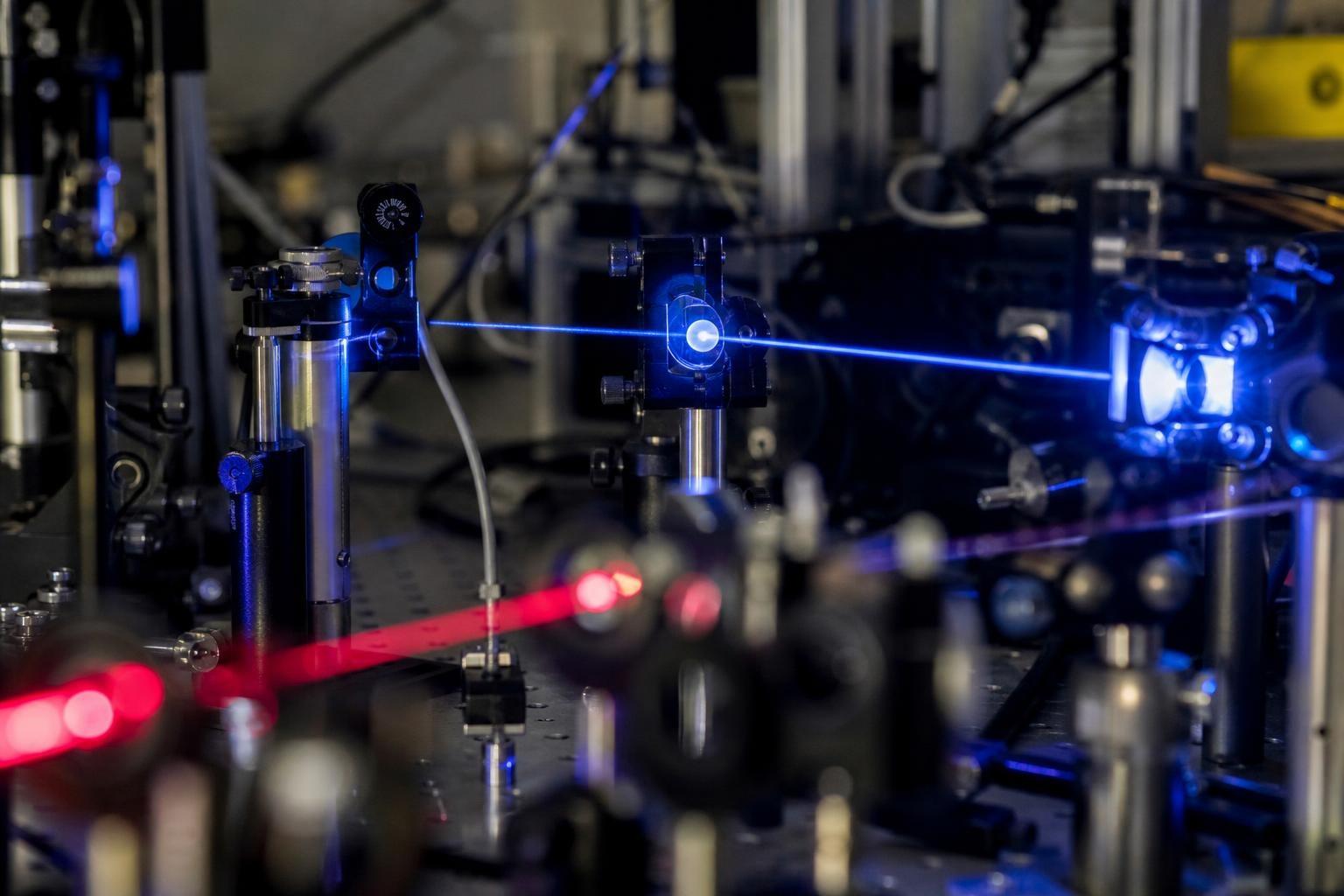
Light is supposed to rush, not wait. Yet a team of physicists has done the unthinkable: they persuaded a beam to pause, to linger in place for a staggeringly long stretch—an entire minute in the cramped timeline of photonics. The experiment sounds like paradox, but it’s rooted in precise engineering, exquisitely tuned materials, and a dance between atoms and electromagnetic fields.
“It’s like catching lightning in a jar,” one researcher remarked, “and then choosing when to uncork it.” That vivid metaphor, while playful, points to a very real transformation: information carried by photons, typically unstoppable, becomes a stored pattern hidden inside matter, waiting to be released on command.
Why stopping light matters
Light is the universe’s courier, moving data, energy, and signals at unmatched speed. If you can halt that messenger, you can buffer information, synchronize distant systems, and make quantum networks less fragile and more scalable. “Storage turns streams into reservoirs,” said a team member, “and reservoirs make control possible.”
In everyday tech, buffers smooth hiccups; in quantum tech, buffers enable new architectures. The ability to catch and hold a photon’s state—its delicate phase, polarization, even entanglement—opens the door to repeaters that can span continent‑scale distances and computers that coordinate operations with exquisite timing.
The trick: turning light into matter and back
The central idea is deceptively simple: convert a traveling wave into an atomic whisper, then reverse the process later. Using a technique called electromagnetically induced transparency (EIT), a control laser reshapes a normally opaque medium, slowing a pulse to a crawl and mapping the photon onto a collective excitation—often called a spin wave.
Inside carefully prepared crystals or ultracold gases, that shared excitation acts like a library, shelving fragile quantum information in ordered atomic rows. When the control field returns, the shelved content becomes light again, rebuilding the original pulse with phase‑coherent fidelity.
From milliseconds to a full minute
Earlier experiments stored light for microseconds, then milliseconds, nibbling at the edges of feasibility. Hitting the 60‑second mark required heroic stability: suppressing noise, dampening motion, and isolating the memory medium from every thermal nudge and magnetic flutter.
Much of the progress hinged on rare‑earth doped crystals cooled to cryogenic temperatures. Their ions offer sharply defined energy levels and remarkably long coherence times. Pair that with meticulous magnetic shielding and dynamical decoupling sequences, and the stored pattern resists the slow drift of dephasing long enough to be read out intact.
What exactly was preserved?
“Stopping light” can sound like a stunt, but the crucial test is fidelity. Does the released pulse match what went in—phase, amplitude, and quantum properties included? According to the team, the memory preserved coherence over the entire interval, passing stringent interference checks and quantum‑state tomography within stated uncertainties.
One physicist put it plainly: “If you only keep the envelope and lose the whisper, you don’t have a memory—you have a mirage.” Maintaining that whisper—the phase—is what upgrades a neat demonstration into a genuine tool.
Why this isn’t just slower light
Slowing light in a medium is impressive; fully storing it is categorically different. In slow‑light experiments, photons remain partly photonic, inching along but never fully stilled. In a true memory, the field is extinguished, and the information lives as a collective atomic excitation. Nothing propagates; the roadway is empty, the traffic paused.
That distinction matters for synchronization, error correction, and long‑distance entanglement. A real pause lets systems agree on timing, bridge network gaps, and orchestrate multipart protocols that would otherwise race ahead and fall out of step.
What this unlocks next
A one‑minute memory changes the calculus for quantum networks, enabling repeaters that wait for companion nodes, tolerate loss, and stitch together entanglement over vast spans. It also informs hybrid architectures, where photons interface with solid‑state qubits, trapped ions, or superconducting circuits without sacrificing quantum coherence.
Expect rapid work on:
- Raising retrieval efficiency, pushing error rates down, and wrangling multi‑mode capacity so one device stores many channels at once.
Limits, costs, and the path forward
No triumph is free. Cryogenic systems add complexity, and magnetic quiet is hard to maintain outside specialized labs. Scaling requires robust devices with relaxed conditions, maybe via materials with engineered disorder, new echo protocols, or integrated photonic‑crystal platforms that tame noise at the chip level.
There’s also the matter of efficiency. A great memory with poor in‑out throughput is a cul‑de‑sac, not a highway. Groups worldwide are chasing the trifecta: long storage time, high fidelity, and strong efficiency—ideally at or near room temperature.
The human angle
The romance of the result is hard to deny. “You feel the lab go quiet,” one team member said, “because you know the photon is still in there, like a note held on breath alone.” It’s a reminder that science can be both rigorous and strangely poetic, turning abstract equations into tangible, time‑bending feats.
For decades, the speed of light was an untouchable constant, a boundary we measured against rather than molded. Now we can ask it to wait, and, astonishingly, it does—long enough to give the future a buffer, and the present a chance to catch up.
