
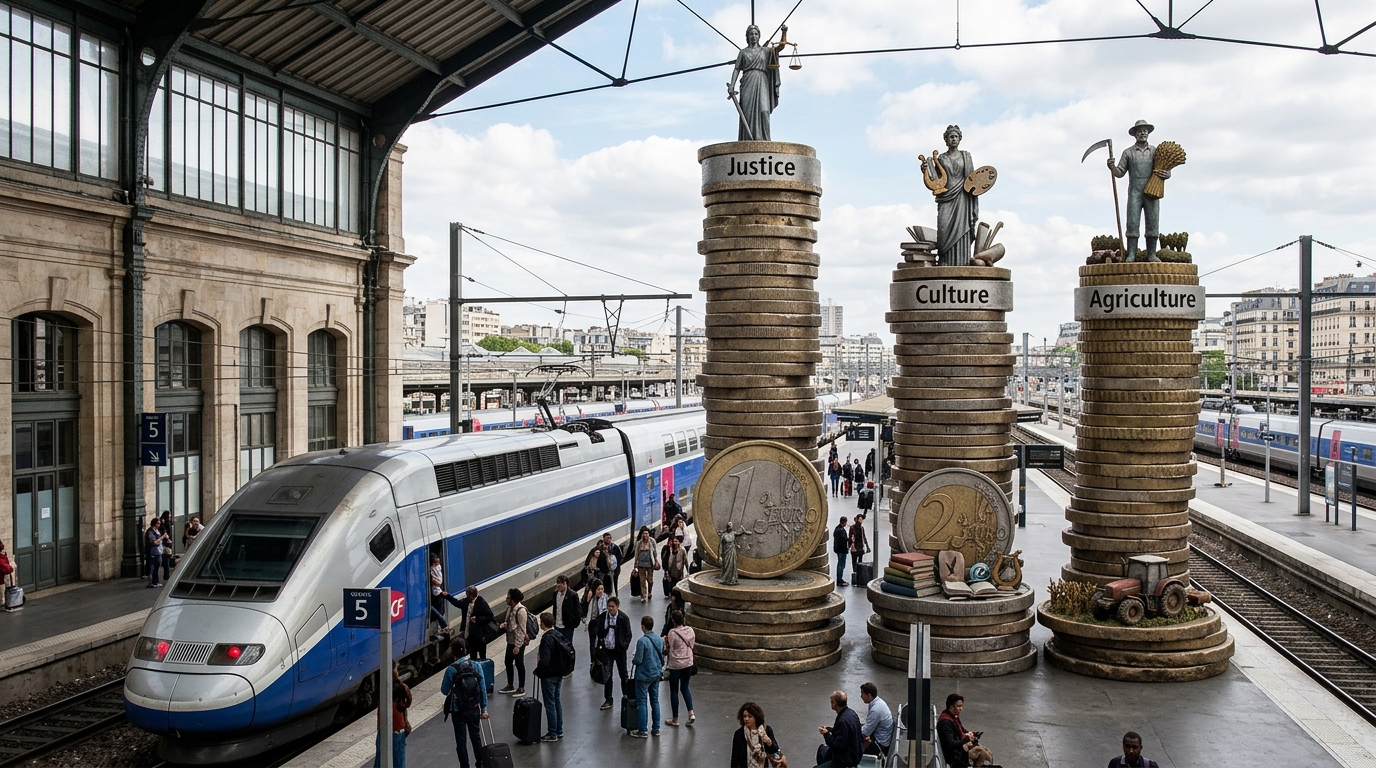
You’re waiting for your train on a platform, the display shows a delay, and an announcement mentions track work. A banal scenario, experienced by millions of French people every year. What is less known is that this very network, often criticized for its aging infrastructure, swallows a colossal amount of public money. More than 20 billion euros are paid to SNCF each year by the state and local authorities. A figure so dizzying that, when added up, it surpasses the budgets of three entire ministries: Justice, Culture, and Agriculture. It is enough to prompt serious questions about how our country allocates its resources.
The great budget gap no one sees coming
The reality is stark when you line up the numbers. In 2024, all public subsidies paid to SNCF reached 21.7 billion euros, compared with 12.9 billion euros in 2014. In just ten years, the bill has almost doubled. This sum includes direct subsidies from the State, the regional allocations to fund the TER, as well as the financing of the national rail network as a whole.
To put this sum in perspective, it is enough to compare it with the budgets of other essential state missions. Justice, Culture and Agriculture together weigh less than this single rail envelope. In other words, the public money devoted each year to keeping trains running exceeds what is collectively allocated to delivering justice, supporting artistic creation, and assisting our farmers. A gap that raises questions, especially since the network continues to deteriorate, with nearly 3,000 kilometers of lines classified as being in very poor condition according to a recent senatorial report.
Why does SNCF cost the State so much
To understand this budget surge, one must dissect the different spending items. The TER and the Transilien account for the largest share of these public aids, with around 7.2 billion euros disbursed in 2023. These regional lines, often not very profitable but essential for the unlocking of territories, require massive support from regions and the State to continue operating.
On top of that, there are the network access charges, borne by the State on behalf of the operators, representing about 2.7 billion euros in addition. The investment subsidies, intended for purchasing new rolling stock and modernizing infrastructures, reached 6.8 billion euros in 2023. Not to forget the funding of railway workers’ pensions, which costs more than 3 billion euros each year to the State through the special social security regime. A telling fact: unlike the TER and Transilien, no operating subsidy is paid for the TGVs, supposed to be self-financing through their commercial profitability. Finally, there is debt relief of around 35 billion euros that SNCF Réseau has benefited from in recent years, a financial breath taken entirely at the taxpayers’ expense.
Justice, culture, agriculture: the big losers in the ranking
This budgetary imbalance makes sense when confronted with field realities. Courts are overloaded, the time to judgment lengthens, prisons are chronically overcrowded: French justice operates with far fewer resources than those dedicated to rail. The same holds true for Culture, where public establishments, support for creation and heritage often struggle to obtain budget increases, despite their role in national influence.
Agriculture is not better off. Farmers, facing recurring crises, regularly demand more support in the face of international competition and climatic hazards. Yet their sector remains, in terms of public funding, still far behind rail. This budget ranking raises a simple but unsettling question: how can we justify that a mode of transport, as useful as it is, consumes more resources than fundamental state missions? These comparisons resurface systematically during strikes, when public opinion questions the relevance of these sums relative to the service provided.
What this figure really reveals about our collective priorities
Behind these numbers lies a reality more complex than a mere budget ranking. Rail remains a structuring public service, indispensable to the mobility of millions of French people, especially in rural areas where it is sometimes the only alternative to driving. But the scale of the sums involved, coupled with the persistent deterioration of the network, raises a fundamental question about the effectiveness of public expenditure.
This paradox between massive investments and aging infrastructure illustrates the tensions that thread through our collective choices. Should we keep pouring ever more money into a system whose results remain contested, or rethink its financing model at its core? The comparison with Justice, Culture, and Agriculture is not intended to pit sectors against each other, but it usefully reminds us that budgetary arbitrage always reflects societal choices, rarely neutral and never inconsequential.
Ultimately, this figure of more than 20 billion euros per year goes beyond a mere accounting dispute. It challenges our collective ability to prioritize between mobility, justice, culture, and food sovereignty. As the debate over public debt and budget savings periodically returns to the foreground, one question must be asked plainly: are we sure this money is currently being used in the most useful way for the entire community?
