
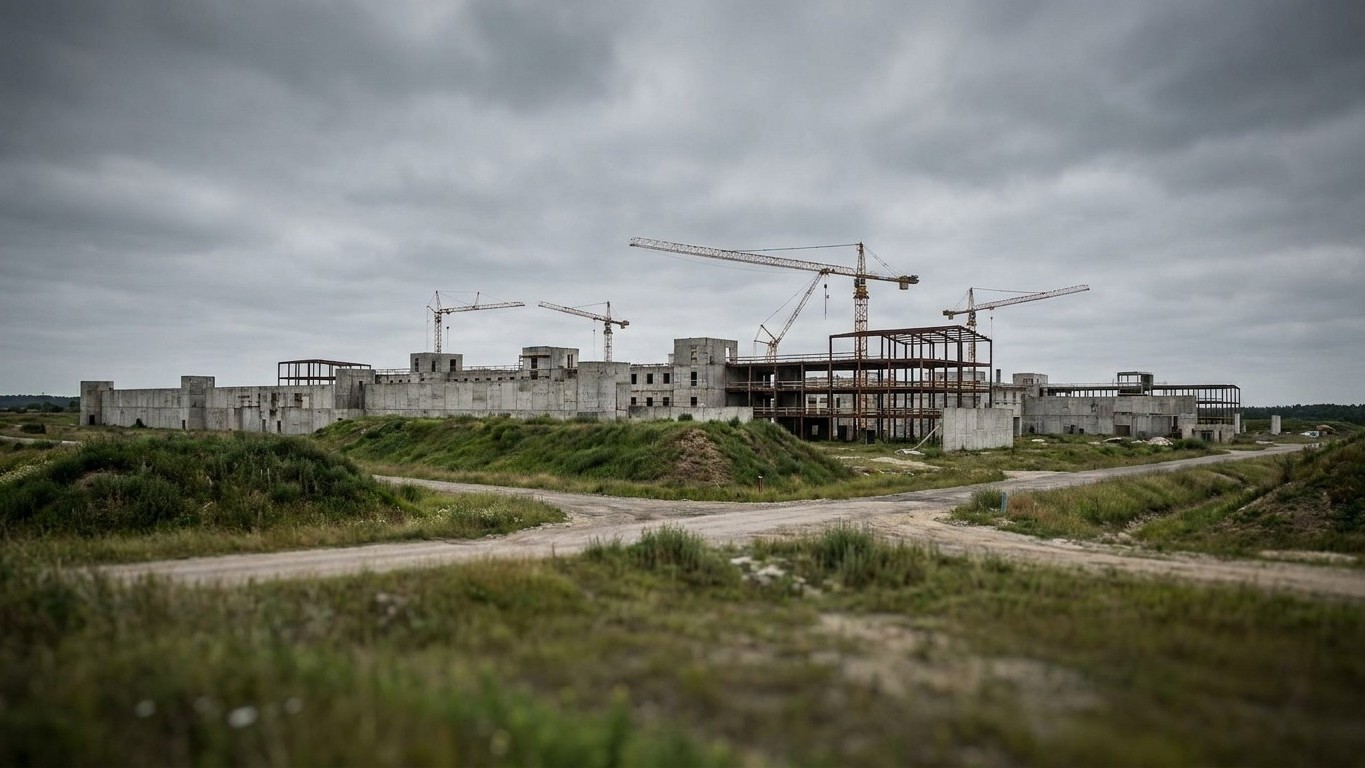
The target is not reached, and by a long shot. According to a flash audit by the Court of Auditors published on December 17, 2025, the implementation of the Plan 15,000 prison places is well below its initial ambitions: by September 2025, only 5,411 new prison places had been delivered, i.e. 35% of the objective. Seven years of work, dozens of operations launched across the country, and in the end barely a third of the program has come to fruition. The budget, for its part, did not follow the same downward trajectory: it exploded.
Key takeaways
- A budget overrun of 1.8 billion euros for only 35% of the promised places
- Land acquisition difficulties and administrative disputes have paralyzed the program for seven years
- France now envisions modular prisons to deliver three times faster
A third of the places, seven years after launch
Announced in 2017 to address the chronic overcrowding in detention facilities and to diversify the types of structures for handling offenders, the “Plan 15,000 prison beds” aimed to raise the prison capacity to 75,000 places by 2027. The ambition was clear: ease the squeeze in remand prisons, where three inmates are sometimes housed in nine square meters, and develop facilities designed for reintegration rather than mere confinement.
The reality of the project tells a very different story. Seven years after its launch, in September 2025, only a third of the planned places had been delivered: 7,384 gross places, but 5,411 net places after accounting for the necessary closure of nearly 2,000 places in obsolete facilities. Some of the new cells are simply replacing places closed elsewhere due to insufficient maintenance of an aging property stock. The ministry must maintain 186 penitentiary establishments, mostly built between 1875 and 1920, a heritage that France has dragged like a millstone for more than a century.
The bill climbs: from 3.9 to 5.7 billion euros
On paper, the plan was to cost 3.9 billion euros. Initially estimated at 3.9 Md€, its total cost was revised to 5.7 Md€ in 2025 (+46%), due to the combined effects of inflation, the materials crisis, construction delays and programmatic changes. Almost two billion euros more for only a third of the promised places — the budget equation no longer holds.
The Senate had already sounded the alarm well before the Court’s audit. As early as June 2022, the Budget Directorate revised this estimate to 5.4 billion euros, and the analyzed data showed that the revised forecast reached 5.55 billion euros in June 2023. A Senate rapporteur even foresaw the outcome: if we follow a pace of 200 million euros more each year, the 6-billion-euro mark could be far exceeded by 2027. Three years later, the Court of Auditors confirms in black and white that the forecast was accurate.
Land is hard to find, lawsuits extend delays
Why such a derailment? The Court points first to a very concrete problem: finding land to build a prison is often a battleground. This situation reflects both the difficulty of producing reliable eight-year population projections for the prison population, the complexity of identifying land parcels, the burdens of administrative procedures, and the uncertainties tied to any large-scale construction project. A parliamentary report already described this obstacle in blunt terms: prison facility construction is regularly hindered by neighbors’ and, too often, local elected officials’ reluctance, and progress on the “Plan 15,000” could be slowed by difficulties in identifying lands and obtaining the necessary permissions.
In addition, there is a legal dimension. Environmental regulations, appeals before administrative courts, protracted urban planning procedures: every prison project becomes a potential contentious file that can delay a site for several years. The Court also notes governance problems and a lack of interministerial oversight, a sign that program leadership did not match its scale. A plan designed for ten years relying on population projections eight years ahead, in a country where the number of inmates has been rising for six decades, was a risky bet from the start.
Overcrowding that keeps getting worse
While the cranes are slow to rise, the cells themselves continue to fill. Seven years after its launch, only 5,411 net places have been delivered, about 35% of the 15,471 planned places, even as the prison population kept rising sharply, reaching over 84,000 inmates in 2025 for fewer than 63,000 places available. The calculation is simple and chilling: France had, by autumn 2025, an average prison occupancy of 135%, well above European standards in this area.
Facing the urgency, the Ministry of Justice shifted gears in 2025 by betting on faster-to-build solutions. The Minister of Justice announced in May 2025 the creation of 3,000 modular prison places, deliverable in 18 months, compared with nearly seven years for a traditional facility. The first of these prefab structures is due to rise at Troyes-Lavau, in the Aube, by autumn 2026, followed by a second at Maubeuge. An implicit concession: building a “durable” prison the French way now takes four times longer than a comparable modular building. The Court of Auditors, for its part, calls for one thing above all: stop announcing numbers that do not hold up budget-wise, and finally prioritize projects that have a real chance of completion before the 2027 deadline.
Sources: justice.gouv.fr | senat.fr | vie-publique.fr
