
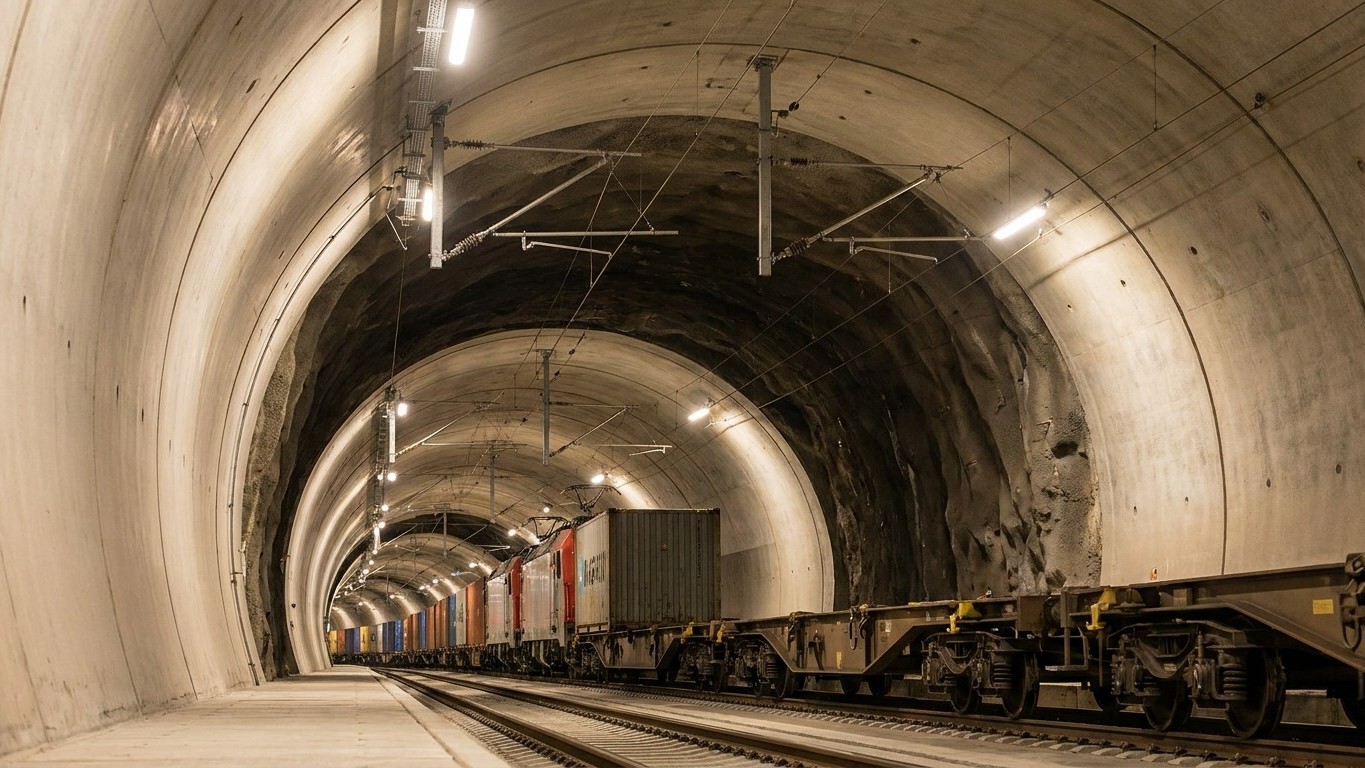
Fifty-seven kilometers of Alpine rock, ten years of budget delays absorbed, and yet trucks never respected the limit set by Swiss law. The Gotthard Base Tunnel, the longest railway tunnel in the world, has been in operation since 2016. But the political objective that justified its construction—to cut transalpine road traffic to 650,000 trucks per year—remains out of reach. In 2024, the Federal Office of Transport counted 960,000 units, almost a million. A figure that raises questions about the ability of a single infrastructure, even an exceptional one, to alone alter freight transport habits.
Key takeaways
- A colossal railway infrastructure inaugurated in 2016 never reached its political objective set by Swiss voters
- The August 2023 derailment paralyzed the tunnel for 13 months, paradoxically giving ground back to the road
- The end of accompanied ferroutage in 2025 threatens to worsen the trend with tens of thousands more trucks
A titanic construction project, a twenty-year bet
The project originates from a simple observation: at the turn of the 1990s, heavy goods vehicle traffic across the Swiss Alps reached more than one million trucks per year, bringing a host of nuisances to the valleys. The Swiss people decide at the ballot box. In February 1994, the population approved by 52% the Alpine Initiative, which demanded shifting freight from road to rail. From this popular will emerged the New Railway through the Alps, of which Gotthard is the centerpiece.
Construction began in 1996. The boring work finished in 2011, after fifteen years of drilling through rock sometimes subjected to extreme temperatures. Commercial operation began on December 11, 2016, after an opening ceremony held as early as June 1 of the same year in the presence of German, French and Italian leaders. The final bill: 12.2 billion Swiss francs, including escalation, VAT and interim interest, i.e., about 5 billion more than the initial estimate. To put the scale of the figure into perspective, it represents more than half of the annual budget of several Swiss cantons combined. The project now enables freight trains to run on an almost flat profile, with a maximum slope of only 12.5 per thousand compared to 26 per thousand on the old mountain line, allowing longer and heavier convoys.
The objective of 650,000 trucks, a mirage since the start
The Swiss law on traffic transfer set a clear ceiling: 650,000 heavy-truck trips per year across the Alps, an objective that should have been reached two years after the tunnel opened. It was never met. As early as 2016, the federal authorities themselves admitted that they would not reach it. Since then, the trajectory has looked like a frustrating yo-yo: the number of trucks first fell, then rose again in recent years. In 2022, the Federal Office of Transport counted 880,000 trucks crossing the Alps, a number of trips that only slightly decreased (by 15,000) compared with 2021. Two years later, the figure rose to 960,000, and the rail modal share even fell in 2025, dropping from 70.3% to 68.6%, notably due to numerous construction sites and a tense economic situation.
The paradox is striking. The tunnel offers a theoretical capacity of 260 trains per day in each tube, more than sufficient to absorb the freight targeted by the law. But road demand does not adjust as readily to a railway infrastructure, even a perfect one. Old logistical habits, costs, and international connections weigh more heavily than expected in the balance.
The derailment that paralysed the axis for thirteen months
On August 10, 2023, an accident reminded everyone that even the world’s safest structure is not immune to a grain of sand, or rather a broken wheel. A freight train derailed in the west tube, causing damage initially judged limited but quickly revised upward. The tracks were damaged over about 8 kilometers, with 8 km of track and 20,000 concrete sleepers needing to be replaced entirely. The material damages were eventually estimated at around 150 million Swiss francs, of which about 140 million were covered by insurance.
What was supposed to be repaired by the end of 2023 stretched much longer. Almost 13 months after the derailment, the full operation of the world’s longest railway tunnel resumed on September 2, 2024. For more than a year, freight had to pass via the historic mountain route, lengthening journeys and paradoxically giving more leeway to road traffic at the very moment when the intention was to reduce it. Since then, the SBB have strengthened safety: derailment detectors have been installed at the tunnel entrances, and the company now advocates for a reform that would hold wagon owners more accountable for the maintenance of rolling stock, which is sometimes neglected.
And now, the road is reclaiming ground
The 2025-2026 context does not help the case for rail. The accompanied ferroutage, the historic service that allowed drivers to load their trucks onto a train to cross the Alps, ends definitively at the end of 2025, due to lack of profitability. Between 1990 and 2024, the number of trucks crossing the Swiss Alps by road fell from 1.3 million to 960,000, a real decrease but far from what the legal objective would demand. Estimates now point to tens of thousands more road trips in the coming years, running against the transfer policy enshrined in the Swiss Constitution.
The Gotthard Tunnel remains an engineering feat without equal, and it daily carries the bulk of transalpine rail freight in the country. But its history reminds us that a single infrastructure, even extraordinary, never suffices on its own to reverse an economic logic. The ongoing works on the German access line, extending to 2036, also suggest that the number of trucks on Alpine roads will continue to exceed, year after year, the limit set by Swiss voters more than thirty years ago.
Sources: tunnel.ita-aites.org | ville-rail-transports.com | tresor.economie.gouv.fr
