
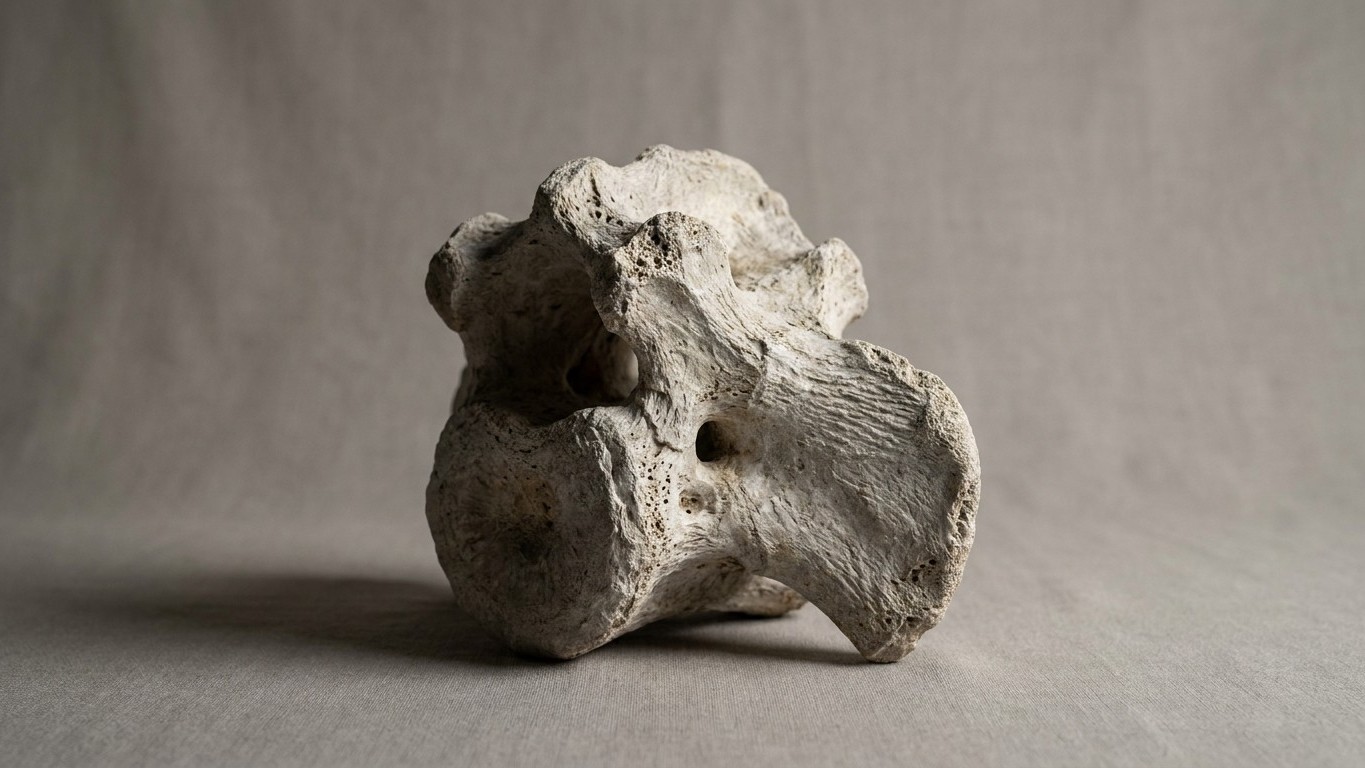
Twelve meters long, a weight that could exceed fifteen tons, and a menu that sometimes included crocodiles. This is the portrait of Palaeophis colossaeus, a marine snake that has since disappeared and that ruled a sea about 56 million years ago, a sea now buried beneath the Sahara’s dunes. Its story, unveiled by a recent reevaluation of its fossil vertebrae, upends much of what we believed about the physical limits a reptile could reach.
Its remains were unearthed in Mali, from Paleoene rock layers. The bones come from sediments laid down in the ancient Trans-Saharan marine corridor, a warm, shallow branch of the Tethys Ocean that flooded large swaths of North Africa during the Eocene, about 56 million years ago. Where today there are sand dunes and storms, there once stood a mangrove and sandbars bathed in tepid waters. It is hard to imagine a more striking contrast.
A study published in 2018 measured these vertebrae and compared them with those of living snakes, yielding an estimated length between 8.1 and 12.3 meters. This range places this marine serpent in the same league as the famous terrestrial Titanoboa, but with a key difference: unlike its South American cousin, Palaeophis colossaeus spent its entire life in the water. Scientists also note that its vertebrae, broad and sturdy rather than highly flattened, suggest a powerful swimmer with a thick body rather than a slender ribbon gliding through water.
Key takeaways
- A fossil marine snake 12 meters long reveals surprising clues about the extreme climate of a bygone era
- The Sahara’s giant crocodiles weren’t the only rulers of the waters — something even more terrifying swam there
- Fossilized bones become past thermometers, confirming that the Earth has already experienced radically different conditions
A predator capable of swallowing crocodiles whole
This isn’t merely a sensational hypothesis. Fossils found in the same geological layers sketch the portrait of an ecosystem saturated with giants. Among them are large fish, sharks, coastal crocodylomorphs, and other marine snakes such as Amananulam sanogoi, pointing to a complex, multi-tiered predator-prey system. In this marine theatre, crocodiles were not invincible rulers of the waters: they shared their territory with a snake capable of swallowing them.
The situation becomes even more striking when you learn that the Sahara of that era also housed Sarcosuchus imperator, nicknamed the “SuperCroc,” one of the largest crocodylians ever to exist. Two monsters of about forty feet coexisting in the same warm sea is no small matter. Researchers estimate that Palaeophis colossaeus behaved as a dreadfully efficient hunter, ecologically comparable to modern predators such as orcas. Its build and the way its bones articulate suggest a highly effective marine hunter, ecologically akin to modern predators like orcas or crocodiles.
Why the extreme temperatures of the Eocene produced such a giant
Here lies the heart of the matter, where biology meets climatology. A snake, unlike a mammal, does not generate its own internal heat: it depends entirely on external temperature to fuel its metabolism. Higher tropical temperatures raise the metabolism of ectothermic reptiles, which rely on external warmth. With abundant energy and food available year-round, gigantism can become advantageous: a larger body retains heat more effectively and can dominate territorial disputes.
This link between heat and body size is not just a hypothesis. Studies conducted on Titanoboa cerrejonensis, the colossal land snake from Colombia that preceded Palaeophis colossaeus by a few million years, showed that supporting such massive ectotherms probably required average annual temperatures around 30 to 34 degrees Celsius. A study published in Nature on Titanoboa corroborates this figure: a snake of that size would have needed average annual temperatures between 30 and 34°C, higher than present-day tropical values. The measurements made on Palaeophis colossaeus fit precisely within this same climatic pattern.
What makes the case fascinating is that the reasoning works in reverse as well. A fossil snake becomes a true thermometer of the past. The Trans-Saharan marine corridor existed during one of the warmest intervals of the Cenozoic, when global temperatures and sea levels were markedly higher than today, and surface temperatures of tropical seas could have been several degrees warmer than current values. Without a thermometer to measure these vanished waters directly, the size of a fossil bone becomes a climate data point in its own right. This is what several researchers cited by Forbes note: the very existence of such a colossal snake supports, indirectly, reconstructions of Eocene climate models proposing tropical seas significantly warmer than today.
A snake that was not alone in its category
Palaeophis colossaeus was not an isolated blip in evolution. At the same time and in the same tropical latitudes, Gigantophis garstini—another terrestrial snake estimated at 9 to 11 meters—also appeared, capable of taking on large prey through constriction. The same pattern shows up across three continents: giant snakes emerging precisely during the globe’s warmest phases, only to disappear as the climate cools toward the late Eocene. The message these fossils send to today’s climatologists is neither reassuring nor alarming; it is simply factual: Earth’s life has already endured tropical heat far hotter than today’s, and it responded by giving rise to creatures that stretch the imagination to conjure.
A detail worth clarifying to avoid any premature leap of interpretation. Researchers cited by several science outlets emphasize that the correlation between heat and reptilian gigantism does not imply that current warming will yield new oceanic titans in the coming decades. The evolutionary mechanisms that shaped Palaeophis colossaeus played out over millions of years, not a single century. That said, the Malian fossil continues to tell a 56-million-year-old story, of a world where the Sahara was an ocean and where crocodiles had every reason to fear what swam beneath the surface.
Sources: cultinfos.com | ecoticias.com
