
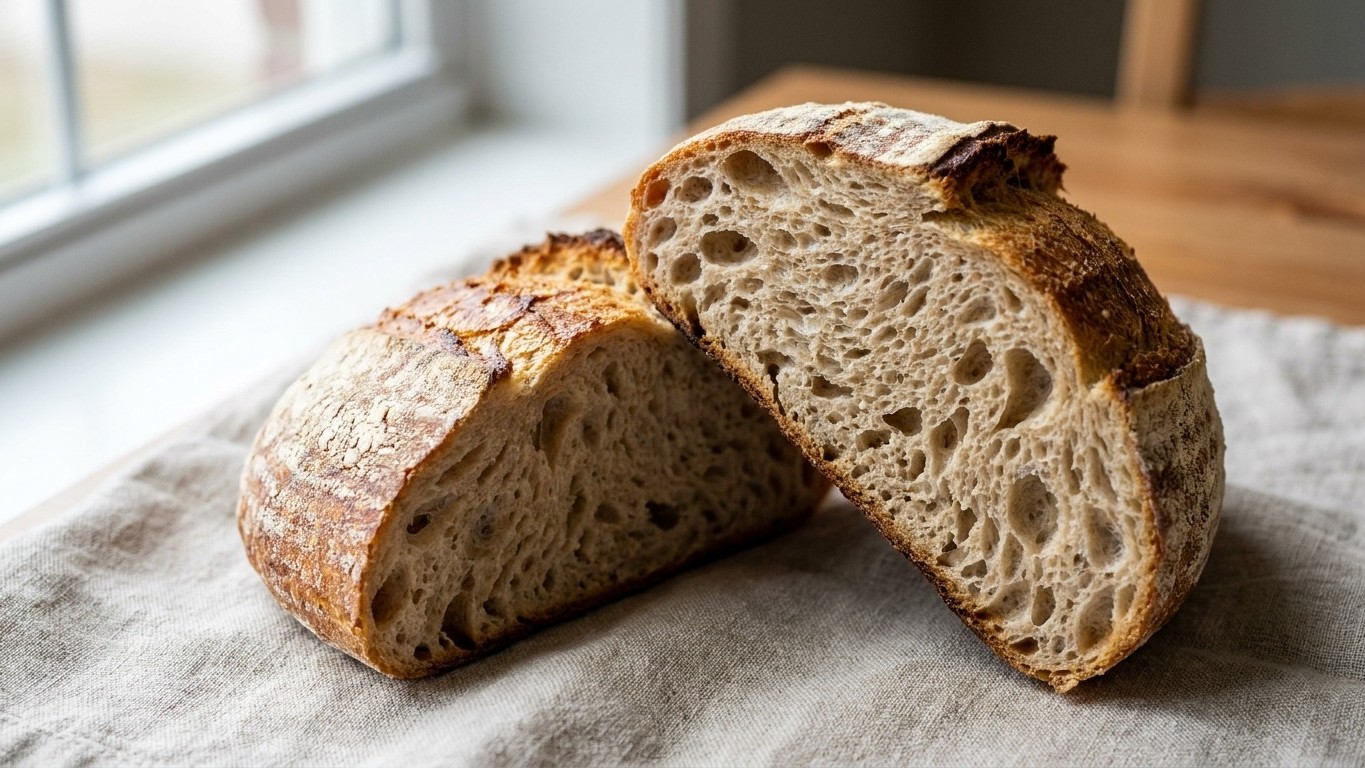
A number to remember before switching bakery aisles: 71. On average, that is the glycemic index of bread, whether white or wholemeal. The nearly reflex action of swapping your traditional baguette for a slice of whole-wheat bread to “better manage your glycemia” rests on a logical intuition, but one that is widely contradicted by scientific data. The real lever does not lie in the color of the crumb, but in an ingredient much less emphasized on packaging: the sourdough starter.
Key Points
- A revealing figure bakeries don’t highlight
- Why the fiber in whole-wheat bread doesn’t do what we think
- The hidden secret in breads fermented for centuries
A Small Gap Between White Bread and Whole-Wheat Bread
The numbers speak for themselves. A synthesis of thirteen distinct studies established that the average GI of bread, whether made from whole-wheat or white flour, was 71 ± 2. Statistically, the difference between the two breads is close to zero. Another recent analysis confirms this troubling proximity: whole-wheat bread shows a GI of 74, placing it in the high-GI category, barely different from white bread at 75.
This finding directly contradicts the rosy image of whole-wheat bread as the natural ally of glycemia. Researchers even went further by directly comparing the glycemic response of the two flours on the same type of bread: no difference in the glycemia induced by bread made from refined white flour and bread made from whole-wheat flour was demonstrated. A database specialized in ranking breads by GI sums up the situation plainly: standard whole-wheat bread, with a GI of 69, is only marginally better than white bread at 75.
Why Fiber Isn’t Enough to Change the Game
The fiber argument seems unassailable on paper. Whole grain contains more fiber, particularly insoluble fiber, which should slow the digestion of starch. But the biochemical reality is more intricate. A study published in the scientific journal dedicated to the impact of flour microstructure on glycemic response observed a counterintuitive phenomenon: whole-wheat flour exhibited higher alpha-amylase activity, so bread made from this flour, with no other additions, showed a glycemic response similar to that of bread made from white flour.
Finely milling whole grains releases enzymes that digest starch more readily, which more than compensates for the expected slowing effect of fiber. The researchers behind these studies emphasize a point that diabetics should be aware of: health professionals who recommend whole-wheat bread for its fiber content must remain cautious, because diabetic patients, thinking they are making a better choice, may end up consuming more and destabilizing their glycemic regulation.
The real fiber content matters, but you need much larger quantities than a single slice of store-bought whole-wheat bread to observe a measurable effect on glycemia. Industrially milled whole-grain flour, finely ground to yield a soft crumb suitable for retail, loses a substantial portion of the grain’s structural advantages.
The Sourdough Starter, the Only True Corrector of the Glycemic Index
One variable remains that produces a measurable and reproducible effect: sourdough fermentation. The internationally used reference data to classify foods by their glycemic impact, drawn from work at the University of Sydney, place long-fermented breads well below those leavened with commercial yeast. A direct comparison conducted on commercial breads contrasted a classic white loaf with a sourdough whole-wheat loaf prepared with yeast and allowed to ferment naturally: the glycemic index of the two breads proved markedly different, 70 for the white bread versus 54 for the whole-wheat sourdough bread, in a study published in Cell Metabolism examining individual responses of twenty participants after a week of consuming each bread.
The mechanism behind this difference lies in the chemistry of long fermentation. The lactic acid bacteria in the sourdough produce organic acids that modify the starch structure before baking, slowing its hydrolysis in the small intestine after ingestion. A database specialized in the glycemic ranking of breads summarizes the magnitude of the phenomenon: sourdough constitutes the best possible modification for glycemia, lowering GI by about 20 points regardless of the flour type used, to the point that a white sourdough bread with an GI of 54 beats a typical industrial whole-wheat bread at 69.
This result will surprise many: a white sourdough bread performs better for glycemia than a whole-wheat bread that has not undergone long fermentation. The crumb color, after all, was never the right indicator.
What to Look For When Buying
Three criteria matter more than the label “whole” on the package: the actual presence of a natural sourdough starter (and not merely a sourdough flavor added to a dough leavened with baker’s yeast), the duration of fermentation, and the fineness of the flour’s grind. A true sourdough bread requires several hours of resting, a delay that retail and industrial channels are often reluctant to respect for profitability reasons.
That said, the fiber richness of whole-wheat bread still has its own nutritional value, independent of glycemia: improved transit, satiety, mineral content. But for anyone who strictly monitors their blood sugar peaks, it is better to rely on the phrase “natural sourdough” and a long proof rather than the simply displayed crumb color in the shop window.
Sources: ancred.fr | iufn.org
