
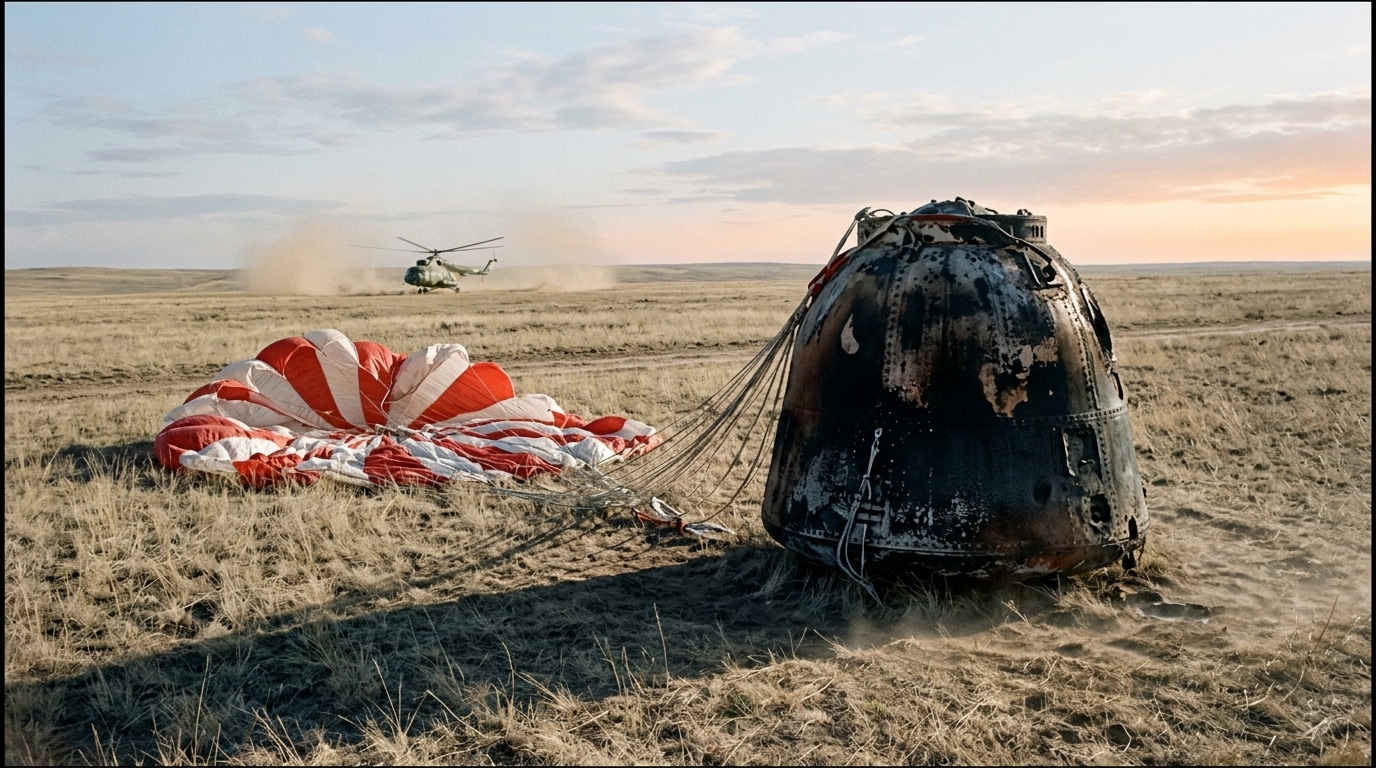
Three cosmonauts perish within seconds, at an altitude of 168 kilometers, with no explosion nor failure of the thermal shield. The trigger is minute: a 16-millimeter valve that opens far too early. On June 30, 1971, Soyuz 11 lands perfectly in Kazakhstan. But inside, there are no signs of life anymore.
- On June 30, 1971, a pressure-equalization valve opened prematurely at an altitude of 168 km, venting the Soyuz 11 cabin of all its air in seconds and killing the three cosmonauts in roughly thirty seconds.
- Autopsies revealed cerebral hemorrhage, ruptured eardrums, and lung injuries—typical consequences of explosive depressurization, with no burn marks or external trauma observed.
- In the wake of this accident, the Soyuz was transformed from a three-seat to a two-seat configuration so that cosmonauts could wear the Sokol pressurized suits, a safety measure still in place today.
- A fist-sized valve was enough to empty the cabin of all its air
- Fifteen minutes of radio silence that hid a chilling truth
- How a three-person Soyuz rewrote the rules of space exploration
A fist-sized valve was enough to purge the cabin of all its air
Georgy Dobrovolsky, Vladislav Volkov and Viktor Patsayev had just completed a record-breaking 23-day stay aboard the Salyut 1 station. An achievement for its time, that was about to turn into a catastrophe of the highest order. Before the modules separated, around 22:35 GMT on June 29, 1971, radio communications suddenly cut off. No one on the ground knew it yet, but that moment would prove pivotal.
The culprit lay in a technical detail that bordered on the trivial. A pressure-equalization valve, meant to open only when near the ground to prepare for landing, triggered far too early. At an altitude of 168 kilometers, in the vacuum of space, this barely 1-millimeter-wide piece opened under the jolt of a mechanical shock.
The consequence was relentless. Cabin air escaped in mere seconds, like a balloon being pierced with a needle. Yet there is no second chance here: in the vacuum, pressure plummets to essentially zero in an instant. The three men had no pressurized suits to shield them.
Fifteen minutes of radio silence that hid a chilling truth
While the descent module continued its path toward Earth, the crew fought a death that would arrive in a few seconds. The cosmonauts tried to mute the radios and the fans to better hear the hiss of the leak. They appear to have managed to locate the source: the infamous valve tucked beneath Dobrovolsky’s seat.
They even undid their seat belts in a desperate bid to reach the mechanism and seal the leak. But time ran out. According to published accounts of the accident, the loss of pressure proved fatal for the crew in roughly thirty seconds. A delay far too short to hope for an effective response, even with the best of intentions.
Autopsies conducted after the capsule was recovered confirmed the horror of the outcome. Cerebral hemorrhage, ruptured eardrums, and lung injuries — all classic consequences of explosive depressurization. The module landed normally at 02:18 Moscow time, about 202 kilometers east of Dzhezkazgan. Recovery teams opened the hatch within a minute and found the three bodies lifeless, with no visible burns or external trauma.
How a three-seat Soyuz rewrote the rules of space exploration
The Soviet investigation commission, chaired by physicist Keldych, released its conclusions on August 17, 1971. Depressurization of the descent module appeared to be the most probable cause of the disaster. Further investigations clarified the mechanism: the pyrotechnic charges used to separate the modules caused the pressure-equalization valve to open prematurely, a design flaw that had never been detected before.
Soviet engineers then took radical steps. The valve was moved and resized to prevent a repeat of the accident. But the most notable change concerned the crew itself: the Soyuz, originally designed to accommodate three cosmonauts without suits, shifted to a two-person arrangement so that the crew could wear the famed Sokol pressurized suits. A radical compromise, but one that has saved lives for more than fifty years.
This tragic lesson from 1971 remains timely. On June 5, 2026, NASA ordered five astronauts to seek shelter in a Crew Dragon spacecraft docked to the International Space Station. The cause: an air leak worsened in the Russian segment of the station, with the leak rate rising in days from about one pound of air per day to two pounds, according to a NASA official cited by Reuters. The four members of Crew-12, joined by another American astronaut, had to suit up as a precaution. A stark reminder that depressurization remains one of the most feared hazards of human spaceflight, more than half a century after Soyuz 11.
Dobrovolsky, Volkov and Patsayev remain to this day the only humans to have died in outer space proper, beyond the Karman line that marks the symbolic boundary with Earth’s atmosphere. Their sacrifice directly shaped the safety standards that safeguard every astronaut during the critical phases of flight. A 16-millimeter valve was enough to change the course of space exploration forever.
👉 A small gesture for Space Group? Follow us on Google, add us to your bookmarks, and find us on Google News so you don’t miss any discoveries.
