
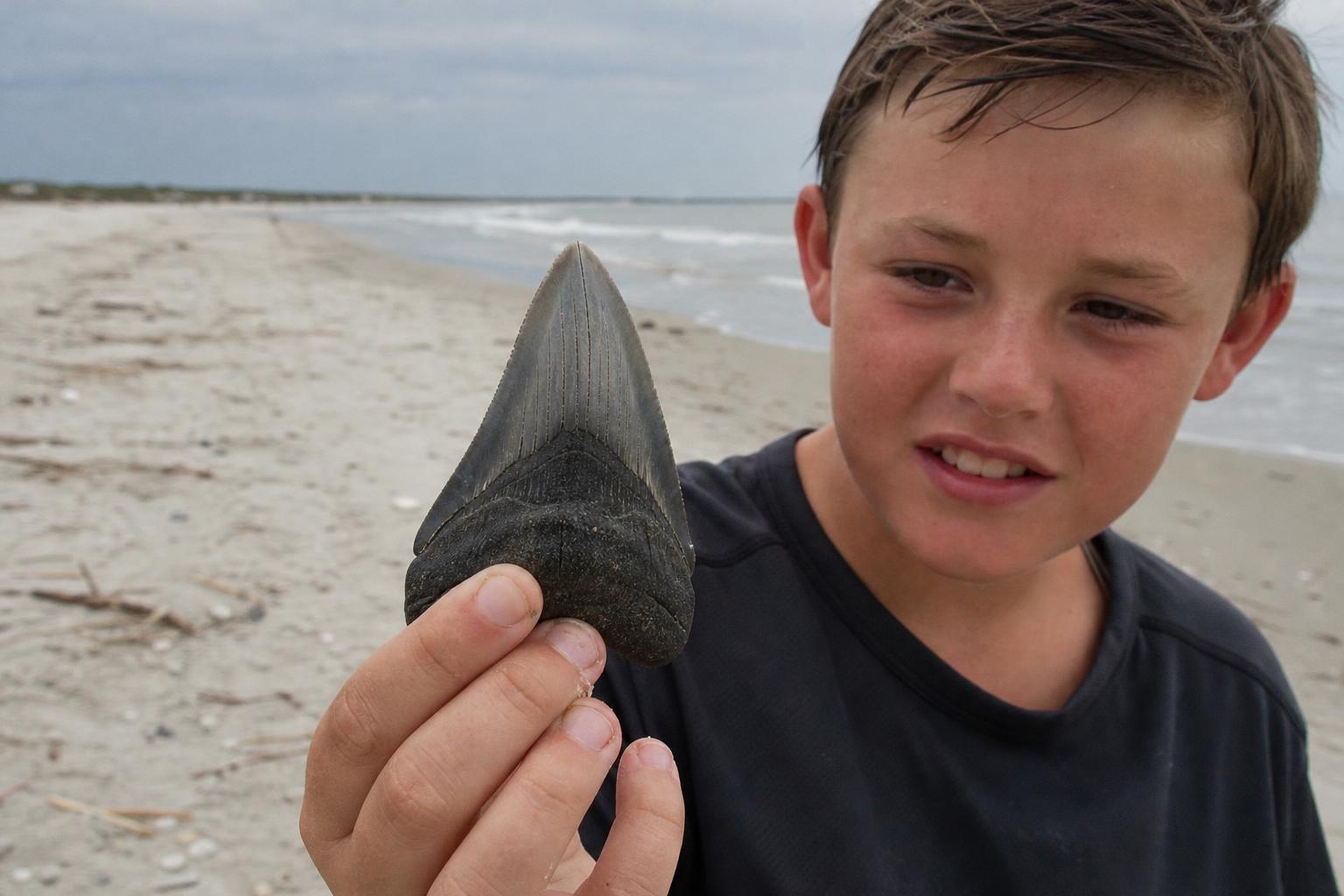
Salt spray hung in the air when a curious kid bent down to pluck a dark, triangular object from wet sand. Within seconds, a quiet stroll turned into a wide‑eyed moment of wonder, the kind that freezes time and shrinks the modern world down to a single ancient clue.
He cradled the find with both hands, marveling at the weight, the glossy enamel, and the serrated edge. “It was the biggest thing I’ve ever seen,” he said, grinning through the shock, as his family gathered around to stare.
A parent admitted they almost kept walking. “I thought it was a rock until he turned it over,” they laughed, still processing how a backyard adventure collided with the Ice Age and oceans far older than our beach‑day maps.
A chance discovery in the surf
The tooth’s surface was worn smooth, but the outline remained razor‑true and bold. It measured several inches from root to tip, heavy enough to feel like a stone pulled from a deep well.
Sunlight flashed across faint serrations, those tiny bite‑marks of design that once helped a predator shear through bone and blubber. The enamel’s smoky gray hinted at long burial in mineral‑rich sediment, a natural varnish of time and pressure.
Beach finds like this often ride in with shifting tides, exposed by storms, sandbars, and the patient work of waves. What looks like luck is sometimes geology on a moving stage, revealing pieces of a very old play.
What kind of shark left this relic?
Experts say large, triangular, heavily serrated teeth commonly point to a giant, now‑vanished species. Many such finds are attributed to the megalodon, a colossal shark that prowled seas millions of years ago.
A marine paleontologist described teeth as “nature’s time capsules, stamped with the engineering of formidable predators.” In their view, a single tooth can narrate a story of diet, size, and the watery roads these animals once ruled.
While identification from photos alone is never perfect, the size and shape here strongly suggest a prehistoric lineage well beyond today’s great white. Even worn serrations whisper of power honed by evolution’s relentless tide, a mouth built to end the argument quickly.
Measuring a giant by a single tooth
Fossil hunters use a practical rule of thumb for estimating the length of an extinct shark. Roughly, each inch of tooth height can map to about ten feet of the animal’s overall length, though results vary with position in the jaw.
That means a 5‑inch tooth can hint at a shark spanning forty‑plus feet, rivaling a city bus. “Numbers like that are hard to grasp,” said one expert, “until you picture a shadow longer than a classroom gliding under your feet.”
Of course, measurements are estimates, not courtroom proof. Teeth shift along the jawline, sizes differ, and fossilization changes dimensions, but the scale remains breathtakingly clear.
Why these shores hide ancient surprises
South Carolina’s coast sits near layers of marine sediments that record eons of rising and falling seas. River systems shuffle gravel and shell, while storms rearrange sand, occasionally unveiling fossils like stagehands pulling back a heavy curtain.
Local communities know these beaches as fossil hotspots, where patience and careful looking can pay off in spades. Responsible collecting keeps that legacy alive without scarring fragile habitats or disturbing protected sites.
- Search after strong tides, handle finds gently, photograph in place, respect posted rules, and consider sharing with a local museum or university for expert insight.
From backyard curiosity to real science
A single tooth can help scientists map ancient ranges, infer feeding habits, and compare growth patterns across different regions. When verified, such finds become data points in a living catalog of the prehistoric Atlantic.
“Every verified tooth tightens the timeline, connects the dots, and pressures our models to be more honest,” noted a researcher, emphasizing community science as a force multiplier. Citizen discoverers widen the search in ways even well‑funded teams cannot, simply by being there when the ocean blinks.
Some families choose to keep remarkable specimens, while others loan or donate them for study and display. Either way, the best next step is documentation—good photos, measurements, and location details recorded with care.
The thrill of holding deep time
The boy kept turning the tooth in the light, catching new flecks each time the enamel met the sun. What he held was not just a trophy, but a handshake across unthinkable years, from a hunter that never knew our name.
For a minute, the shoreline felt quieter, as if the surf itself paused to listen. Big discoveries do that—compressing oceans, eras, and food chains into a single, weighty curve of mineralized history.
“Finding this makes the past feel close,” the boy whispered, “like it’s still out there, just under the waves.” And in a sense, it is: remnants of vanished giants waiting for tide, wind, and one more curious pair of eyes, ready to kneel where the wild old world still breaks on our shores.
