
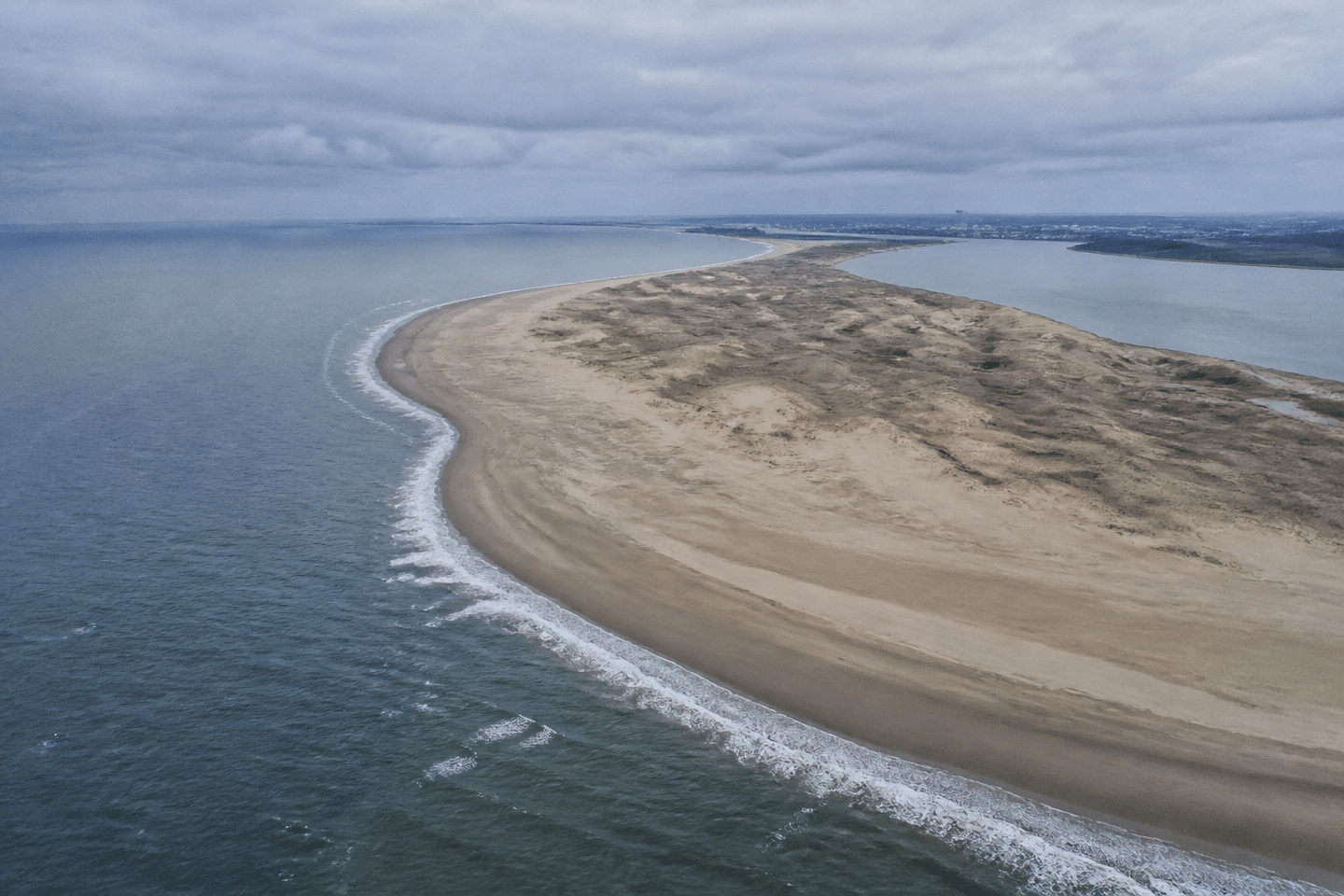
A single offshore deposit of 21.5 million cubic metres of sand, dumped off the coast of The Hague, and then nothing more. No excavator, no trucks, no workers to shape the shoreline. The Dutch engineers simply watched the North Sea redraw the coast on its own, year after year, with a patience rarely afforded to natural forces.
- In 2011, Rijkswaterstaat created an artificial peninsula of 21.5 million m³ of sand between Ter Heijde and Kijkduin, letting the sea currents naturally redistribute it.
- After ten years, the project is deemed a success thanks to the emergence of natural dunes, and its protective lifespan is now estimated through 2041, well beyond the initial twenty-year projection.
- This model has inspired other schemes such as the Hondsbossche Duinen in the Netherlands and a sand engine off the coast of Britain near Bacton in 2019.
- A bold bet: letting the ocean do the engineers’ work
- Fifteen years later, the sand has traveled along the coast on its own
- The Sand Engine, a model already being copied worldwide
A Bold Bet: Letting the Ocean Do the Engineers’ Work
For decades, coastline protection followed a familiar recipe. They would fetch sand from offshore waters, dump it onto the beach, and repeat roughly every five years. Between two and five million cubic metres each time, pumped straight into the zone where the coast was retreating.
The approach was effective, but it carried a substantial ecological cost. Each sand-replenishment campaign disrupted the seabed, disturbed local wildlife, and required heavy logistical planning. A never-ending cycle, to be repeated indefinitely.
In 2011, Rijkswaterstaat and the province of South Holland tried something different. Between the towns of Ter Heijde and Kijkduin, they shaped an artificial, hooked peninsula that extended right into the North Sea. Dredging vessels drew sand from about ten kilometres offshore and deposited it near the shore. In total, 19 million cubic metres formed the body of this peninsula, completed by 2.5 million cubic metres distributed in two preshore replenishments on either side. The project, inaugurated on 24 November 2011, jutted one kilometre into the sea and rose up to five metres above the reference Dutch sea level.
The wager rested on a simple idea: instead of fighting the currents, let them do the work. The North Sea would take care of redistributing this sand along the coast, guided by winds, tides, and storms. A project conducted without workers, entrusted entirely to natural forces.
Fifteen Years Later, the Sand Has Traveled Along the Coast on Its Own
For fifteen years in the Netherlands, the Sand Engine artificial peninsula has relied on North Sea currents to naturally spread these 21.5 million cubic metres of sediment and to provide lasting coastal protection against erosion. The principle surpassed initial expectations.
Year after year, waves and littoral currents nibbled away at the peninsula, gradually spreading its sand further, creating new beaches and dunes where nothing was built directly. An assessment after ten years of operation labelled the pilot project a success, with a striking indicator: the appearance of natural dunes clearly visible, born spontaneously from the sand carried by the sea.
Another surprise, not the least: the lifespan of the structure. The engineers had initially anticipated at least twenty years of effectiveness before another sand deposit. Rijkswaterstaat now estimates that the protection will endure until 2041, far longer than planned. A single sand dump, and the Dutch coast gains several decades of security against rising waters.
This result is a game-changer for coastal managers. Rather than multiplying costly and repetitive interventions every five years, a single, large-scale action suffices, provided there is time for nature to do its work.
The Sand Engine, a Model Already Emulated Worldwide
Faced with such clear success, the Dutch engineers did not keep the method secret. Lessons learned from the Zandmotor, the Dutch name for the Sand Engine, directly inspired the construction of the Hondsbossche Duinen, another dune-protection system along the Dutch coast. The same logic also guided a pilot replenishment at the tidal inlet of Ameland, an island in the Wadden Sea.
The idea crossed the Channel as well. In 2019, a sand engine appeared in the United Kingdom, near the Bacton gas terminal in Norfolk. With two million cubic metres of sand moved—much less than the Dutch project—the British work replicates exactly the same principle: deposit the raw material and let the sea arrange the rest.
The results observed at Bacton confirm the method. Thirteen years after the Dutch sand engine’s inauguration, new dunes have emerged at the Dutch site, reaching up to three metres in height. A further sign that this approach, initially conceived as an experimental wager, is increasingly becoming a legitimate coastal-engineering solution in its own right.
What stands out in the Sand Engine story is this reversal of stance. Rather than imposing a fixed shape on the shoreline, engineers chose to collaborate with currents, storms, and time. The North Sea was not tamed; it was invited to participate in the project, almost as a silent partner. And the visible result, in the form of real dunes seen from the beach, invites reflection on how other challenges related to rising seas might be approached elsewhere along Europe’s coasts.
👉 A small gesture for Space Group? Follow us on Google, add us to your favorites, and find us on Google News so you don’t miss any discoveries.
