
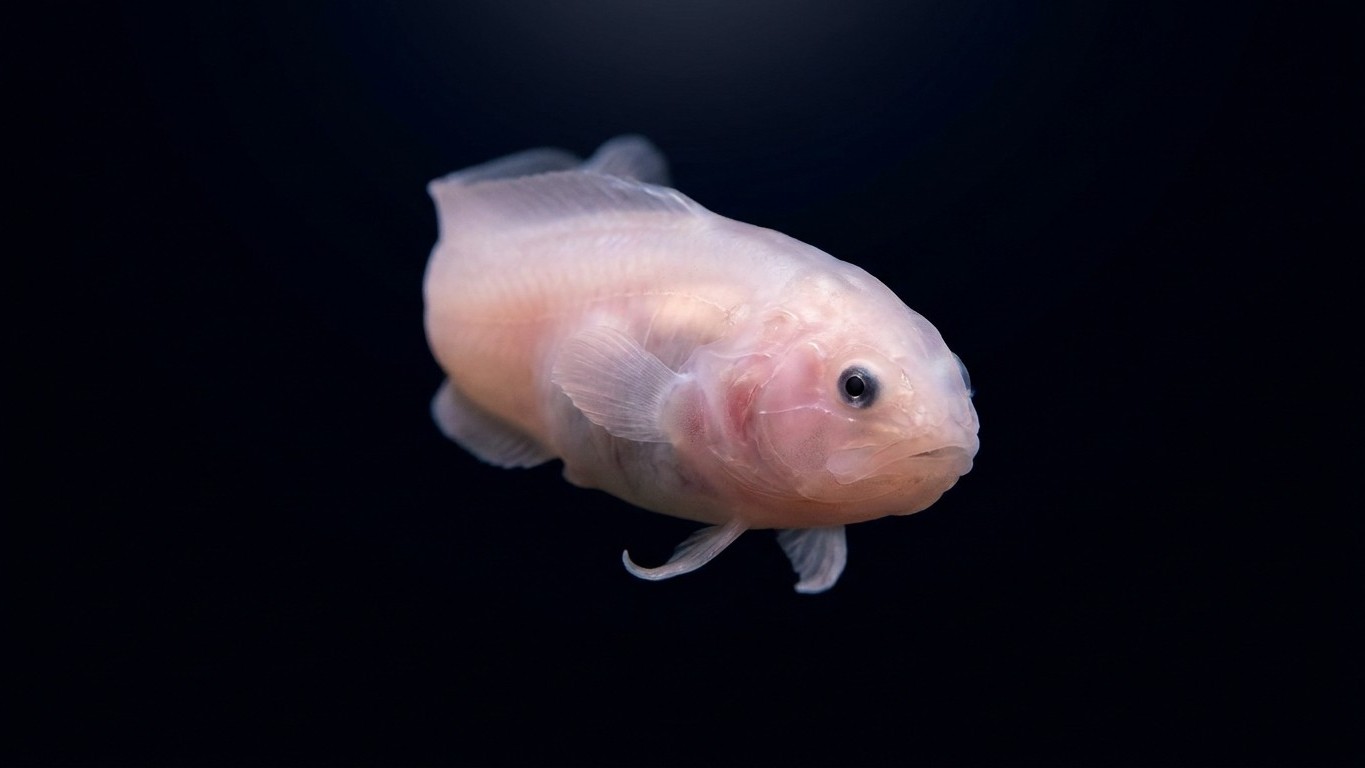
On August 15, 2022, an autonomous camera released into the absolute dark of the Izu-Ogasawara trench, south of Japan, captured something unprecedented: a fish. Not just anywhere. At 8,336 meters below the surface. It’s deeper than the height of Mount Everest. Deeper than anything we had ever seen. And the footage, released in April 2023, has circulated around the world.
This discovery results from a collaboration between scientists at the Tokyo University of Marine Science and Technology and the University of Western Australia, who filmed this fish in the Izu-Ogasawara trench off southern Japan. The project forms part of a ten-year study of deep-sea fish populations. The mission aimed to explore Japan’s trenches—the Izu-Ogasawara and Ryukyu trenches—at depths of 8,000 m, 9,300 m, and 7,300 m respectively.
Key Points
- Researchers film a fish at a depth never reached before
- The pressure at that depth equals about 800 times surface pressure
- A ten-year scientific prediction is realized exactly as anticipated
A juvenile, alone, in total darkness
Scientists observed this fish at a depth of 8,336 meters: an unknown species belonging to the genus Pseudoliparis. This genus groups what are commonly called snailfishes or sea-snails. The fish was a juvenile—very small—juveniles tend to occupy deeper waters than adults. An important detail: unlike other deep-sea fishes, snailfish juveniles tend to inhabit the deepest edge of their geographic range.
The previous record had been set in 2017 by a snailfish in the Mariana Trench at 8,178 meters. This new specimen pushes that limit by 158 meters. It surpasses the previous record by 158 meters and sits within 500 meters of Mount Everest’s height. To give another measure: this unprecedented depth is more than twice the vertical extent of Mount Fuji.
To capture these images, researchers used unmanned, non-motorized submersibles called “landers,” equipped with baited imaging systems, collection devices, and environmental sensors capable of operating down to 11,000 meters. The technique is simple in principle, formidable in execution: lure to attract, film to document.
What the pressure does to biology
At 8,336 meters, the pressure is about 830 atmospheres, roughly 800 times the atmospheric pressure at sea level. Extending a hand to that depth would weigh it down with the force of a column of water eight kilometers tall. No ordinary living tissue can withstand such pressure. Pseudoliparis belyaevi is a snailfish with a gelatinous body, a necessary condition for surviving such pressures, according to the researchers.
The key to the mystery is molecular. Studies have shown that snailfishes maintain a higher concentration of N-oxide trimethylamine (TMAO), a solute that prevents water molecules from destabilizing their proteins in tissues. The buildup of these pressure-stabilizing molecules represents an extrinsic adaptation, altering the cellular milieu to allow proteins to function. But this chemical mechanism has a limit: no fish has been found deeper than about 8,200 meters, a putative physiological limit for vertebrates arising from osmotic constraints tied to the TMAO-based adaptation. The specimen filmed at 8,336 meters sits right at the edge where biology approaches its own threshold.
Pseudoliparis display numerous adaptations to great depths: white, translucent skin; large stomachs; thinner muscles; relatively light skeletons; and an incompletely closed skull. The snailfish family is recognized as the most common and dominant in the hadal zone, where they have adapted to extreme conditions by developing pressure-resistant cartilage and reduced vision. Losing sight in total darkness is not a degradation: it is an energy saving strategy.
A ten-year-old prediction, finally confirmed
Professor Alan Jamieson had predicted ten years earlier that fishes would likely be found down to 8,200–8,400 meters, that such depth would represent the maximum a fish could survive, and that it would be a snailfish. Ten years later, his research has confirmed this hypothesis. A rare moment in science: seeing a prediction come true in both nature and numbers.
Jamieson had published a paper on all ultra-deep-sea fishes and concluded that the deepest inhabitant would probably lie off Japan, where trenches are sufficiently deep and slightly warmer than the previous record in the Mariana Trench. Temperature plays a permissive role: warmer waters permit greater depth because heat and pressure exert similar effects on cells.
A few days after the record film, scientists captured two specimens of the species Pseudoliparis belyaevi in the Japan Trench at a depth of 8,022 meters. The team thus achieved both the deepest sighting of a fish and the first captures of individuals below 8,000 meters. Obtaining physical samples at that depth marks a first in the history of marine biology.
Jamieson told the BBC that if this record were to be broken, it would likely be by only a few meters. The video has been certified by Guinness World Records as the footage of the fish found in the deepest part of the world. What remains to be explored, however, is less the maximum depth than the richness of the events happening there: around Japan, these snailfishes are far more abundant than in the Mariana Trench, where their numbers decline beyond 8,000 meters. A far more populous hadal ecosystem than imagined, in which large snailfishes sometimes prey on other fishes, but most deep-water species primarily rely on amphipods, those small crustaceans ubiquitous in trench environments.
Sources: kaiyodai.ac.jp | adsedelacreativite.eklablog.com
