
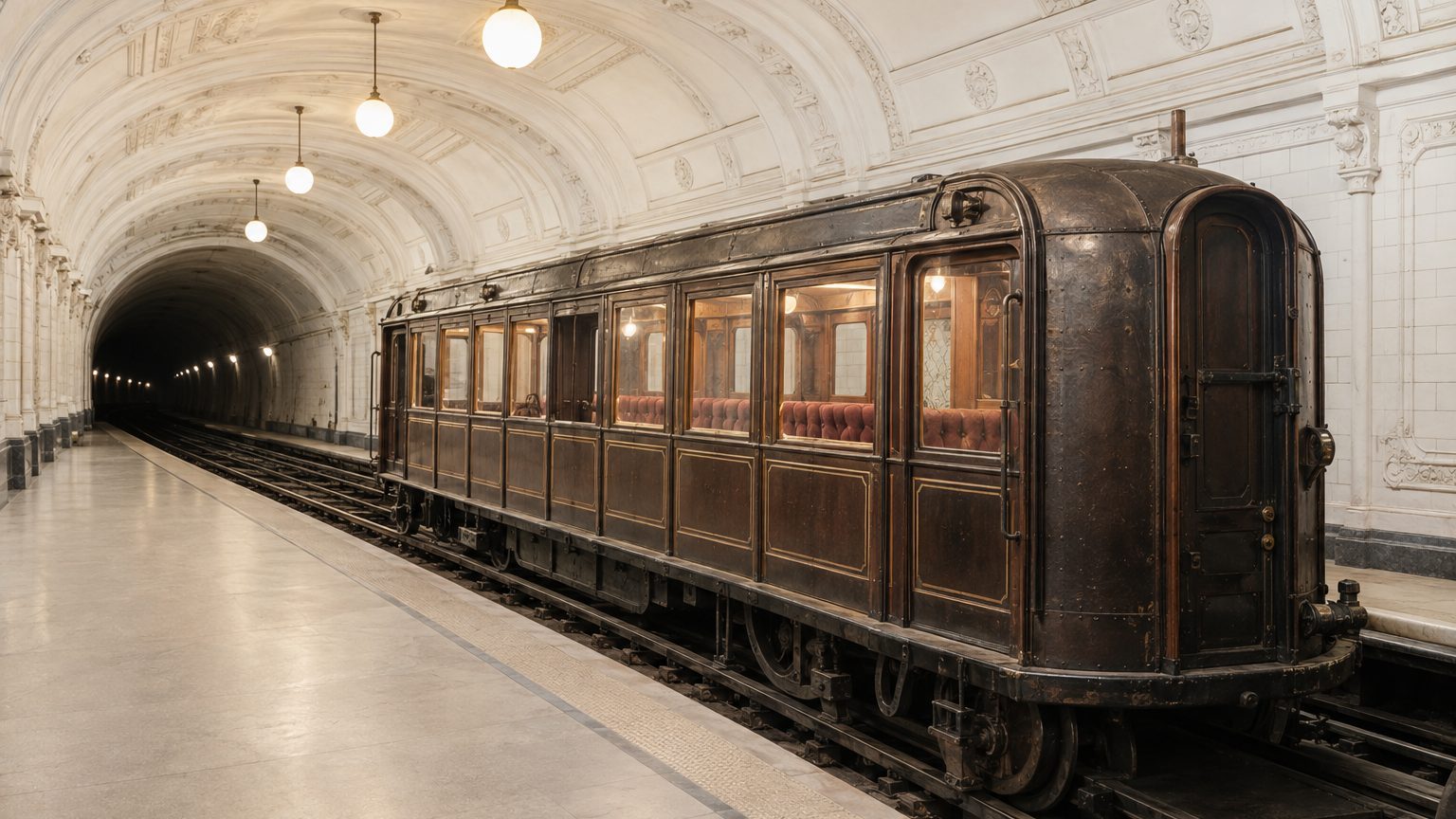
It took 58 days of digging to bore, beneath Broadway, a tunnel 90 meters long and 2.4 meters in diameter, roughly the height of a typical apartment. The project opened to the public in February 1870, spearheaded by Alfred Ely Beach, editor of Scientific American, who had secured a permit for small postal tubes. The pneumatic subway, however, was not halted by compressed air nor by the gallery: politics, then the stock market, would take charge.
The line operated from February 1870 to 1873.
- A ninety-meter tunnel was dug in under sixty days beneath Broadway with a steel shield.
- The pneumatic line operated from 1870 to 1873 with a single car shuttling back and forth in a dead-end.
- More than 400,000 trips were made before the 1873 crash and political obstruction closed the line.
A permit for letters, a tunnel for travelers
As early as 1849, Beach proposed in Scientific American a horse-drawn subway beneath Broadway, a thoroughfare already choked with traffic. He then turned to pneumatics, after examining the work of the English, who move mail and parcels through narrow tubes in London.
In 1867, he presented a model at the American Institute Fair. A fan pushes the car to the end of the tube, then reverses to bring it back. This back-and-forth mechanism would be adopted beneath Broadway, with a single car.
The authorization lingered. Beach secured a permit for small postal tubes, which he then had amended. Under this cover, he had excavated, with a shield, from Warren Street to Murray Street, a tunnel designed for passengers. The work took place beneath a shop facing City Hall, and the paperwork existed: it wasn’t a completely clandestine tunnel, but a permit diverted from its original purpose.
The bill, $350,000, was paid out of Beach’s own pocket.
The shield, that metal structure protecting workers as the gallery advances, allowed a pace of about 1.5 meters per day. At that rate, the 300 feet, or 90 meters, were swallowed in less than two months.
A car, a dead-end, more than 400,000 trips
The line resembled a rolling drawing room. A single car made the round trip to a dead-end, a 22-seat car according to the New York State official site. The station, painted white, boasted a grand piano, a fountain, and chandeliers, and its terminus occupied the basement of the Rogers Peet Building. The fare stood at 25 cents.
Over 11,000 trips are recorded in the first two weeks. In total, more than 400,000 trips would be made—more than the population of Nantes. Each trip covered 90 meters, a little less than the length of a football field.
Tweed, the crash, and a permit arrived too late
The bottleneck lay at City Hall, not in the tube.
William “Boss” Tweed, a dominant figure in New York politics, refused to back the project. According to the same account, his influence over elected officials was such that hardly anyone dared to endorse the line. Faced with this official obstruction, the tunnel remained a demonstration of a single block of streets.
The permit finally arrived in 1873. But the stock market crash drove away investors, and the line closed in the same year.
The crash may not have been the sole cause. According to a CultureNow fact sheet, the rebound of the Ninth Avenue elevated subway, which had become a success during the tube’s three years of operation, also worked against it. This elevated subway offered investors a ready-made alternative.
What remains of the line
Nothing of the tunnel survives today: its route lies within the footprint of the current City Hall station, where a plaque marks its approximate location. The modern subway, by contrast, did not open until 1904 with the Interborough Rapid Transit. That was 31 years after Beach’s line closed. As for the digging of the future line, work did not begin until 1900, after years of political maneuvering, according to nycsubway.org.
nycsubway.org remains skeptical: it questions whether a pneumatic system scaled to the size of a car could operate across a large network. Only small tubes, those that carry mail inside buildings, survived.
Sources: boweryboyshistory.com | nycsubway.org
