
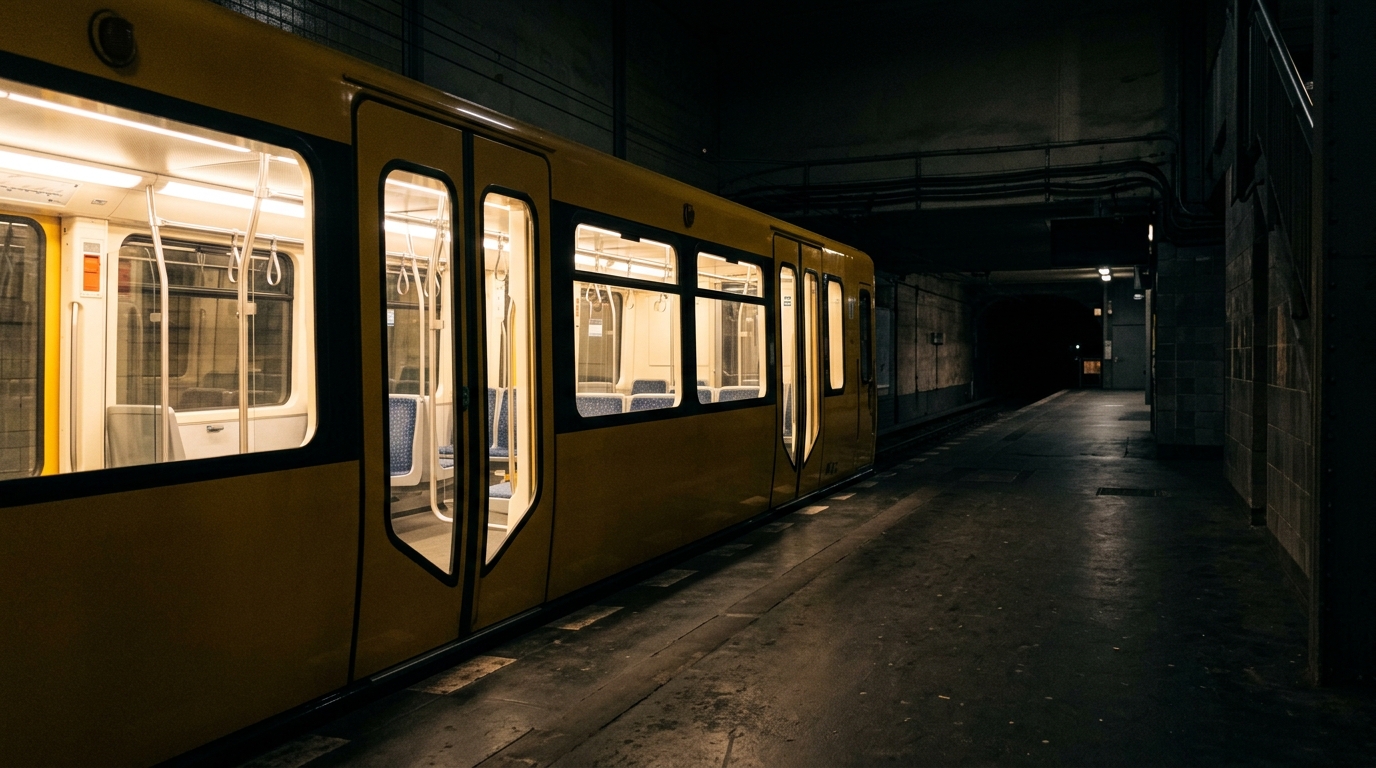
Imagine a brand-new train set pulling out of its terminus in the dead of night, rolling through perfectly lit tunnels, stopping for a few seconds on a deserted platform, then heading off in the opposite direction without a single passenger setting foot on it. This scene, worthy of an urban science-fiction film, actually played out for years beneath Berlin Brandenburg Willy Brandt Airport. A project intended to embody German discipline turned into one of Europe’s most spectacular engineering fiascos, with a bill that exploded and an underground station that was fully operational but utterly useless for nearly a decade.
- The underground station of BER airport was completed as early as 2009-2011, but the airport itself opened only on October 31, 2020, after 14 years of work.
- A regional train ran empty two nights per week for eight years to ventilate the tunnels and protect equipment from deterioration.
- The initial budget of €2 billion ballooned to over €7 billion, in a context marked by more than 75,000 construction defects, the resignation of Klaus Wowereit, and a corruption conviction.
- A ghost station beneath Berlin Brandenburg Airport
- Why trains ran empty for eight years
- The cascade of delays that blew up the bill
- What this project reveals about the management of Germany’s major projects
A ghost station beneath Berlin-Brandenburg Airport
Everything began in 2006, when Berlin authorities launched the construction of a new airport intended to replace the aging Tegel and Schönefeld facilities. The project, dubbed BER, envisioned a budget of €2 billion and an opening slated for autumn 2010, or at the latest 2011. In the wake, as of 2007, the teams tackled the construction of an underground station designed to accommodate regional trains directly beneath the future terminals. The tunnels were completed by June 2009, a record lead time that starkly contrasted with what followed. The station was officially handed over to the rail operator Deutsche Bahn in March 2010, then electrified in June 2011. At that moment, everything seemed ready to welcome the first travelers. Except that the airport itself would not see the light of day until October 31, 2020, after fourteen years of work and six successive postponements.
Why trains ran empty for eight years
Leaving a brand-new railway infrastructure idle for years has consequences. The tunnels, rails, and electrical equipment need a certain amount of activity to stay functional, somewhat like a car engine that should never be left completely idle for too long or it will seize up. To prevent moisture from taking hold and tracks from degrading, a regional train therefore circulated empty, two nights per week, for eight years. This phantom shuttle had a double mission: ventilate the underground tunnels and keep equipment in working order that, without this, would have deteriorated before carrying the first passenger. A nearly absurd situation when you consider that each trip mobilized staff, electricity, and logistics for a station that no one could use.
The cascade of delays that sent the bill skyward
If the station was ready, the airport, by contrast, was plagued by a wide range of technical problems. The originally planned opening was canceled less than a month before the scheduled date due to major failures in the fire-safety system, deemed completely non-compliant. A subsequent general audit uncovered more than 75,000 construction defects, a number that boggles the mind for a single building. Among the most notable anomalies were mechanical escalators that were too short for the floors they were to serve, and a fire-suppression system that had to be redesigned from scratch. The information displays and computers installed far too early, meanwhile, became obsolete before commissioning, forcing a second replacement. As a result, the initial €2 billion budget leapt to €5.7 billion by November 2013, eventually peaking at over €7 billion at the time of the final opening, more than three times the original estimate.
What this project reveals about the management of Germany’s major projects
This fiasco reverberated far beyond the construction site itself. Klaus Wowereit, the former Social Democratic mayor of Berlin who chaired the airport’s management company’s board, eventually resigned in August 2014, unable to bear the political responsibility for such a high-profile failure any longer. The affair also revealed less savory practices, as a former employee was convicted in 2016 of three and a half years in prison for corruption directly connected to the project. Beyond anecdotes, the BER case became a national symbol, regularly cited in Germany as the quintessential example of mismanagement of major infrastructure projects, in a country renowned for its industrial rigor and planning culture.
Since its late-2020 opening, Willy Brandt Airport has been operating normally, and the trains serving its underground station now carry real passengers rather than mere drafts of air. Yet the tale of these phantom trains, running for eight years through empty tunnels solely to prevent deterioration, will likely remain one of the most striking symbols of this extraordinary project. An anecdote that, with a touch of irony, reminds us that even the best-laid plans on paper can derail completely once faced with real-world conditions.
