
Before going any further, one clarification is in order: the story we are about to tell is about a spectacular accident that nearly cost a man his life. It deserves to be told with precision, far from the shortcuts that sometimes circulate about this forgotten episode of French aviation.
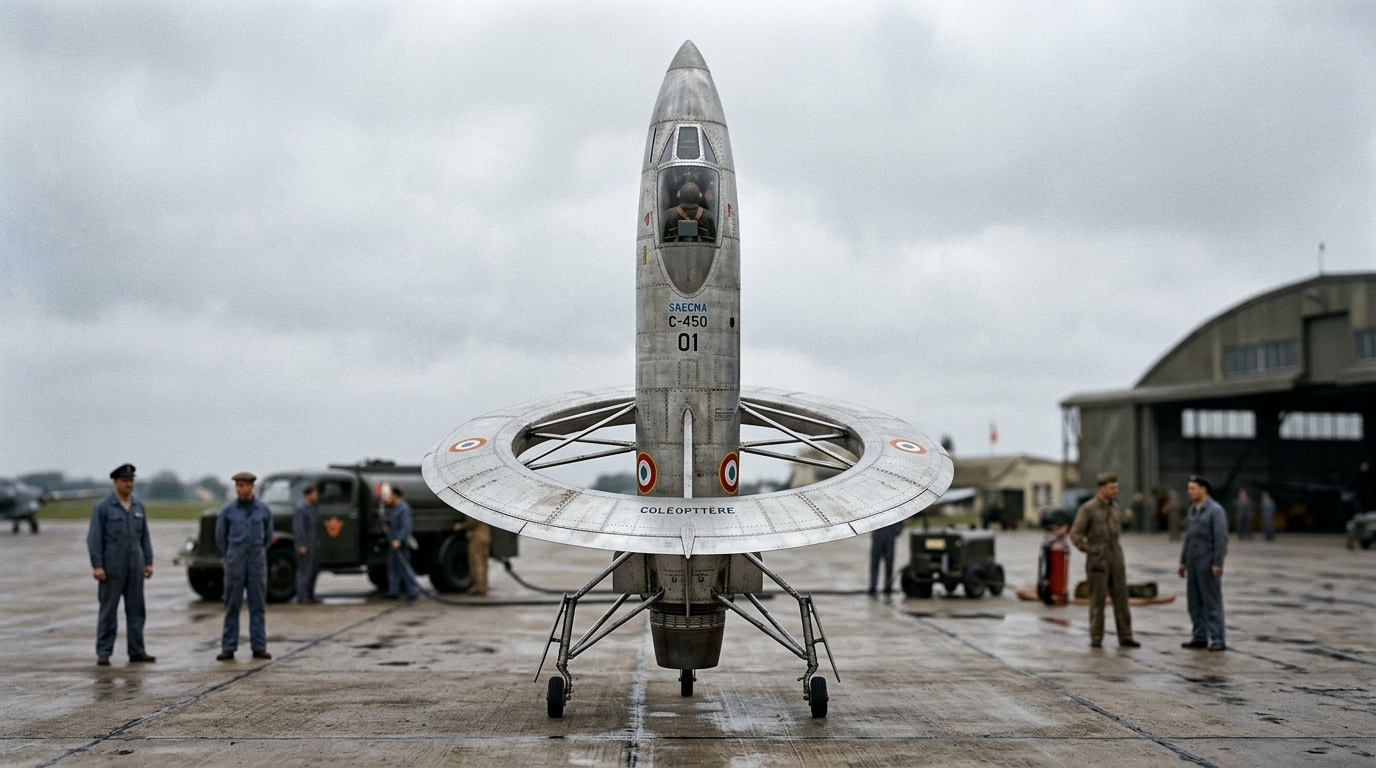
- The Snecma C-450 Coléoptère, featuring a unique annular wing, took off vertically powered by an Atar E-5V engine before pitching into horizontal flight.
- On July 25, 1959, during its ninth flight in front of officials, the aircraft tilted to 50 degrees and crashed, pilot Auguste Morel ejecting at an altitude of 150 meters and surviving with serious injuries.
- The accident was caused by a structural aerodynamic instability tied to the absence of conventional wings, a flaw never corrected due to the lack of full tests on the transition phase, which ended the program for want of funding for a second prototype.
- A Flying Barrel: The Coléoptère’s Bold Idea
- Vertical Takeoff, the Unprecedented Technical Feat by French Engineers
- The Ninth Flight, When the Demonstration Turns into a Nightmare
- Aerodynamic Instability, the Invisible Flaw That Changed Everything
In 1959, France tested an aircraft capable of launching like a rocket and flying like a conventional plane. Its shape? A barrel-shaped, annular-winged marvel, unique in the world. Its ninth flight was supposed to be a triumphant public demonstration. It ended in a matter of seconds, before the officials’ eyes, for a reason no one anticipated.
This project, born from the collaboration between Snecma and , embodied the boldest ambitions of post-war French aviation. At a time when air conquest relied on increasingly radical designs, a machine would push the concept to the extreme: take off vertically, like a rocket, before tilting into horizontal flight, like a fighter jet. Here is the short yet fascinating fate of the Snecma C-450 Coléoptère.
A Flying Barrel: The Coléoptère’s Bold Idea
The very name sparks curiosity. The Coléoptère looked unlike any aircraft of its era, and probably unlike any aircraft built since. Developed between 1957 and 1959, this single-seat prototype stood out for its annular wing, literally wrapped around the fuselage like a barrel. From a distance, the machine more closely resembled a futuristic projectile than a conventional airplane, with tubular lines and a complete absence of conventional wings.
Hidden behind this unusual bodywork was a Snecma Atar E-5V engine capable of delivering 3,700 kilograms of thrust. The craft measured 8.02 meters in length and had a wingspan of 4.51 meters, modest dimensions for a machine intended to revolutionize the way aircraft take off. The engineers’ idea was simple on paper but prodigiously challenging in practice: to free itself from long runways and allow a vehicle to reach the sky from a tiny space, vertically, while later preserving the flight characteristics of a traditional aircraft.
Vertical Takeoff, the Unprecedented Technical Feat by French Engineers
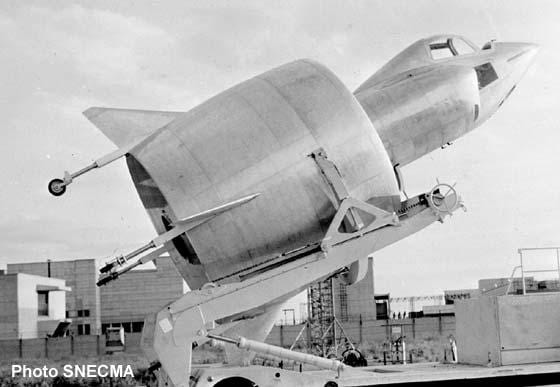
Launching an aircraft without a runway is a challenge that only a few nations managed to meet at the time. The Coléoptère was designed to rise off the ground on its tail, engine pointing downward, before gradually tilting to adopt a horizontal trajectory, matching the cruising path of a conventional aircraft. This transition, brief as it might be in action, lay at the very heart of the technological challenge posed by this kind of machine.
May 6, 1959 marks a pivotal date in this program: on that day the machine achieved its first free flight, unrestrained by any ground safety devices. A success that seemed, on the surface, to validate years of research and restore the confidence of Snecma and Nord Aviation teams. The test pilot entrusted with these perilous flights was Auguste Morel, a man accustomed to pushing the limits of experimental aircraft of the era. Each additional flight drew the Coléoptère closer to the full validation of its concept, the one that would prove an aircraft could both dispense with runways and rival conventional aircraft in speed.
The Ninth Flight: When the Demonstration Turns into a Nightmare
July 25, 1959 would live in memory as a date of glory for French aeronautics. On that day, the Coléoptère carried out its ninth test flight, and the program planned a seemingly simple maneuver: transition from vertical flight to horizontal flight before officials gathered to witness the demonstration. A tilting maneuver that had previously been successful, seemingly routine for a team seasoned in such exercises.
But nothing went as planned. In the midst of the ascent, the aircraft lost balance violently and tipped to nearly 50 degrees, an angle far too steep for an airplane expected to make a gentle transition. The machine plunged at a dangerous speed, only a few tens of meters above the ground, with no recovery means available to Morel. The pilot fought against the controls, desperately trying to regain command of a machine that had become uncontrollable. It was only at 150 meters altitude that he managed to eject, in extremis, moments before the Coléoptère crashed and broke apart on the runway. Gravely injured, Morel survived this spectacular accident, but the single prototype was lost, taking with it any hope of continuing the tests.
Aerodynamic Instability, the Invisible Flaw That Changed Everything
For a long time, the accident could have been interpreted as a simple piloting error or an engine failure, two explanations that might seem almost logical for such an experimental device. The reality, however, is quite different, and clearly more revealing of the concept’s own limits. What truly kept the Coléoptère on the ground was not its engine, nor the pilot’s fault, but a structural aerodynamic instability problem inherent to its design.
The absence of conventional wings, replaced by that famous annular wing, made the aircraft extremely difficult to maneuver once it departed from purely vertical flight. During the deadly transition, the Coléoptère entered a state of uncontrollable oscillations, a phenomenon already observed on earlier flights but not corrected before this one. A technical detail sheds light on this flaw: the wind-tunnel tests of the model, particularly those concerning the transition phase between vertical and horizontal flight, were never made public. This flight envelope seemed poorly understood and had never undergone full-scale tests before this witness demonstration. In other words, the engineers were venturing into unknown territory, without possessing all the data necessary to anticipate such behavior.
After this crash, the program’s continuation nonetheless seemed feasible: the construction of a second prototype was discussed by Snecma teams. But the necessary funding was never released, sealing the annular-wing concept as a curiosity of French aviation history rather than a mature technology.
Behind this technical anecdote lies a broader lesson about the limits of aerospace innovation: a brilliant idea on paper can prove unmanageable once faced with the physical realities of flight, especially when portions of the flight envelope remain unexplored. The Coléoptère flew only nine times, but its failure likely influenced, indirectly, later reflections on vertical takeoff aircraft. A lingering question continues to fascinate aviation enthusiasts: how many other audacious projects were abandoned for similar reasons, before they could reveal their full potential?
