
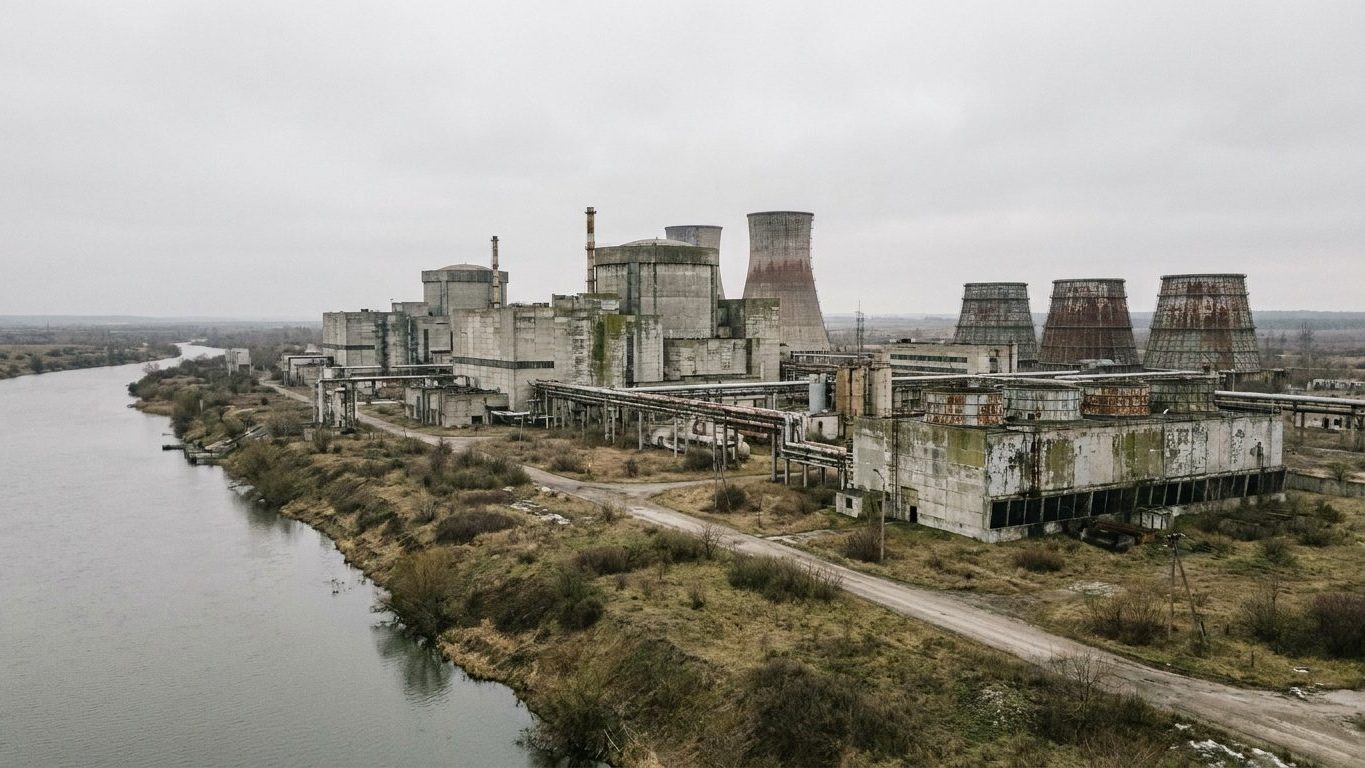
Twelve billion euros. That is the total bill, updated in 2010, for this Isère fast breeder reactor perched on the banks of the Rhône at Creys-Malville.
It operated at only 6.7% of its capacity over eleven years.
- The reactor produced only 8 TWh out of the 120 TWh expected between 1985 and 1996
- The total cost reached 12 billion euros instead of the initially planned 4 billion
- Decommissioning, started in 1999, is to continue until 2030
A technological gamble launched during the oil crisis
The project was born in 1974, in the midst of the oil shock, when France sought to reduce its energy dependence and bet everything on nuclear power. In the 1970s, the oil shock and the country’s excessive energy dependence led France to decide on building in Isère the Creys-Malville plant, designed to produce electricity. Prime Minister Pierre Messmer then presented this fast-neutron reactor, cooled by liquid sodium, as the showcase of French nuclear know-how, officially unveiled on March 5, 1974 by Prime Minister Pierre Messmer. Twelve years of construction later, the nuclear plant was connected to the electrical grid on January 15, 1986.
Technical incidents followed in the early years, with serial breakdowns and long shutdowns; the recurring incidents, the lengthy technical stoppages, and the high costs would prevail over what was touted at the time as the flagship of French nuclear power. Around the site, anti-nuclear protests multiplied, reaching Geneva, barely 70 kilometers away, where numerous demonstrations against Creys-Malville, sometimes colorful marches, and slogans filled with black irony occurred for years. On January 18, 1982, in the midst of the construction, rockets were fired at the Creys-Malville site, causing no injuries but resulting in some material damage. The author of this attack, a former Geneva ecologist-deputy, would not claim the attack until 2003, after obtaining a Russian rocket launcher through the Belgian Combatant Communist Cells.
8 TWh produced out of 120 expected: the unforgiving tally
Over the 1985-1996 period, operating at full capacity would have delivered about 120 TWh of electricity to the grid, with full-power operation (1,240 MW) for 365 days; the theoretical maximum annual production would be 10.86 TWh, i.e., about 120 TWh for the 1985-1996 period. The reactor produced only 8, according to the report of the French National Assembly inquiry committee.
The average capacity factor over this period thus stood at 6.7%.
The construction, for its part, was originally supposed to cost 4 billion francs; the construction price is estimated at 26 billion francs with an initial forecast of 4 billion. By including the maintenance of the reactor throughout its operation, the total bill reaches 12 billion euros updated to 2010, up to its permanent shutdown. In its January 1997 report, the Cour des comptes estimated it at 60 billion francs distributed among the partners of the European consortium NERSA. The dismantling, meanwhile, adds to this bill and continues to this day, more than twenty-five years after the reactor was shut down.
A dismantling that has stretched for more than twenty years
The government formalized the reactor’s permanent shutdown by decree on December 30, 1998. The dismantling work began the following year and is not limited to the reactor building alone. Most of the sodium used as a coolant has since been immobilized in the form of concrete; the reactor has been defueled and most of the sodium has been immobilized in concrete; Superphénix is connected to another facility, the workshop for storing spent fuel.
In 2025, EDF removed the reactor vessel’s bottom assembly, a massive and irradiated part, transferred in February to a teleoperated cutting workshop.
The project is now expected to continue until 2030, while the
Sources : osti.gov | senat.fr | techno-science.net
