
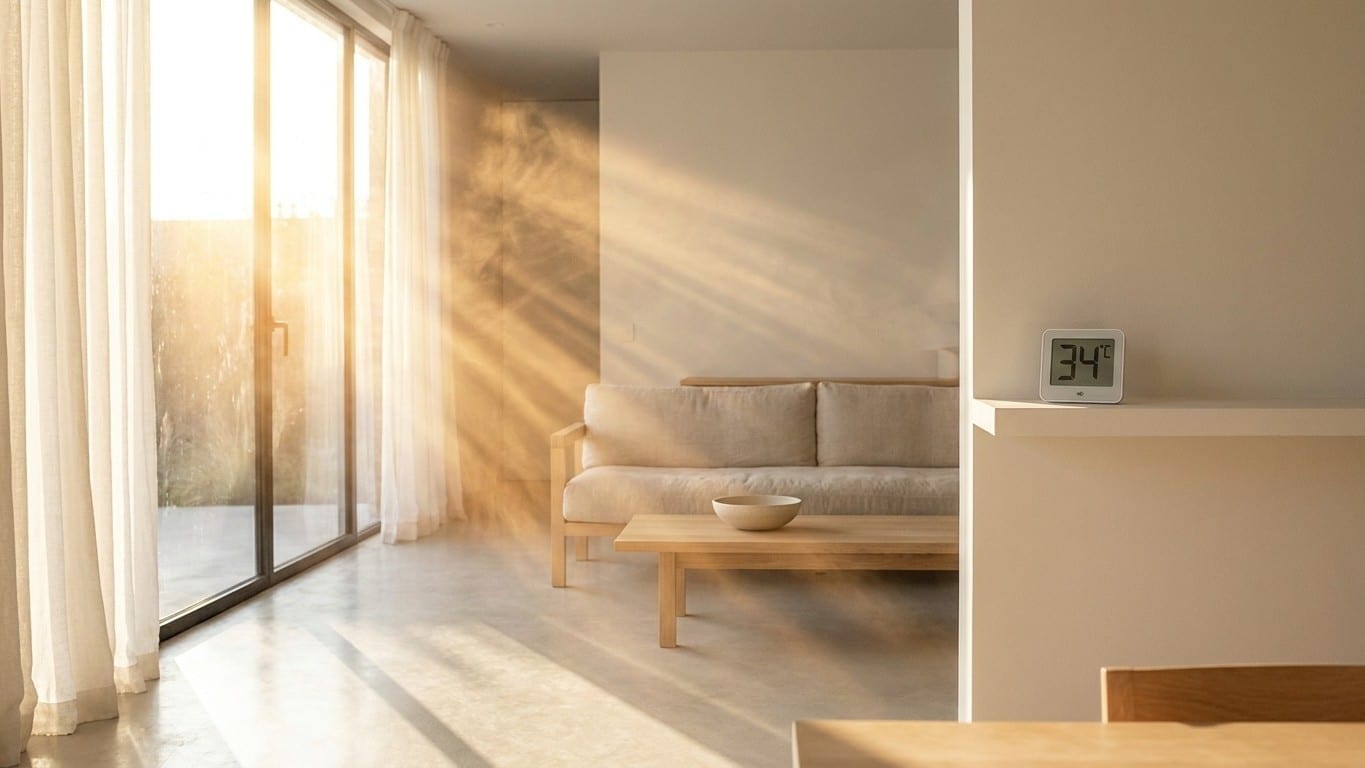
A dwelling rated A on the energy performance certificate, touted as the ultimate in thermal comfort, can turn into a furnace as soon as the first 30°C arrives. The paradox is no longer a paradox for occupants of homes built under RT2012: the insulation that protects them so well from winter cold becomes, in summer, a thermal prison from which heat never escapes.
Key takeaways
- Houses rated A on the energy performance certificate consume little in winter but accumulate heat in summer with no escape
- The thermal mass of ancient stone buildings can paradoxically provide more comfort than modern insulation that is poorly conceived
- RE2020 attempts to address the issue with the DH indicator, but professionals deem this correction still timid and insufficient
The RT2012, Winter Champion, Forgotten in Summer
Entering into force in 2013, the 2012 thermal regulation aimed at a simple objective: drastically cut the heating needs of new buildings. Mission accomplished. Homes built under this rule consume very little energy for heating—roughly 25 euros per month for a family of four in a 110 m² dwelling. The problem is that this winter prowess was built on a summer blind spot. Its Achilles’ heel has been identified for years by professionals: RT2012 did not sufficiently address the risk of summer overheating.
The mechanism is almost mechanical, no pun intended. A well-insulated house is, by definition, a hermetic one. This air-tightness, well managed and excellent in winter, can turn against comfort in summer if the architecture does not include passive cooling solutions. Concretely: heat mainly enters through sun-exposed glazing and accumulates inside the home with no way to escape. A south-facing full-height glass wall, highly valued for its free solar gains in winter, becomes in July a furnace-like window.
Concrete vs Stone: The Comeback of Thermal Inertia
The ultimate irony of this story is that an old stone building the DPE labels as F or G can be more bearable during a heatwave than a recently built A-rated bungalow. The reason lies in one technical term: thermal inertia. It describes a material’s ability to store heat and release it gradually. The more a material has high thermal inertia, the more it dampens interior temperature fluctuations. Heavy materials like stone, brick, concrete, or fired clay are particularly effective at storing heat.
A thick stone wall, 50 or 60 centimeters deep, acts like a heat sponge: it absorbs calories during the day and releases them only hours later, often in the middle of the night when people are already asleep. The phase shift goes hand in hand with the building’s inertia: thick stone or fired-clay walls absorb nocturnal coolness and reintroduce it during the day, which explains why an old shop can stay cooler than a modern lightweight construction poorly protected from the sun. A study quantified this paradox: an early-20th-century stone building can be labeled an energy sieve under the DPE without necessarily behaving like a kettle, particularly if it has shutters and strong thermal inertia, so that only about 60% of energy sieves are also kettles. The two notions, energy and summer comfort, overlap only partially, which should encourage a tempered view of a flattering DPE rating.
Conversely, new homes often suffer from a lack of mass. A study by Pouget & IGNES shows that 94% of A-rated homes with insufficient summer comfort lack external solar protections. Insulation made of glass wool on the interior side, paired with a lightweight frame, offers almost no storage capacity. As a result: the heat that enters remains inside, with no thick wall to absorb it or shutters to block it upstream.
RE2020, A Timid Correction
Aware of the problem, the 2020 environmental regulation introduced a new indicator, the DH (degree-hours), intended to better track overheating risks than the old RT2012 metric. RE2020 includes the DH to evaluate summer comfort in new buildings: a dwelling is compliant if its DH stays below 1250, and below 350 it is considered comfortable. On paper, the advance is real. In practice, professionals in the sector remain skeptical about its effectiveness.
“The regulation is rather lax, since it pays more attention to winter comfort than to summer comfort,” sums up architect Yann Champion of Hobo Architecture in Bordeaux. A view shared by a technical buildings director, who argues that we should stop talking about summer comfort and talk about livability or resilience to extreme heat, the issue going beyond comfort when schools close or vulnerable people are endangered by overheating buildings. The calculation method itself is criticized for its lack of realism. The test weather ignores center-city overheating and assumes residents open blinds and windows at exactly the right moment, while the reference heatwave dates from 2003, even though climate projections anticipate more intense episodes by 2050.
A recent study confirms the scale of the problem in the existing stock. A study published in June 2026 by Pouget Consultants for the IGNES association showed that nearly one in two homes would be rated with “insufficient” summer comfort, with the authors deeming the calculation method too crude and calling for a revision. One detail matters for future buyers: this indicator has no influence on the energy label from A to G, which depends solely on energy consumption and greenhouse gas emissions, so a dwelling can be strongly rated for energy yet flagged as insufficient for summer comfort. In short, a rushed buyer focused only on the DPE letter completely misses the real summer issue.
The most effective solution remains the oldest: exterior shutters that block the sun before it passes through the glass, rather than interior curtains that merely filter heat that has already entered. A report commissioned this summer by the Ministry of Housing to a real estate specialist is expected to propose a revision of this DH indicator, evidence that even public authorities are beginning to take the issue seriously.
Sources: ocordo-travaux.fr | usinenouvelle.com
