
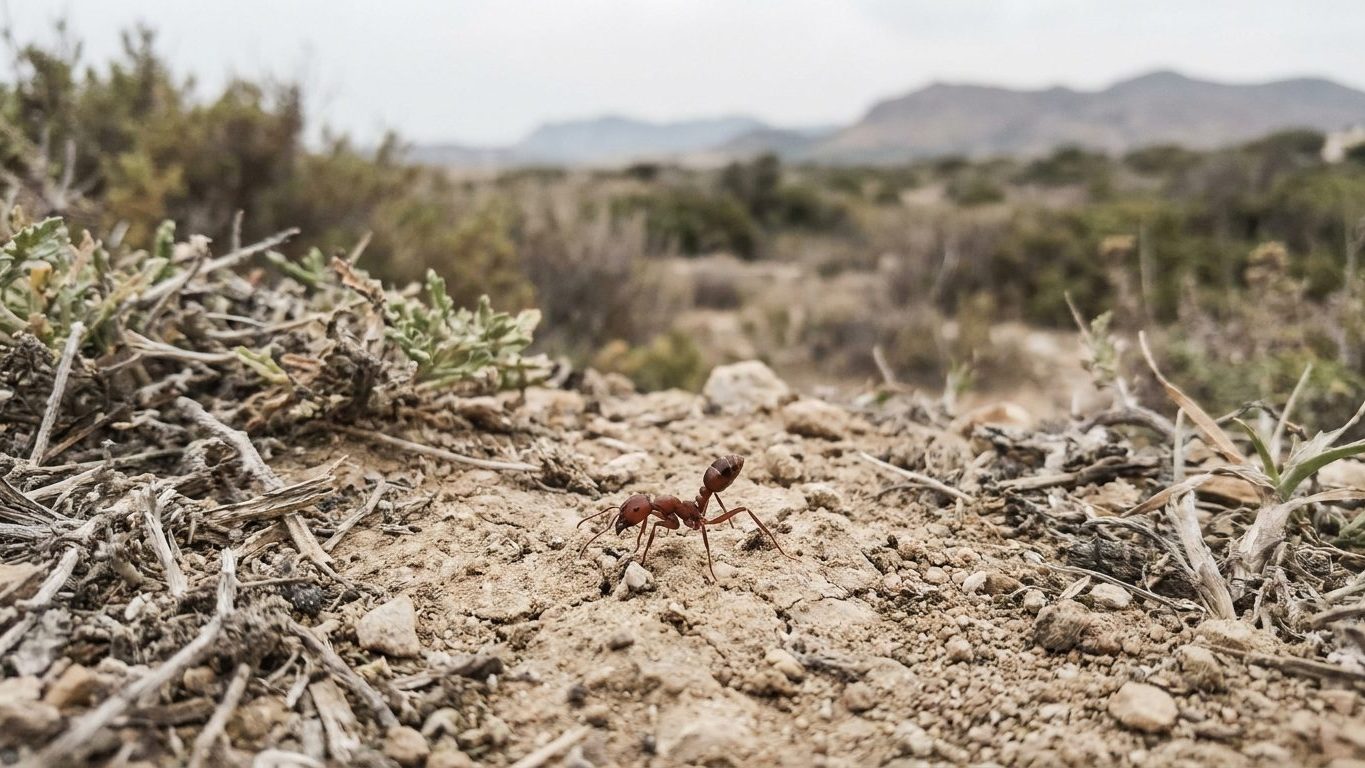
Barely three millimeters in length, yet it has opened a breach that scientists have feared for decades. A study published on September 11, 2023 in Current Biology confirmed the establishment of Solenopsis invicta in Europe for the first time, documenting a mature population in Sicily. It was not a lone, lost individual aboard a cargo ship: researchers documented 88 nests spanning roughly 4.7 hectares during the winter of 2022/2023 in Sicily, near the city of Syracuse.
- Solenopsis invicta has established itself in Sicily naturally with at least 88 nests detected in 2022-2023
- The fire ant bites like a wasp and can trigger severe allergic reactions that may include anaphylactic shock
- The species has never been eradicated in the United States since the 1930s, costing billions of dollars annually
- According to climate models, 50% of European cities are vulnerable to an invasion
A colony discovered almost by chance
While the species had already been found sporadically in imported goods across Europe, this time it marked the first establishment in the wild. The discovery owes much to chance and to the curiosity of residents bothered by repeated stings. Mattia Menchetti, an entomologist at the Barcelona Institute of Evolutionary Biology and the study’s lead author, recalls that “we found them almost by accident. Residents sent us photos of these ants, whose bite is particularly painful.” Genetic analyses subsequently traced the invasion: the ants found in Sicily originate from the United States, China, and Taiwan, according to the DNA tests conducted.
A freight port lies only a few kilometers from the first nests identified.
This detail is not trivial. Global trade, combined with wind patterns studied by the researchers, outlines a highly efficient pathway for spreading the species toward the rest of the continent.
A sting that leaves no mercy
The fire ant does not bite in the same way as local species: it grips with its mandibles and then stings with a lancet, much like a wasp. These insects can be aggressive when disturbed, and their painful sting irritates the skin, potentially triggering allergic reactions. For some individuals, the reaction goes far beyond a simple reddening.
Anaphylactic shock remains the most feared risk.
The impact could prove devastating and costly for biodiversity, crops, and human health, as these ants typically become the dominant species wherever they establish themselves. They do not merely weaken local insect populations: their venom also attacks small wildlife, frogs and lizards included. In the United States, the situation is serious enough for health authorities to record severe sting-related cases each year. An entire region can thus become difficult to access for hikers as well as for farmers.
The American precedent, or the impossible eradication
The story of this ant begins in the 1930s, on the docks of a port in the southern United States. A cargo ship from South America docked in Mobile, Alabama, carrying stowaways particularly adept at invading new territories.
Since then, no program has managed to remove it.
According to Charles Brown, head of the American quarantine program against imported fire ants, these ants will never be eradicated: small infestations can be halted in new areas, but total eradication in the United States will not occur. The assessment rests on decades of failures: as early as the 1950s, eradication seemed within reach, before the treatments proved ineffective against the species’ reinvasion capability. The bill, however, keeps climbing: according to data cited by the U.S. agricultural services, the damage and control efforts amount to several billions of dollars each year, spanning agricultural losses, medical treatments, and repairs to infrastructure damaged by nests.
What European public health authorities are saying
In response to this precedent, the European Union did not wait for the insect to physically appear to act on paper. In the 2022 update of the list of invasive exotic species of Union concern, Solenopsis invicta was added to regulation after a risk assessment detailing its impacts. Concretely, its import, transport, and cultivation are now prohibited on European soil. But a regulatory listing has never abolished an ant: it is on the ground that everything now hinges.
The researchers’ projections, however, offer little reassurance. According to their model, 7% of the European continent is already suitable for the establishment of Solenopsis invicta under current environmental conditions, and 50% of European cities are vulnerable to an invasion. Climate warming will only expand this favorable zone in the coming decades.
A chilling detail completes this picture: this Sicilian population, documented for the first time in 2022-2023, had in fact been established for several years, possibly more than eight, as residents had already reported frequent stings in multiple localities as early as 2017. The fire ant had already colonized the Sicilian coast well before anyone officially noticed.
Sources: especes-exotiques-envahissantes.fr | insectes-sociaux.org
