
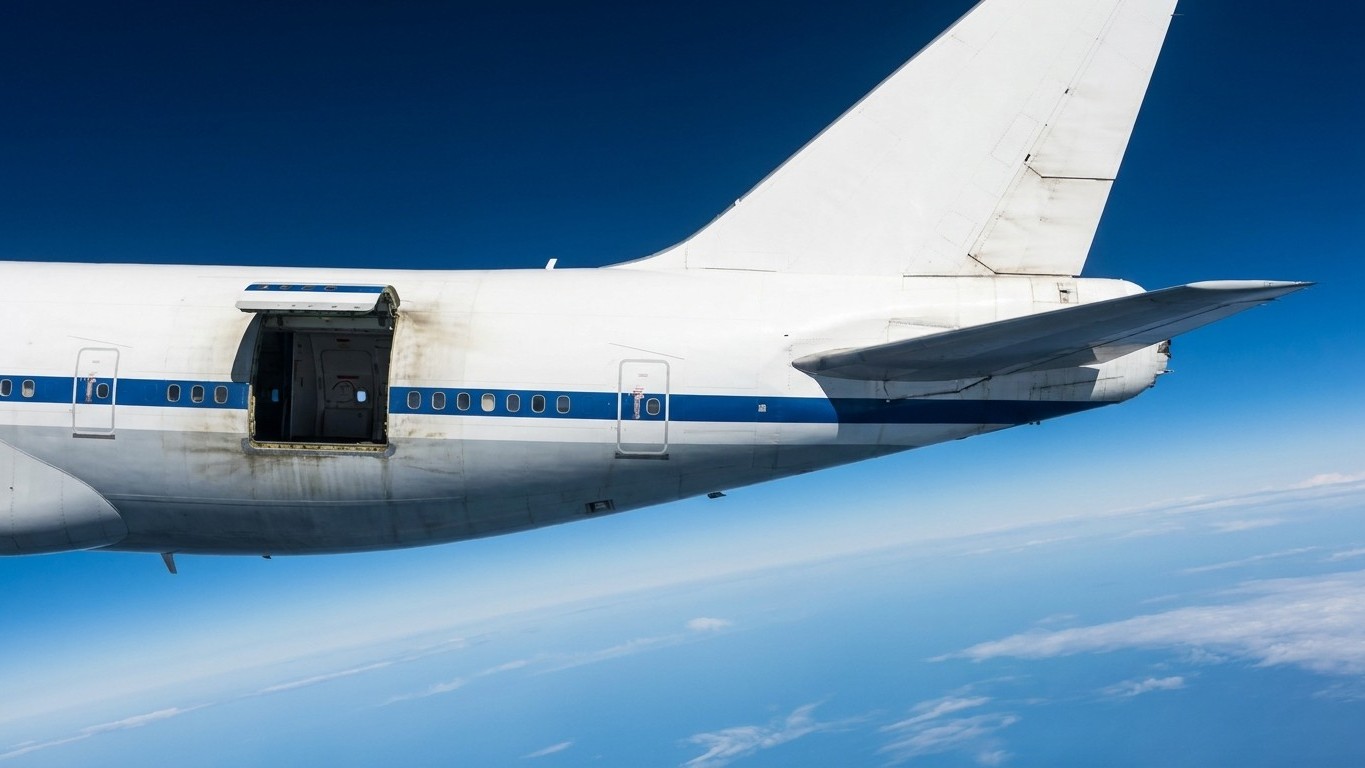
A Boeing 747, a standard commercial airliner, with a gaping hole cut into the rear fuselage, opened in flight at an altitude of 13 kilometers. This isn’t science fiction: it is exactly what NASA did with SOFIA, the Stratospheric Observatory for Infrared Astronomy, a project conducted with the German Aerospace Center (DLR) for more than a decade. A 2.7-meter-diameter telescope aboard its frame pointed its mirrors skyward through a sliding door, turning an old passenger jet into a flying observatory.
Key takeaways
- What exactly happens when you cut a wide-open aperture in a passenger plane in mid-flight?
- Why did scientists agree to leave 99% of Earth’s humidity beneath their feet?
- How did an old 1970s commercial jet become a doorway to the universe?
A commercial airliner turned into a giant telescope
The aircraft chosen to support this feat was not a bespoke prototype. It is a Boeing 747SP, the shortened version of the long-range airliner, built for exceptionally extended flights. Delivered to Pan Am in 1977, it was sold to United Airlines in 1986. NASA bought it in 1997, before subjecting it to a genuine open-heart operation: the agency, with Raytheon assisting for the most delicate technical work, took charge of the major modifications required to install the telescope in the aft fuselage.
The result of this adaptation is a dramatic opening. The telescope is aimed through a sliding hatch fitted between the wings and the tail, standing 5.5 meters tall and 4.1 meters wide, which can be opened in flight. Behind this hatch lies a remarkable optical instrument: a 2.7-meter primary mirror, yielding an effective diameter of 2.5 meters, weighing nearly 17 tons by the project team’s data. This is enough to turn the aft cargo hold of a long-haul airliner into a laboratory for astrophysics.
What stands out most is the uncompromising commitment to safety. The fact that the fuselage is partly exposed to the vacuum does not affect the aircraft’s flight characteristics or aerodynamics, according to the program’s technical description. The telescope itself was installed in a section entirely separated from the rest of the cabin by a watertight wall, allowing the crew and researchers to work in a pressurized environment while the instrument faced the stratospheric vacuum just behind the partition.
Flying above water vapor, the real reason behind this engineering frenzy
Why endure such engineering headaches instead of building a ground-based observatory? The answer is one word: water. SOFIA flew at altitudes between 39,000 and 45,000 feet, above more than 99% of Earth’s water vapor, enabling scientists to observe celestial objects in the infrared spectrum that ground-based telescopes often cannot detect due to atmospheric humidity.
Water vapor acts as a filter that specifically absorbs the infrared wavelengths astronomers study to understand star formation or the compositions of planetary atmospheres. By climbing to more than 13 kilometers, the aircraft escaped the majority of this barrier. Studies published about the program even mention a residual water layer that is hundreds of times thinner than at the best terrestrial sites. Unlike a satellite, the aircraft returned to the tarmac every morning, allowing for instrument changes, maintenance, and flight adjustments based on rare astronomical events—a luxury no space telescope can offer.
Eight years of scientific flights, then the stop in 2022
The first test flight took place in 2007, but it was not until 2010 that the instrument captured its first data, with an observation of the star Antares. The program then ramped up to full scientific operations from 2014. Over its career, the aircraft completed more than 900 flights, accumulating observations on star formation, the atmospheres of Jupiter or Triton, black holes, and supernovae.
The program’s end, however, did not meet universal agreement. On April 28, 2022, NASA and the German Space Agency announced they would cease operating SOFIA, despite warnings from scientists in Germany and the United States. The operating costs of a flying observatory—crew, fuel, and maintenance for a aging 747—were weighed against newer space instruments. After more than eight years of scientific discoveries, SOFIA completed its mission in September 2022. The precise date of the last scientific observation is September 29, 2022.
A well-deserved retirement in the Arizona desert
On December 13, 2022, the aircraft completed its final commercial flight, the very one that carried it from the Palmdale, California base to Tucson, Arizona. The teams then moved the plane from Davis-Monthan Air Force Base to the Pima Air and Space Museum, where it now rests. The final leg, carried out on the ground along muddy roads for part of the journey, took about three hours, a convoy sufficiently unusual to require several public road closures.
Before its permanent installation, some German equipment was removed from the aircraft to return to Germany, notably the telescope’s secondary mirror and the focal plane imager, the observatory’s main camera. Pima Air and Space Museum, one of the world’s largest aerospace museums with six hangars and 80 hectares of outdoor exhibits, is working toward a definitive public display of the aircraft. The plane, nicknamed Clipper Lindbergh, which carried passengers for Pan Am and then United before peering into the far reaches of the universe, ends its career not dismantled but frozen for eternity in the Sonoran Desert, its telescope hatch likely closed for good.
Sources: futura-sciences.com | cults3d.com
