
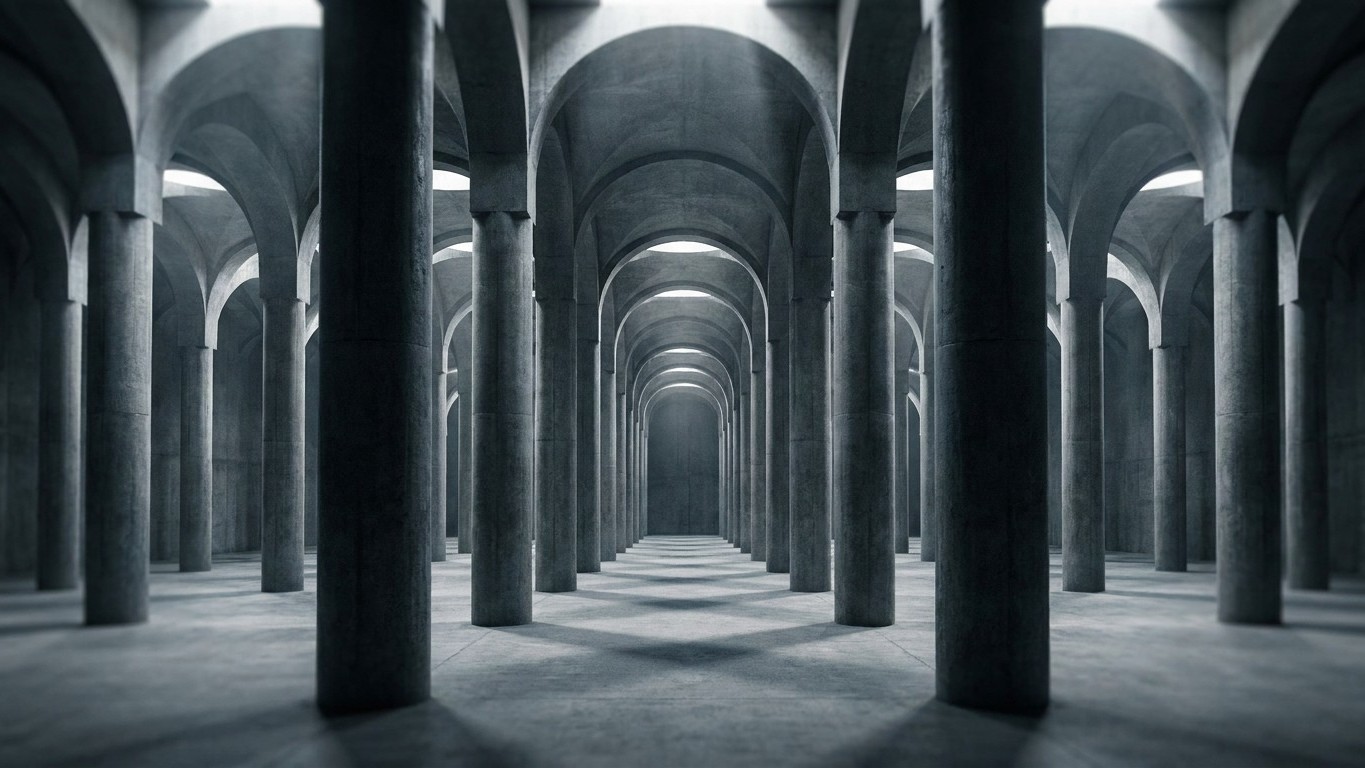
Eighteen meters beneath the suburb of Kasukabe, about a thirty-minute train ride from central Tokyo, lies one of the most remarkable hydraulic works in the world. There’s no visible dike, no concrete barrier along a river: here, flood protection is handled entirely underground, in a reinforced concrete cathedral that most Tokyoites will never glimpse.
The installation has an official name that reads more like a technical report than a science‑fiction novel: the Exterior Underground Discharge Channel of the Metropolitan Area, better known by the acronym G-CANS. It was constructed beneath Kasukabe’s suburban landscape in Saitama Prefecture to shield Tokyo and its environs from devastating floods. The project was not a sprint: completed in 2006 after nearly 14 years of construction and a public investment of 230 billion yen, it pursued a precise objective—prevent flooding in Tokyo’s low-lying areas, particularly during typhoons and heavy rainfall.
Key takeaways
- A colossal underground network operates secretly beneath Tokyo, used seven times a year to fight floods
- Modified aircraft turbines discharge 200 tonnes of water per second into the rivers
- A 177-meter-long concrete cathedral remains completely invisible to residents above
Five giant shafts that siphon the rivers
The principle rests on a cascading architecture, almost worthy of a catastrophe-management video game. The system comprises five concrete confinement silos, 65 meters tall and 32 meters in diameter, linked by 6.4 kilometers of tunnels located 50 meters below the surface. These vertical shafts act as colossal funnels: when a river such as the Nakagawa or the Kuramatsugawa threatens to overflow, the water is drawn into them before moving horizontally toward the heart of the mechanism.
The choice of the area is not arbitrary. The basins of the Nakagawa and Ayase rivers are surrounded by major waterways like the Tone, the Edogawa, and the Arakawa, and this zone has suffered flood-related damage many times because the ground resembles a bowl, which makes water accumulation easy. Without this artificial outlet, water would stagnate in this bowl instead of flowing toward the sea.
The subterranean chamber, nicknamed “the temple”
At the end of this tunnel network opens the space that has made G-CANS world famous. It is a vast holding basin whose dimensions are dizzying: 177 meters long, 78 meters wide, and 18 meters high, supported by 59 pillars. Each column is more than just a decorative element: the massive storage tank is sustained by 59 reinforced concrete columns, each weighing 500 tons. Their function is almost counterintuitive: the pillars support the ceiling of the enormous reservoir by compensating for the buoyant force exerted by the water underground, which is why so many gigantic pillars are necessary.
The visual result has earned the site its popular nickname of the “underground temple.” Symmetrical rows of massive columns, a mineral silence, and an echo that carries far: the ambience evokes more a Gothic nave than a pumping plant. Yet it is merely a technical accessory, sized to withstand the pressure of thousands of cubic meters of water before releasing it toward its final outlet.
The final discharge toward the Edogawa
Storing the water is not enough; it must then be expelled, and quickly. This is where pumps of staggering power come into play. Fifty-nine pillars are connected to seventy-eight pumps of 10 MW each, capable of pushing up to 200 metric tons of water per second toward the Edogawa River. To put this flow into perspective, the water stored can be released into the rivers at a maximum rate of 200 cubic meters per second, the equivalent of emptying an Olympic swimming pool (25 meters) in a single second.
The technology behind these pumps is itself a product of ingenious redirection. Each drainage pump features a high-speed rotor that imparts kinetic energy to the water to evacuate it rapidly, powered by a gas-turbine engine, a modified version of the high-performance engine used in commercial airliners. In other words, airplane jet engines recycled within the depths of this facility are used to push back the rivers.
A discreet shield that has already proven its worth
G-CANS is not a dormant curiosity you visit for a photo opportunity. The installation operates, and on a regular basis. According to estimates by Japan’s Ministry of Land, Infrastructure, Transport and Tourism, the canal—used on average seven times a year—has reduced the economic impact of floods. Each activation diverts a typhoon or heavy rain episode before it can flood residential districts in the Nakagawa valley into an open-air lake.
What stands out, in essence, is the contrast between the scale of the project and its total invisibility to everyday life. Residents living above this temple of concrete walk, drive, and go about their lives without ever suspecting its existence, except on days when the valves open and, fifty meters beneath their feet, recycled airplane turbines swallow the equivalent of an Olympic pool every second. In the face of increasingly extreme rainfall events tied to climate disruption, this logic of subterranean gigantism—visible only in rare operational moments yet always available—could well inspire other coastal megacities grappling with the same dilemma of urban density and vulnerability to floods.
Sources: metropolisjapan.com | architecturelab.net
