
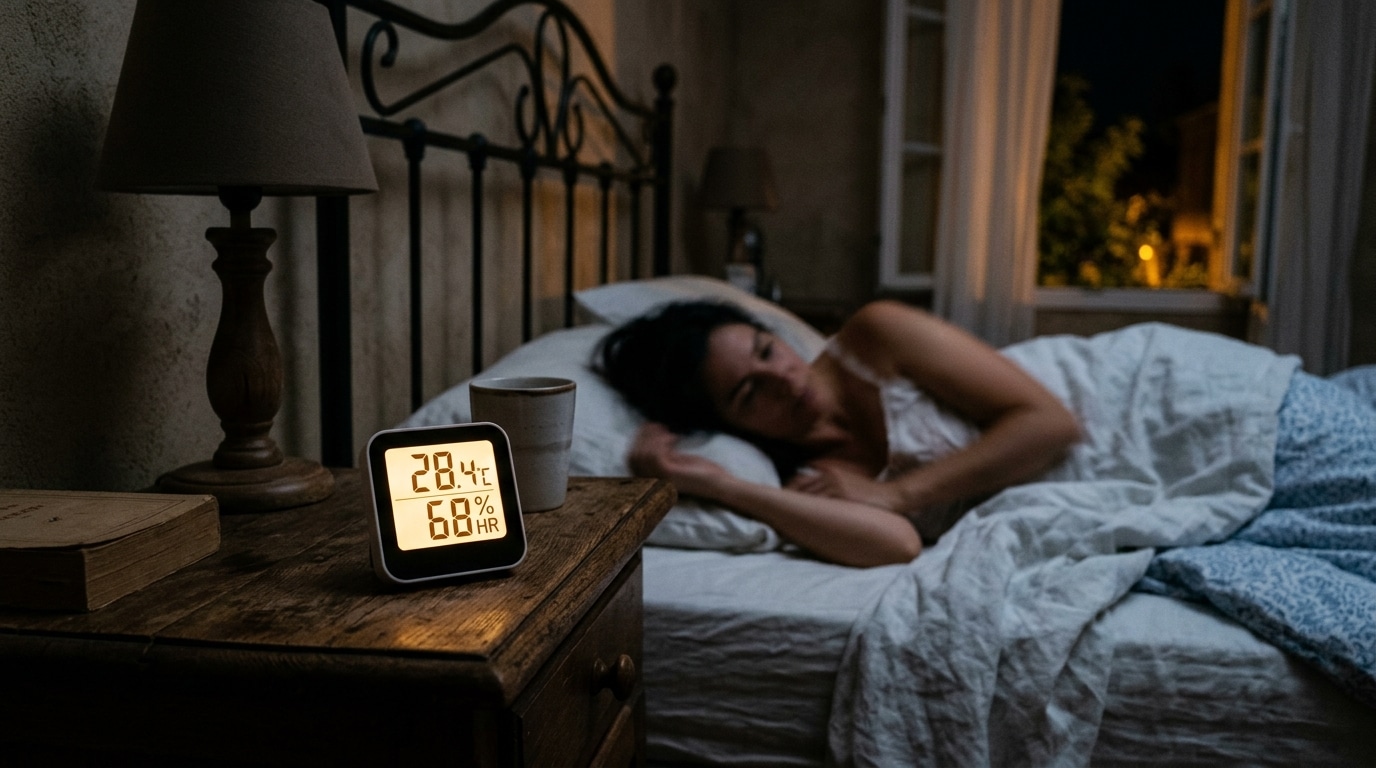
You go to bed at a reasonable hour, you escape screens, you breathe in absolute calm, and yet, upon waking, that cottony sensation of a night wasted persists. The cause may not be the noise of a nocturnal neighbour, nor the glare of a streetlamp filtering through the shutters: it could hinge on a simple thermometer. In the midst of a heatwave, as our bedrooms sometimes turn into little saunas, a long-underestimated parameter comes to the bedside of our rest. The ambient temperature, quiet but tenacious, seems capable of nibbling away at the most precious phase of our nights. We believed deep sleep to be unshakeable, almost impervious to anything. It would take only a few degrees too many to see it erode, silently, night after night.
What Heat Really Does to Your Sleeping Brain
To understand why an overheated room sabotages our nights, we must first grasp a fascinating mechanism: sleep isn’t just a matter of fatigue, it’s also a story of thermoregulation. Even before we plunge, our body begins a small cooling-down process. The core temperature drops slightly, as if the organism is gradually turning off the heat to signal that it’s time to drift off. This internal cooling acts literally like a biological switch that triggers entry into slow-wave sleep.
However, when the room is too hot, this process gets stuck. The body struggles to shed its heat into an environment that is already saturated, somewhat like trying to cool a kettle in a sauna. The result: the famous slow waves, those broad brain rhythms that mark the most restorative phase, become rarer. Sleep becomes lighter, more fragmented, punctuated by micro-awakenings of which we often have little to no memory. We do sleep, yes, but we recover much less.
The numbers that challenge our habits
What makes the phenomenon particularly intriguing is that a high ambient temperature has been linked to a measurable reduction in deep sleep. In plain terms, the warmer the room gets beyond a certain threshold, the more the share of slow-wave sleep tends to shrink. A night spent around 25 °C, often perceived as comfortable during the day, could thus be enough to dent this key phase, even as the sleeper feels they have slept their eight hours.
That said, caution is warranted. This type of observation rests on correlations, not on a rock-solid cause-and-effect relationship. Each body has its own thermal sensitivity, and many other factors come into play, from humidity to age to individual habits. The effects described could therefore vary from person to person. What remains is a persistent trend hard to ignore: nocturnal heat indeed seems to weigh on the quality, not just the quantity, of our sleep.
Why deep sleep matters more than the number of hours
For a long time, sleep was reduced to simply adding up hours. Yet quality far outweighs quantity, and slow-wave sleep is the best illustration. It is during this phase that the body undertakes its nighttime maintenance: tissue repair, memory consolidation, hormonal regulation, and strengthening of immune defenses. A night rich in deep sleep is somewhat like a nighttime workshop where the body tidies up, repairs, and prepares for the next day.
Depriving the brain of these precious slow waves, night after night, is therefore not insignificant. Chronic deficit could translate into persistent fatigue, difficulties with concentration, mood swings, and increased vulnerability to everyday maladies. Sleeping systematically in a overheated room would thus amount to unknowingly sabotaging the body’s most important repair workshop.
Setting your bedroom to the right degree: concrete levers
Good news: this parameter is one of the easiest to master. The temperature range often recommended for the bedroom sits around 16 to 19 °C, a cool environment that naturally supports the body’s cooling down. During heat waves, reaching this figure can be an achievement, but a few simple steps help bring it closer.
- Ventilate in the early morning and late evening when outdoor air is coolest, then close the blinds and windows during the day.
- Opt for breathable bedding and fabrics, such as cotton or linen, which help the skin dissipate heat.
- Watch humidity, as overly humid air hinders sweating and amplifies the feeling of being smothered.
- Avoid unnecessary heat sources in the evening, from electronic devices to bright lighting.
The through-line is the same: give your body the conditions to cool down gently and let the slow waves settle in. Thermoregulation is not a detail; it’s the keystone of deep sleep.
Ultimately, it might not be stress or noise robbing your nights, but a few degrees too many on the thermostat. Setting your room to the right degree thus appears as one of the simplest and most cost-effective actions to protect this restorative phase too often neglected. And before chasing the tiniest source of light or the faintest creak, perhaps we should start by listening to what our thermometer has to tell us?
