
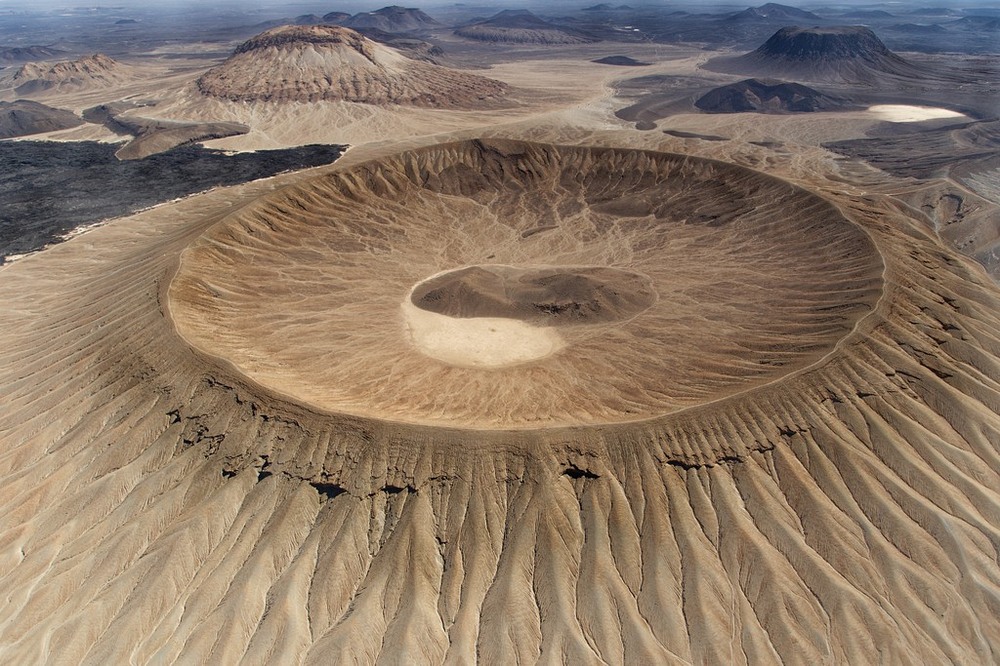
Imagine a sea of rock frozen in place, and right in the middle of this dark expanse, domes of immaculate white that look as if they had been set there by accident. This isn’t a computer rendering nor the backdrop for a science-fiction film, but a real landscape that exists in Saudi Arabia. The stark contrast between black and white has long puzzled observers, some attributing it to salt or sand. Yet the truth is far more astonishing and lies in the very chemistry of the volcanic rock.
- In the Harrat Khaybar volcanic field, white cones pierce a sea of black basalt, a contrast visible even from the International Space Station.
- This whiteness arises from comendite, a rare silica-rich volcanic rock, with Jebel Bayda being the most notable example.
- The presence of tuff cones, formed by lava-water contact, proves that this presently arid region once experienced much wetter climatic episodes.
- A sea of black lava pierced by white craters
- Comendite, a lava almost unique on Earth
- Jebel Bayda, the volcano that should never have existed here
- When the driest desert concealed a humid climate
A Sea of Black Lava Intersected by White Craters
In the Harrat Khaybar desert, not far from the holy city of Medina, stretches a colossal volcanic field covering more than 14,000 square kilometers, one of the largest in the entire Arabian Peninsula. The region is so intimately tied to the volcanic history of the site that Medina itself sits atop ancient basalt flows stemming from the same system. A stark, mineral landscape, dark and austere, stretching to the horizon.
Yet at the heart of this sombre monotony emerges an anomaly that even astronauts have observed from space. White volcanic cones puncture the black basalt layer, creating a contrast so sharp that it was captured on camera by the crew aboard the International Space Station. Neither salt—often responsible for whitish desert deposits—nor sand, which is virtually absent in this arid region, can explain this phenomenon. The answer lies elsewhere, hidden in the very chemical makeup of the rock.
Comendite: A Lava Almost Unique on Earth
The culprit behind this unusual hue bears a name that almost reads like a formula: comendite. This alkaline igneous rock stands out for its remarkably high silica content, a factor that strongly influences its color and texture. Unlike basalt, which is dark and dense, comendite presents a pale blue-gray shade that starkly contrasts with its surroundings.
This type of lava forms only under very particular volcanic conditions, which explains its planetary rarity. While black basalt dominates 99% of the Harrat Khaybar landscape, these pockets of comendite represent an almost anecdotal geological exception, yet one that is visually striking. It is as if, amid a field of coal, a few blocks of marble had erupted from the ground without an obvious logic, except that the logic here is purely chemical.
Jebel Bayda, the Volcano That Should Never Have Existed Here
Among these white formations, one name stands out in particular: Jebel Bayda. This volcano alone embodies the region’s geological exception. It formed along a north-south oriented fissure system that stretches for about a hundred kilometers and has been active for roughly five million years. Its last known eruption dates to a period between 600 and 700 CE, which, on a geological timescale, is relatively recent.
What makes Jebel Bayda so remarkable is the extreme rarity of its composition. This silica-rich lava has only been recorded in a handful of places on Earth, such as the Australian Glass House Mountains where the phenomenon was first identified, as well as in Sardinia, Corsica, Ascension Island, and parts of Ethiopia and Somalia. Finding such rock in the heart of the Arabian Desert is nearly a statistical anomaly, given the demanding conditions required for its formation.
When the Driest Desert Concealed a Humid Climate
Around these white volcanoes rise other intriguing formations: tuff cones, recognizable by their symmetric, steep silhouettes. These structures form through a very specific process—the explosive encounter between molten lava and water. This contact yields damp, sticky pyroclastic deposits that rapidly harden, sculpting these characteristic cones.
Yet their mere existence tells a story that the present landscape hardly supports. Today, Harrat Khaybar is an extremely arid region, where rainfall is nearly nonexistent and vegetation struggles to take root. Nevertheless, the formation of these tuff cones requires the presence of a sufficient amount of water at the time of eruptions. In other words, this desert’s current dryness belies periods in its volcanic history when wetter climates prevailed far more than one would imagine by looking at the landscape today.
Between a lava of almost unparalleled rarity in the world, an extreme chemistry capable of turning black into white, and a vanished climate leaving only rock-locked cones behind, Harrat Khaybar encapsulates the active mysteries beneath the Arabian Desert. A reminder that even the aridest landscapes today carry the memory of radically different worlds, and that geology continues to uncover surprises where they are least expected.
