
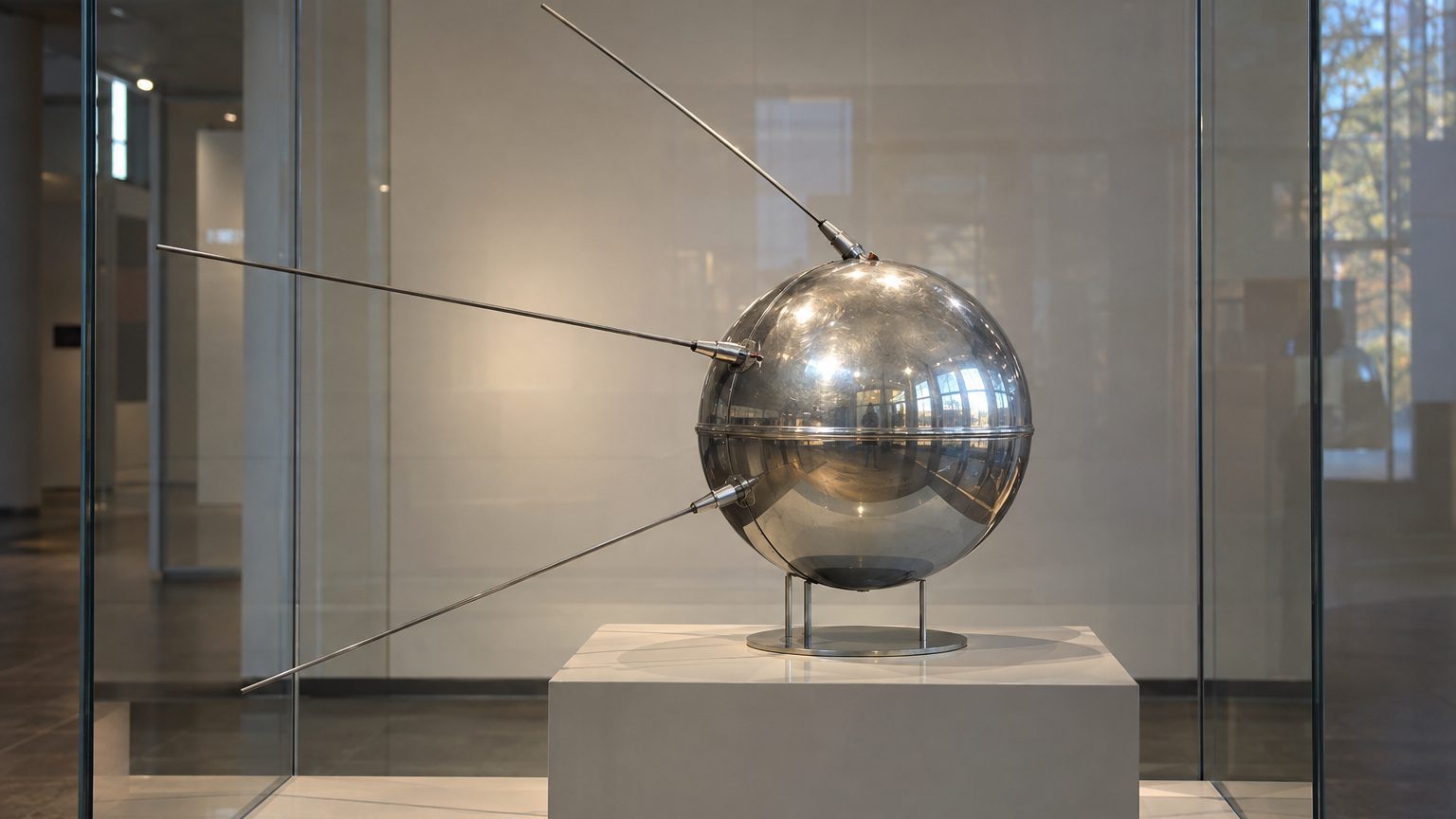
By launching a sphere 58 cm in diameter and weighing 83.6 kg on October 4, 1957, the Soviet Union literally opened the space age. NASA History marks this day as the dawn of the space era. The vehicle, however, was merely a polished metal ball that today would be photographed as a showroom piece, and its batteries endured only 22 days. The anniversary arrives in two days: 69 years.
The lift-off occurred at 19:28:34 GMT.
- Sputnik 1 weighed 83.6 kg and measured 58 cm in diameter, about the size of a beach ball
- The satellite’s batteries were exhausted after 22 days, on 26 October 1957
- The launch sparked an American response that led to the creation of NASA in 1958
A Sphere the Size of a Beach Ball
NASA describes the object as something akin to a beach ball: 58 cm in diameter, 83.6 kg, roughly 184 pounds. In detail, Sputnik 1 was a polished metal sphere that transmitted data by radio on temperature and pressure. Its power supply delivered about 1 W, enough only to run a small LED night-light, nothing more.
The real powerhouse was the rocket. Sergei Korolev’s engineers had built a large launcher for an intercontinental ballistic missile, meaning Soviet bombs were less miniaturized than their American counterparts. This R-7 launcher could therefore place a relatively heavy satellite directly into orbit, from the Tyuratam site, which NASA today designates as the Baikonur Cosmodrome.
There were no scientific instruments aboard, only a transmitter.
That transmitter sent a “bip-bip” that radio amateurs around the world tried to pick up on 20.005 and 40.002 MHz. A life-size replica of the satellite is also among the objects offered to the UN.
22 Days of Bip-Bip, Then Silence
The satellite’s electrical components operated for 22 days, until the batteries exhausted on 26 October 1957. Three weeks in the history books, and it was already a blazing milestone.
In its orbit, the perigee sat at 225 km and the apogee at 947 km, with a revolution period of about 96 minutes according to Wikipedia (NASA records show roughly 98 minutes). The relatively low perigee caused a continual drop in altitude. Sputnik 1 eventually re-entered Earth’s atmosphere on 4 January 1958, after around 1,400 orbits. That is 92 days after launch, or 70 days of radio silence.
What observers could spot with the naked eye wasn’t the satellite itself. The central stage of the launch vehicle had also reached orbit, and its reflective surface made it far more visible than Sputnik, according to NASA.
From the Washington Shock to the Creation of NASA
The satellite left Soviet Central Asia at 22:26 Moscow time on Friday, 4 October. At 1:22 a.m., Radio Moscow announced that the Earth had gained a new moon. In the United States, officials offered congratulations to the USSR, but many Americans saw it as a strategic win for the Communist system at their expense.
Congress responded in 1958 with a law signed by President Eisenhower.
That law, the National Aeronautics and Space Act, established NASA. In the meantime, the USSR kept up the pace: on 3 November 1957, Sputnik 2 carried the dog Laika and weighed 508.3 kg, more than six times the mass of its predecessor. On the American side, Vanguard TV-3 exploded on its launch pad on 6 December. Explorer 1, a mere 14 kg, did not reach orbit until 31 January 1958 and revealed the Van Allen belts.
Sputnik 1 was part of the International Geophysical Year 1957-1958, and studying its trajectory was intended to reveal details about the density of the upper atmosphere and the precise shape of the Earth. It would be Vanguard 1, a 1.47 kg satellite, launched on 17 March 1958, that demonstrated the Earth is pear-shaped.
Sources: air-cosmos.com | un.org
